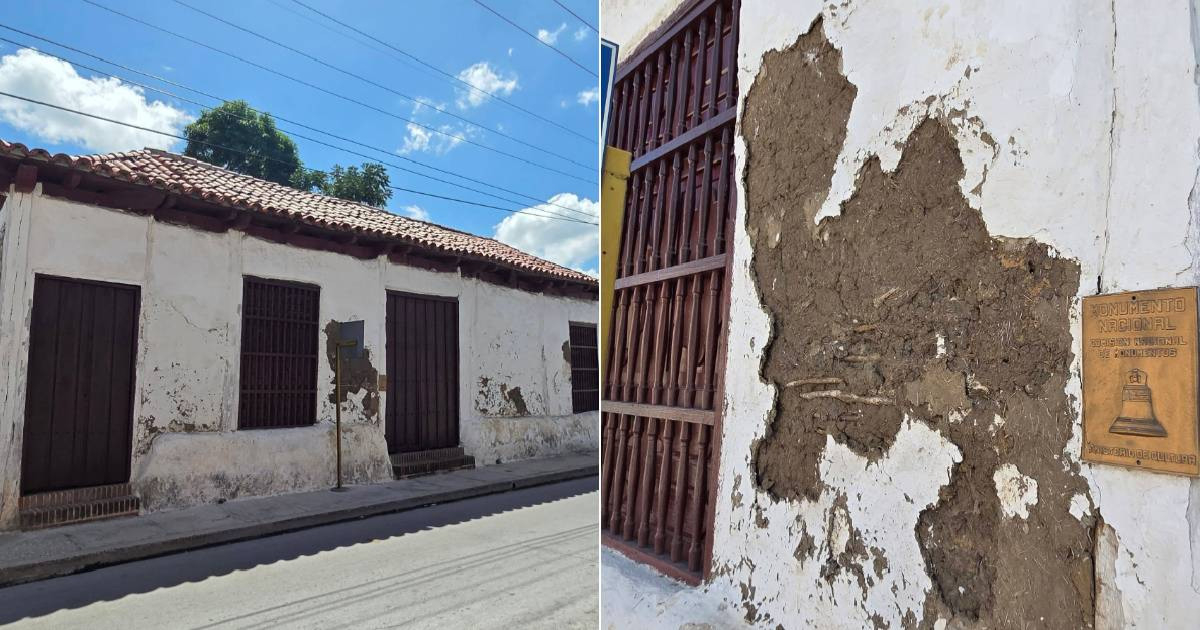
The House Museum of the Lieutenant Governor of Holguín, the oldest building preserved in the city and designated a National Monument, shows visible deterioration on its walls just four months after undergoing a rehabilitation intervention, reported this Sunday the Facebook page Holguín en fotos with photographs of the building's current condition.
Popularly known as the House of Mud due to its construction technique of plastering - walls made of mud, straw, sticks, and clay - the building dates back to the first half of the 18th century and was declared a National Monument in 2010.
The released images show peeling paint, exposed base material, and cracks in areas that, according to the publication, were recently repaired.
"Only four months have passed, and some of the walls that were renovated look like this. It is concerning that a newly rehabilitated piece shows this kind of deterioration in such a short time," the source noted.
The publication also raised a question that remained unanswered officially: "Let’s hope that the work is still under warranty and that those in charge of the intervention can review what happened and provide a solution. In the end, we are talking about one of the properties with the greatest historical value in our city, and it deserves to be preserved as such."
The public reaction in the comments immediately pointed to poor execution. A commentator with technical knowledge explained that the material used for these walls is called mampuesto, "a mixture of clay and lime that is mixed and left to rest for up to 45 days before use; if it does not have the proper consistency, what happens in the photo occurs."
Other neighbors pointed out that the plastering technique requires specialists: "Not just anyone knows what kind of treatment to apply, and that's why these things happen," wrote one person. Another was more direct: "From what it looks like, what they did was a botched job."
Several comments also questioned the oversight of the project. "What is the purpose of having so many specialists, so many technicians, so many researchers in our province if before undertaking a project like this, we don’t analyze, don’t determine what materials should be used, and Heritage doesn’t supervise?" asked a citizen.
Someone else demanded transparency regarding the resources invested: "Find out the cost of the restoration and where the money went."
The perception that the intervention may have been carried out hastily to meet administrative goals also emerged among the comments.
"It seems like they did it to meet a goal or something similar. Those heritage properties must be treated seriously, not just to fulfill a commitment or a deadline," noted a reader.
The case is not isolated. Holguín has accumulated a series of heritage abandonments this year without an official response, including the partial collapse of the roof of the Ismaelillo theater in May, the theft of a bronze star from the mausoleum of Major General Calixto García in August, the state of neglect of the IPVCE José Martí, and the conversion of the old Holguín-Gibara train station into a landfill.
Three months after the collapse of the sculpture "Woman with Parasol" on the pedestrian boulevard of the City of Parks, the empty pedestal continues to obstruct the passage without any authority providing public explanations, a silence that is now echoed in the face of the deterioration of the oldest building in the city.
Related videos:
Filed under: