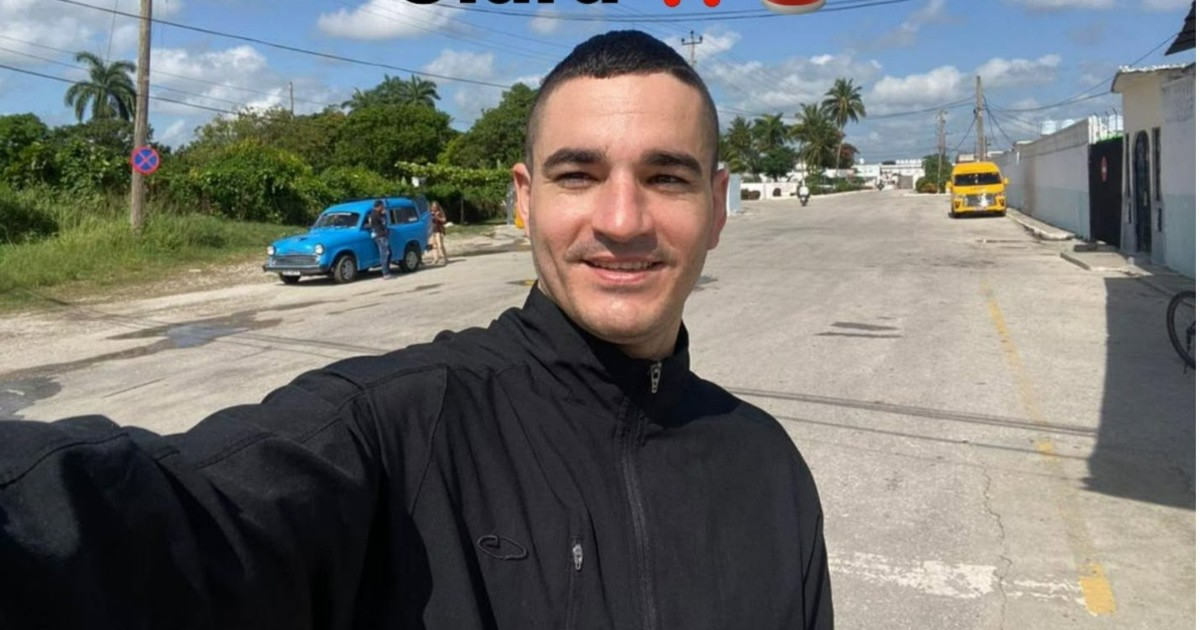
The political activist Andy García Lorenzo, one of the most visible figures to emerge from the protests on July 11, 2021, in Santa Clara, was arrested this Sunday in that city and taken to the Third Unit of the National Revolutionary Police for simply walking and recording in the street with his mobile phone, according to his sister Roxana García Lorenzo's statement on Facebook.
Roxana reported that her brother was arrested on 2nd Street in La Vigía and that a State Security officer came to inform the family that he would be held for 24 hours for an alleged "Public Disorder." "Walking and recording in the street is also considered a crime in Cuba," she wrote sarcastically in her post.
"Simply for being on the street, because no, they don't need a reason to arrest you; just the fact that they know you are against the dictatorship is enough for all your rights to be violated," Roxana stated.
From the police station, Andy García managed to call his parents to confirm what had happened. He also informed them that he would not consume any food during his detention—only water and liquids that his family brings him—to avoid a potential poisoning, “as has happened in the past at the hands of the authorities,” according to his sister's complaint.
The parents of the activist stood in front of the Third Unit despite being asked by State Security to leave, in a scene reminiscent of their actions in December 2024, when they remained in front of the Guamajal prison for the 16 days that their son was on a hunger strike due to the confiscation of personal letters.
From Germany, her brother-in-law Jonatan López —husband of Roxana and exiled activist— was the first to spread the alert: "Andy García has just been arrested in Santa Clara, his parents are standing in front of the third unit in that city. Please share. Andy García Free, he is not alone."
The arrest comes just two months after State Security formally threatened him. On June 26, agents summoned him to the Unit for Crimes Against State Security in Villa Clara and warned him that he could face sentences ranging from 10 to 30 years, life imprisonment, or even the death penalty if he published images of military facilities, invoking Article 116 of the Cuban Penal Code regarding espionage.
The trigger for that pressure may have been their activism on social media, particularly the dissemination of images of cacerolazos in the Condado neighborhood of Santa Clara against power outages, which in Villa Clara lasted up to 20 hours a day.
García Lorenzo was arrested during the protests on 11J in Santa Clara and sentenced to four years in prison for contempt, public disorder, and assault, despite the prosecution seeking a seven-year sentence. He served his entire sentence in Guamajal and was released in July 2025. After leaving, he continued his activism and publicly identified one of the oppressors who assaulted him during his incarceration.
His case falls under a pattern of systematic harassment against those released from the 11J protests: in May, Yoan de la Cruz was detained again in San Antonio de los Baños, and in July, Leonardo Romero Negrín was violently arrested in Centro Habana. The organization Justicia 11J recorded a total of 775 political prisoners in Cuba in April 2026, of which 338 are related to the 11J protests.
"If anything happens to Andy, we hold state security responsible for anything that may occur," warned Roxana García Lorenzo, who stated that "distance will not prevent us from making reports and from being heard around the world about what happens to him."
Related videos:
Filed under: