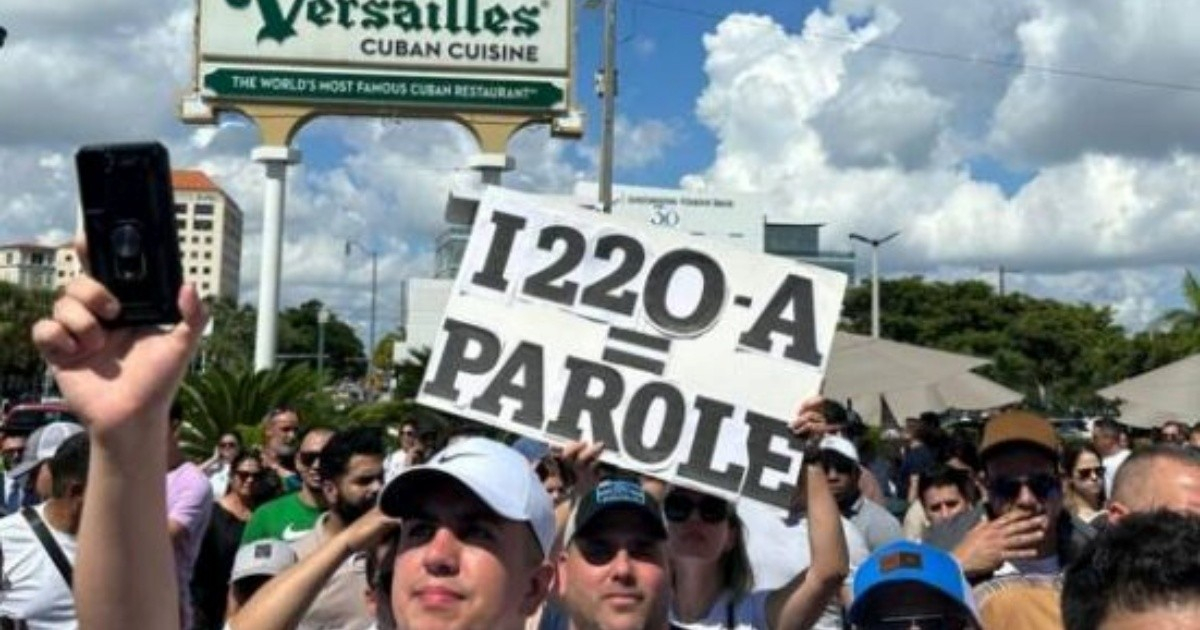
A federal court in Miami has postponed the hearing for the second time in the case Bello-Rubio v. Noem, the lawsuit filed by 992 Cubans holding the I-220A form who seek for their releases to be legally recognized as parole.
An order issued on Thursday, August 27 set the new date for September 10 at 8:30 in the morning, at the Wilkie D. Ferguson Jr. building in downtown Miami.
Expectations with caution
The lawyers in the case are asking not to exaggerate what may happen on September 10. The judge can hear the arguments from both sides and later make a written decision, without issuing any ruling on that same day.
The lawyer Willy Allen was straightforward in his statements to CiberCuba: «This hearing will neither be the beginning nor the end of anything, it simply needs to be considered as part of the ongoing process.»
And he added: “I do not expect final results, but rather a good interim step to clarify the path toward the legalization of all Cubans with I-220A.”
Nor would a defeat imply automatic consequences: it would not entail the immediate deportation of those who possess that document nor would it cancel asylum applications or other individual immigration proceedings.
Two postponements in less than two weeks
The hearing had originally been scheduled for August 26th before Judge Jacqueline Becerra of the Federal District Court for the Southern District of Florida.
A first postponement moved it to September 2, and just days later, the second change set it for September 10. The lead attorney for the plaintiffs, Mark Prada, downplayed the first delay: "For some reason, the judge needed a bit more time; it could be that another case took longer than expected, which is something that frequently happens in courts at this level," he explained to Café Fuerte.
Prada also specified the purpose of the hearing: "The judge wants to hear the motions presented by the government that aim to dismiss the lawsuits, and the government is arguing that there is a lack of jurisdiction for the court to grant the legal remedies we are requesting."
What is being discussed on September 10th?
The core of the dispute —filed before the Federal Court for the Southern District of Florida under case number 1:25-cv-23665— is whether the I-220A, a Grant of Supervised Release issued by the Immigration and Customs Enforcement (ICE), can be legally equated to a parole.
That distinction is crucial: the Cuban Adjustment Act of 1966 allows those who have been "inspected and admitted or granted parole" to apply for permanent residency, provided they have been in U.S. territory for at least one year and one day.
The I-220A, on its own, has not been widely recognized as that parole, which keeps its holders in a migratory limbo.
The plaintiffs also request that the litigation be certified as a class action, which would extend any favorable ruling to all Cubans in the same situation.
A dispute with a background and growing urgency
In January 2026, Prada presented arguments before the Second Circuit Court of Appeals in New York for the I-220A to be recognized as an admission record, a decision that is still pending.
In February, a panel of the Eleventh Circuit in Atlanta overturned rulings by the Board of Immigration Appeals regarding two Cuban nationals with I-220A and returned the cases for further review, without stating that the document automatically equates to parole.
The urgency intensified in July when Cubans with I-220A began to receive deportation orders after attending appointments with ICE.
System data from TRAC revealed that in June alone, the courts issued 1,642 deportation orders against Cubans.
It is estimated that nearly half a million Cubans are in a situation similar to that of the 992 claimants.
El caso de los cubanos con I-220A es uno de los más seguidos en materia migratoria. Mantente al tanto de este y otros procesos legales que afectan a la comunidad cubana en
Related videos:
Filed under: