
Related videos:
This Wednesday, the Second Circuit Court of Appeals in New York will hold a crucial hearing that could redefine the immigration fate of thousands of Cuban residents in the United States who were processed with the I-220A form after entering through the southern border.
The hearing will be held before a panel of three judges starting at 10:00 a.m., and the arguments will be presented by immigration attorney, Mark Prada, who is leading an intense legal battle to have the I-220A recognized as a valid admission record under the Cuban Adjustment Act (CAA).
The law, in effect since 1966, allows for the application of permanent residency after one year and one day of physical presence in the country, provided that the applicant has been formally admitted or is a beneficiary of a parole.
On this occasion, the case to be discussed is that of Aguilar Díaz, a person whose residency was denied based on a prior ruling by the Board of Immigration Appeals (BIA), on the grounds that the I-220A form does not constitute a parole and therefore does not grant eligibility to regularize immigration status.
“What we are arguing is basically that people detained at the border lack the rights to request or receive bail, so the only legal way they can be released is through parole,” Prada explained in statements to Café Fuerte.
Although the immediate scope of the decision would be limited to the states of New York, Connecticut, and Vermont, a favorable ruling could set a significant legal precedent for similar cases across the country.
More than 400,000 Cubans could be affected, many of whom are in a migratory limbo, with pending asylum applications or under the threat of deportation.
Moreover, the audience takes place at a tense moment: numerous immigrants with I-220A have been detained, deported, or transferred to third countries, a practice that has raised concern among Cuban communities and immigration rights organizations.
A legal battle that has been ongoing for a long time
The audience this Wednesday in New York takes place just a month after a similar proceeding before the 11th Circuit Court of Appeals in Atlanta, where attorney Mark Prada also participated.
On that occasion, held on December 12, the case was presented by two Cuban women—one of whom was identified as Labrada Hechavarría—who were denied permanent residency due to having been processed with an I-220A.
The defense argued that, during the Biden administration, thousands of Cubans were misclassified by the Immigration and Customs Enforcement (ICE), which issued them an I-220A instead of a parole, preventing them from benefiting from the Cuban Adjustment Act.
"The goal is for the court to recognize that holders of the I-220A have a status similar to parole and, therefore, can benefit from the Cuban Adjustment Act," stated Prada.
In that hearing, according to lawyer José Guerrero, the Government "ran out of arguments," and the defense was "masterful."
In fact, Guerrero indicated that the judges pressured the Government during their presentation, and that it even acknowledged flaws in the handling of the cases.
What is the I-220A and why is it in dispute?
Form I-220A is a Order of Supervision issued by ICE to migrants who cannot remain detained, but whose case is still pending.
Although these migrants do not formally receive parole, they remain under surveillance and are subject to court summonses for immigration proceedings.
The problem is that the I-220A does not equate to a formal admission or parole, which automatically excludes them from the Cuban Adjustment Act, despite meeting the physical presence requirement.
The Board of Immigration Appeals (BIA) has upheld this interpretation since its decision in the Cabrera Fernández case (2023), creating a legal loophole for thousands of Cubans who, despite having lived in the U.S. for over a year, are unable to regularize their status.
What's at stake
The decision of the Second Circuit – like that of the Eleventh Circuit – will not be immediate.
It could take weeks or months, and either party could appeal to a panel of judges or even take the case to the Supreme Court.
However, both hearings are seen as crucial by lawyers and immigration activists.
A favorable ruling could allow Cubans with I-220A to adjust their status and obtain permanent residency, which would have significant humanitarian and legal implications.
On the contrary, a denial would strengthen a restrictive legal precedent that would keep thousands of people in a prolonged state of legal uncertainty.
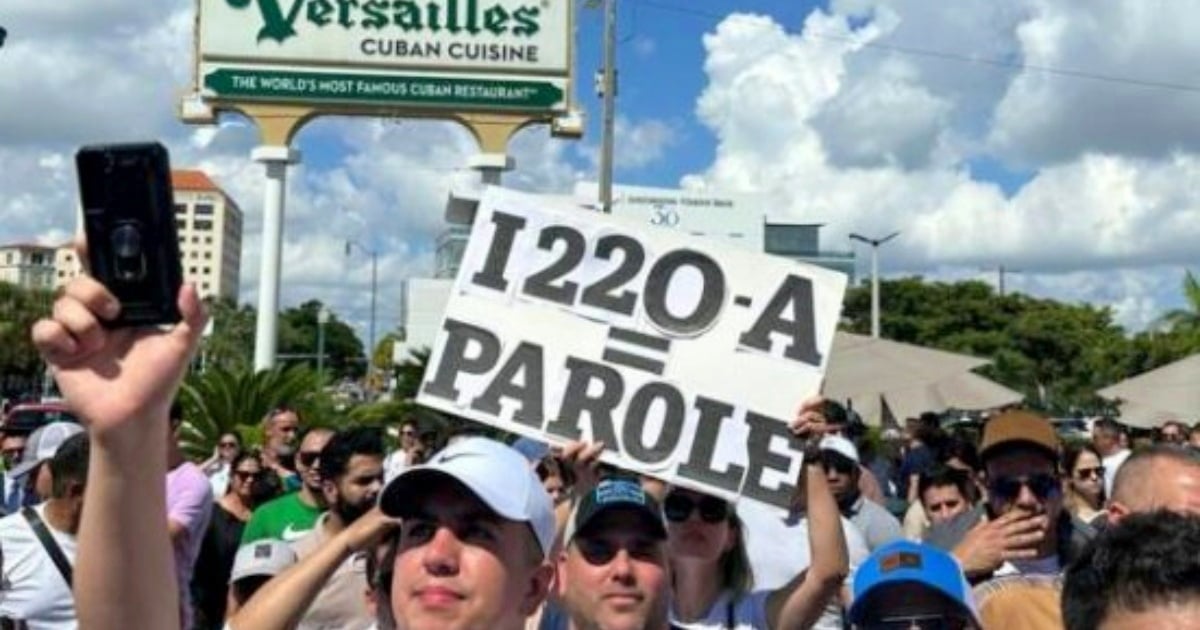
In Miami, the December hearing sparked demonstrations of support outside the courthouse. Entire families continue to wait for a decision that would restore their chance for a stable life in the United States.
With the hearing this Wednesday in New York, another chapter begins in a legal battle that could determine the immigration fate of thousands of Cubans across the United States.
Filed under: