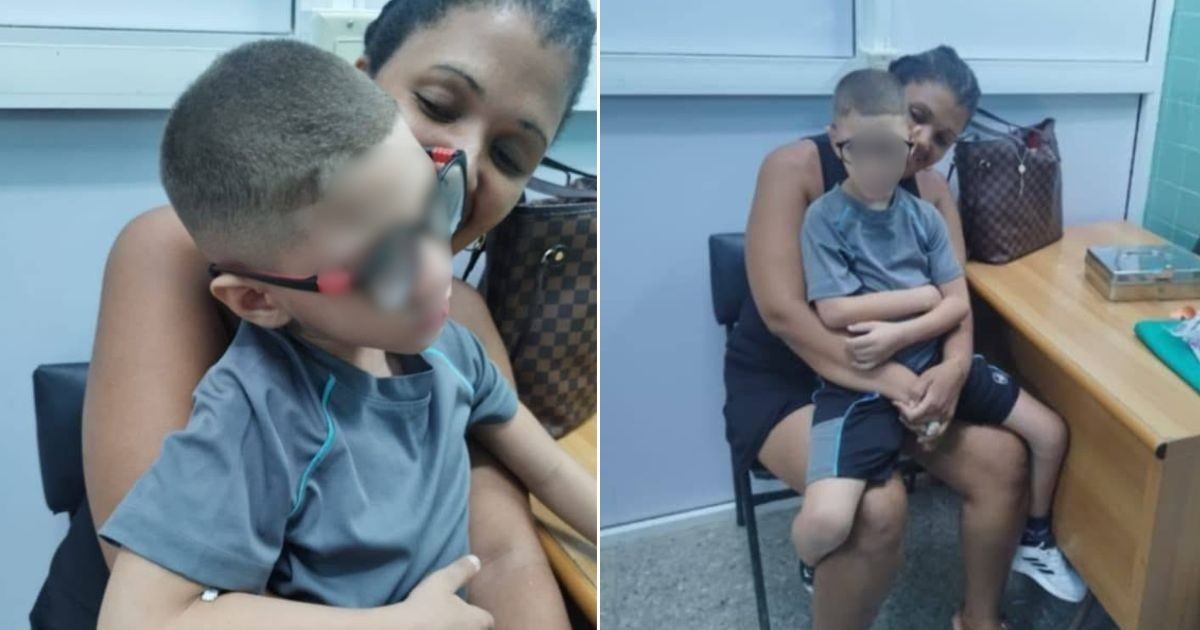
A Cuban mother made a desperate plea for help to take her seven-year-old son, Eithan Urbay Rosell, to Argentina. He has a rare chromosomal disorder that is still being studied, and as she explained, he has already been accepted to receive specialized care at a medical center in that country.
Dalma Rosell Marrero brought up the case this Monday on Facebook, where she stated that her son was born with a "structural unbalanced chromosomal abnormality on the short arm of chromosome 3," a condition whose definitive diagnosis is still pending.
I am reaching out to you with a heartfelt plea for help for my son Eithan Urbay Rosell, who is 7 years old," the mother wrote at the beginning of a message detailing the steps she is taking to get the child out of Cuba and obtain the medical attention he has been seeking for years.
Rosell reported that Eithan has been accepted for treatment at the Jérôme Lejeune Foundation Medical Center in Argentina.
In response to comments from individuals who, according to her, questioned the veracity of the case, she published images of the documents that she claims support the acceptance.
This is not a scam. Eithan is a real case, and the documents are real," he emphasized.
The Jérôme Lejeune Foundation indeed provides specialized medical care in Córdoba, Argentina, as part of its network of centers dedicated to individuals with disabilities and genetic disorders.
The next obstacle for the family is being able to travel. Rosell explained that he intends to submit a humanitarian visa application, even though he has not yet received a letter from the Cuban Ministry of Public Health, which he considers necessary for the process.
"Right now," he said, "the main problem is economic."
All I lack is the financial support for which I am trying to start a fundraising, she explained.
The mother clarified that she currently does not have accounts with GoFundMe or Zelle and assured that she has not been able to get relatives or friends abroad to help her set up those fundraising mechanisms. Therefore, she decided to directly appeal to the solidarity of the Cuban community.
"Without you, I don't think we can achieve it", he wrote.
His message took on an even harsher tone when referring to the consequences he claims to have faced after publicly denouncing the difficulties in obtaining care for his son.
«Everyone here knows what's happening and what we expose ourselves to when we choose to speak up. All doors close to us and everyone knows that here. Our only support is the community,» he stated.
The current request comes after years of efforts by the family.
Rosell had reported days earlier that he had been trying for almost four years to secure the specialized genetic studies that Eithan needs and that the Cuban government still had not paid to the laboratory in Argentina where, according to what he had been informed, they should be carried out.
In that report, it was explained that the child was stable, but still without a conclusive diagnosis.
The information provided by the family indicated that up until then a karyotype had been performed, and that more advanced tests, including a whole exome and microarrays, were still pending—studies that, according to the mother, are not conducted in Cuba.
Rosell argues that these tests could help clarify the child's genetic condition and guide their medical care more specifically.
For that reason, for years, he demanded that Cuban health institutions manage studies abroad.
He had already expressed concern about the possible consequences of making his situation public: "I want to report this because nothing is a lie. But I need support because when I do it they are going to close all the doors for me," he wrote earlier.
He also made it clear that he could not forgo the care that Eithan receives in Cuba as long as he did not have the necessary resources to move him to another country.
The mother went so far as to say that, in her opinion, people living with rare diseases in Cuba are "invisible to the State and to society," after years of searching for answers for her son.
Related videos:
Filed under: