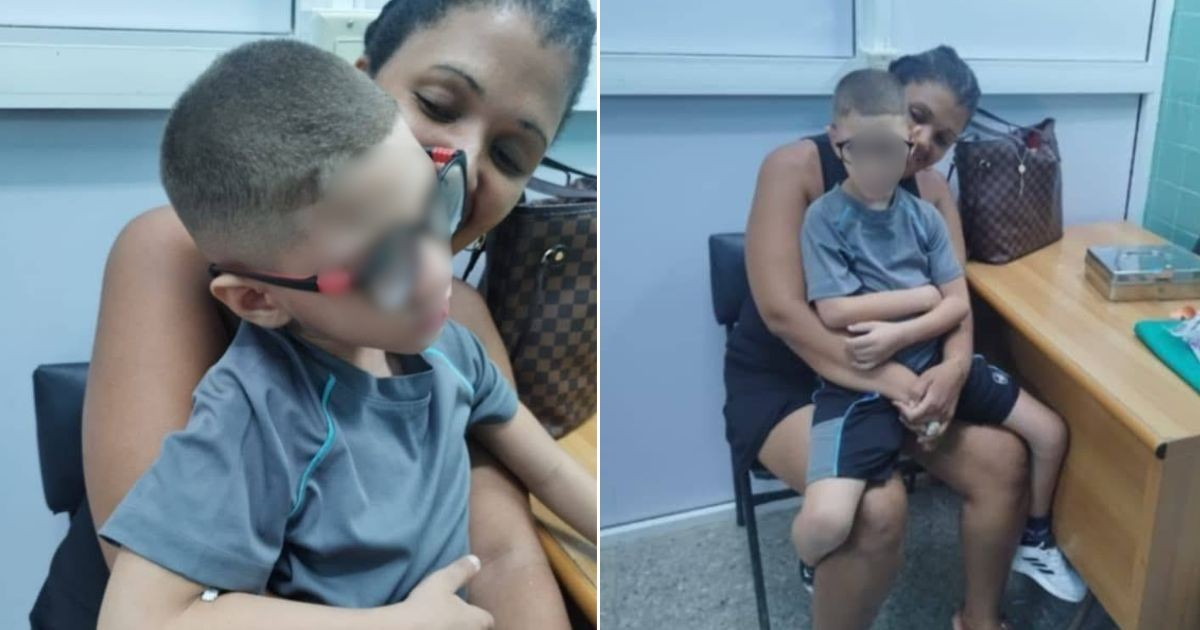
A Cuban mother living in Havana has reported that, after four years of efforts, the Cuban government still has not paid a laboratory in Argentina for the genetic studies her son Eithan needs in order to reach a definitive diagnosis.
Dalma Rosell Marrero explained this Thursday on Facebook that she had hesitated a lot before making the situation public because she does not want to turn her son's case into "a political issue," but she assured that she was deeply affected by a recent visit to the Provincial Genetics Center.
"The people who know me are aware of how much I cried on Tuesday. How badly I came out of Provincial Genetics. The pain I felt seeing so much indifference and so many lies because that has no other name," she wrote.
According to the mother, Eithan is stable and recently had blood drawn to prepare the necessary samples for the required genetic studies.
"Even today, the State has not paid for the studies at the laboratory in Argentina," Rosell reported, adding that four years ago they had already been informed that those analyses would not take place.
The information released by the family indicates that Eithan, 7 years old, has a structural chromosomal alteration related to the short arm of chromosome 3 and that so far only a karyotype has been performed, so his diagnosis is still under investigation.
Among the tests that the mother identifies as pending are a whole exome and microarrays, studies that she claims are not conducted in Cuba.
Rosell asserts that these tests are necessary to definitively clarify his son's condition and to better guide his medical care.
In subsequent comments on her post, the mother also hinted at the fear she feels about making a public complaint while Eithan continues to rely on the Cuban healthcare system.
"I want to file the complaint because nothing is a lie. But I need support because when I do, they will close all the doors on me. Because amid laughter, that's the first thing they warn you. But I'm not afraid. I move forward," he wrote.
In another comment, she explained that she cannot risk the child being without medical attention because she does not have the financial resources to take him immediately to another country.
"I cannot leave Eithan without attention unless I am certain that I will be able to take him out and to a better place. If I had the full amount of money, I would have done it a while ago," she stated.
He also assured that his son is stable, although a definitive diagnosis is still pending, and emphasized that the family's lack of resources ultimately becomes a source of pressure.
This week's complaint was preceded by another post made five days earlier, in which Rosell stated that she was tired of staying silent after nearly five years of searching for answers for her son.
"I'm tired of staying silent and pretending to turn a blind eye as a mother. NO MORE, NO MORE, NO MORE," she wrote then.
The mother stated that, since healthcare in Cuba relies on the public system and there are no private clinics available to turn to within the country, it falls to the Ministry of Public Health to coordinate and finance abroad the tests that cannot be performed on the island.
"The one who is obligated to cover the cost of Eithan's diagnosis in the country where it can be performed is the Cuban State," he stated.
Rosell also questioned why, after four years —almost five by his account— one would expect gratitude from the family for efforts he believes are the responsibility of public institutions.
"In Cuba, and this is my opinion as a mother, people living with rare diseases are invisible to the State and to society," she noted.
"The unusual exists, and it is their right to be treated as people, as human beings," he emphasized.
The woman also described the economic difficulties she faces in meeting the child's daily needs and stated that at that moment she did not even have some of the food and products he requires due to their high prices.
Eithan's case adds to other complaints from Cuban mothers who, in recent months, have turned to social media to demand treatments, medications, or medical alternatives that their children cannot receive on the island.
In April, mothers of children with cystic fibrosis from Santiago de Cuba and Camagüey reported shortages of medications, food in poor condition, and delays in the delivery of solar panels essential for families whose children rely on electrical equipment.
A month earlier, a mother from Camagüey reported that her baby needed a surgery that could not be performed in Cuba.
According to his testimony, the authorities had proposed seeking agreements with other countries, but the family still did not have a concrete solution at that time.
In May, another mother from Santiago de Cuba sought help to take her four-year-old son for treatment in Turkey, after the family claimed that the surgery he needed for a brain tumor could not be performed on the island.
Related videos:
Filed under: