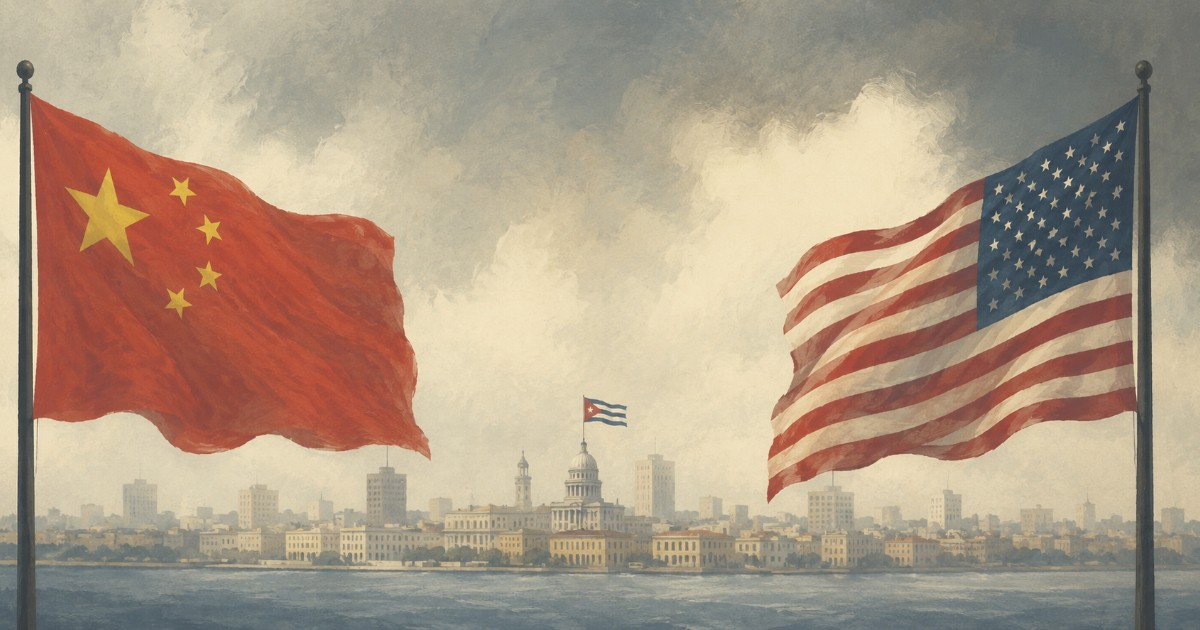
China significantly heightened the tone of its diplomatic confrontation with the United States over Cuba and accused American politicians of acting with a "hegemonic, dominant, and arrogant" mindset, clinging to the Monroe Doctrine and treating Latin America as a "backyard" that Washington can control at will.
The Chinese Embassy in Cuba made its position public in a statement, following several remarks from the United States regarding the increasing economic, technological, and intelligence presence attributed to Beijing on the island.
Without naming the officials or politicians they were responding to, the diplomatic representation accused “some American politicians” of exaggerating geopolitical threats, resorting to ideological maneuvers, and attacking the cooperation between China and Cuba “without basis.”
"His statements are riddled with the obsolete 'Monroe Doctrine', and with ideological biases from the Cold War," stated the Embassy, which noted that these positions again expose the "hegemonic, domineering, and arrogant character" of Washington.
The statement used particularly tough language in accusing certain political sectors in the United States of clinging to the "old colonial dream" that "America belongs to Americans."
Beijing asserted that the United States continues to view the Western Hemisphere as its "private property and backyard" and accused Washington of using "blockades, sanctions, intimidation, and subversion to impose its dominance."
The Embassy went even further by asserting that what should be eliminated is not the Chinese presence in Latin America, but rather "hegemonism and power politics, blockades, sanctions, and gunboat diplomacy."
“The right of Latin American countries to freely choose their own partners must not be interfered with,” he stated, before assuring that China will continue to support the countries in the region in defending their sovereignty, security, and development interests.
The statement comes after Cuban-American Republican Congressman Carlos Giménez directly called for China to be expelled from the Western Hemisphere.
"Communist China has no place in the Western Hemisphere and must be expelled," stated Giménez, who accused Beijing of trying to undermine the United States in its own hemisphere by providing a "lifeline" to the Cuban government.
His statements were related to an opinion piece published days earlier by analyst Gordon G. Chang in The Hill.
Under the title "Don't Let China Rescue Cuba," Chang urged Washington to take action to prevent Beijing from strengthening its presence on the island.
One of the central points of the dispute is the alleged Chinese signal intelligence facilities on Cuban territory.
A report from the State Department released in July stated that China is actively operating three of the 18 known signals intelligence facilities in Cuba and claimed that this presence poses an "acute risk" to U.S. military operational security.
The Center for Strategic and International Studies (CSIS) had also identified four locations potentially related to signals intelligence activities: Bejucal, Wajay, Calabazar, and El Salao.
Havana rejects those accusations. The Deputy Foreign Minister Carlos Fernández de Cossío recently described as "slander" the claims about foreign military bases in Cuba and accused Washington of waging a campaign against the island.
China has also previously rejected accusations of espionage. The spokesperson for its Ministry of Foreign Affairs, Guo Jiakun, defended that "the cooperation between China and Cuba is legitimate and transparent."
At the same time, Beijing has increased its aid to Havana amid the profound economic and energy crisis in Cuba.
At the beginning of August, it was announced that the shipment of another 5,000 photovoltaic systems would take place, while during 2026, it has committed tens of millions of dollars and large quantities of rice for the island.
Washington is watching this cooperation with increasing concern. In August, Secretary of State Marco Rubio announced sanctions against the Cuban military representative in China, Waldo Pérez Cortés, as well as other individuals and entities linked to the acquisition of equipment from Beijing.
Related videos:
Filed under: