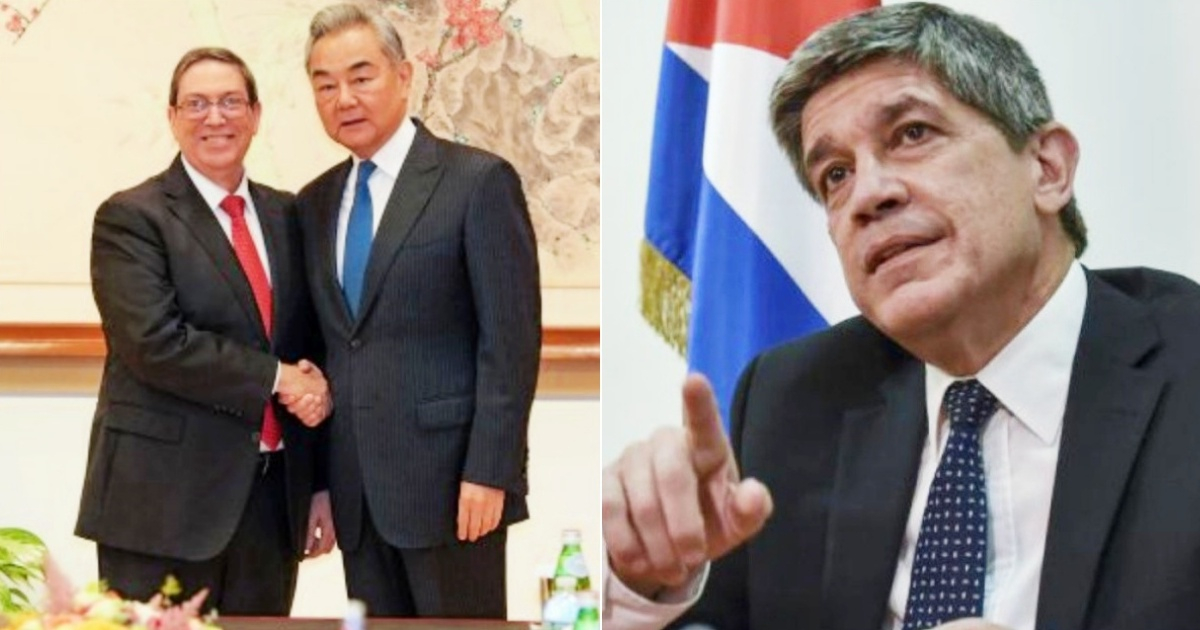
The Deputy Minister of Foreign Affairs of the Cuban regime, Carlos Fernández de Cossío, published a message on X on Wednesday, August 26, to reject the accusations regarding Chinese intelligence facilities on the Island, amidst an escalating pressure from the United States that shows no signs of stopping.
Cossío responded to an opinion article by analyst Gordon G. Chang in The Hill, in which he urges Washington to act urgently to prevent Beijing from becoming the lifeline for the regime in Havana.
The regime's response
The full statement from Cossío, published on his official account on X, was as follows:
«The U.S. government continues its campaign of slander against Cuba. They have now hired another liar named Gordon Chang who published a column in the magazine The Hill, filled with the same ridiculous fabrications about alleged foreign military bases in Cuba.»
The deputy minister denies the existence of foreign military bases on the island, although the technical debate does not center on conventional military installations, but rather on signals intelligence collection sites, a distinction that Chang's own article clearly establishes.
A user responded to Cossío's message with a remark that encapsulates the skepticism of many: “They also claimed it was a slander that there were Cuban soldiers in Venezuela.”
What the reports indicate
The article by Chang is based on a report from the State Department published in July 2026, titled Cuba: The Capital of 21st Century Communism, which states that China is actively operating three of the 18 known signal intelligence facilities on Cuban territory and that this presence "poses an acute risk to U.S. military operational security."
The Center for Strategic and International Studies (CSIS) identified four locations related to that activity in 2024: Bejucal —the largest, near Lourdes, west of Havana, and the former largest Soviet listening station outside the USSR— in addition to Wajay, Calabazar, and El Salao.
In June 2026, the CSIS confirmed that the construction of a large antenna in Bejucal had been completed and that the system was likely already operational.
The pressure from Washington
On August 6, Secretary of State Marco Rubio announced sanctions against the Cuban military representative in China, Waldo Pérez Cortés, along with seven other individuals and five entities — including Tecnoimport, Duna S.A., and the Military Industry Union — for facilitating the acquisition of military equipment from Beijing.
Rubio was emphatic: "The United States will not tolerate a pariah state hosting military, intelligence, and terrorist operations at our doorstep." Since January 2026, the Trump administration has imposed more than 240 new sanctions against Cuba.
Retired U.S. Air Force General Blaine Holt, cited by Chang, proposes even more aggressive measures: "Taking actions that cut off the lifeline for Chinese personnel in Cuba, such as restricting flights to and from the island."
China intensifies its support for the regime
Far from retreating, Beijing has intensified its support. A day after the August sanctions, the Chinese ambassador in Havana announced the delivery of another 5,000 solar panels to the island, and by early 2026, Beijing had already committed 80 million dollars and up to 90,000 tons of rice for the regime.
The spokesperson for the Chinese Foreign Ministry, Guo Jiakun, rejected Washington's accusations and stated, "The cooperation between China and Cuba is legitimate and transparent."
Malliotakis demands a strong response
In parallel, the State Department shared on X an article by Republican Congresswoman from New York Nicole Malliotakis, who calls for a strong response to what she refers to as the "malevolent influence" of Havana, citing the cases of Ana Belén Montes and Víctor Manuel Rocha, both convicted in the U.S. for secretly working for the Cuban regime.
The State Department report describes Cuba as the point where "the ambitions of Moscow, Beijing, and Tehran converge." In that context, the columnist for The Hill warned about the risk that this convergence poses to American security and demanded that Washington take action before China consolidates its position on the Island.
Related videos:
Filed under: