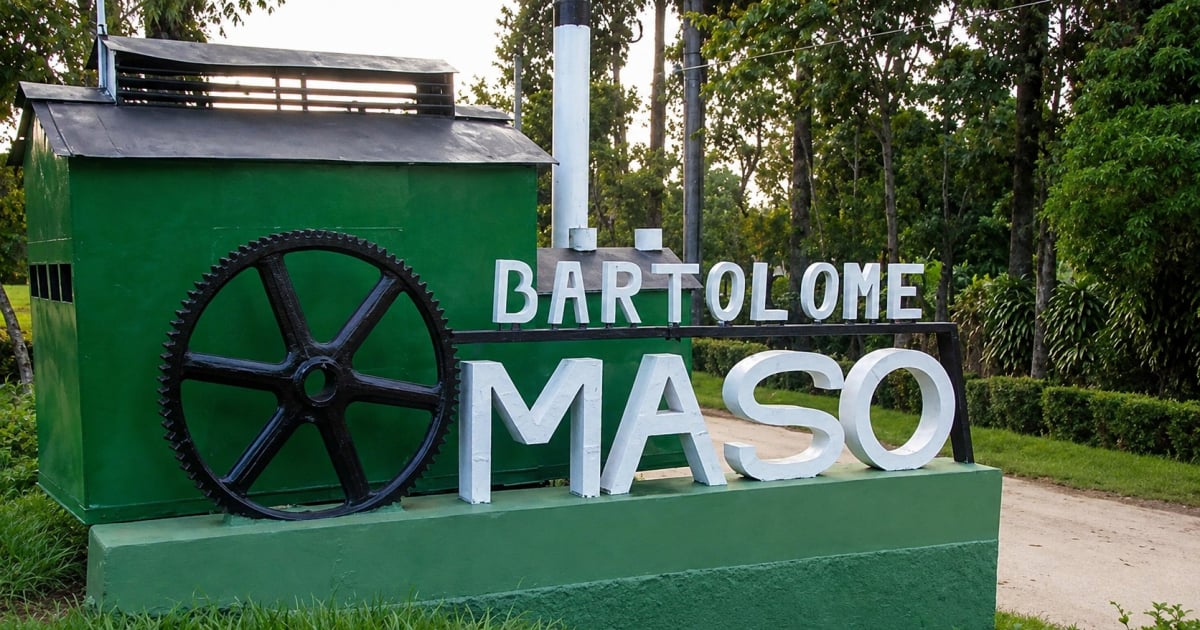
There are figures in our history who have become ensnared between their merits and subsequent judgments. Bartolomé Masó is one of them. I do not intend to portray him as a man without flaws. It would not be historically serious to do so. Masó had disagreements with other leaders of the revolution, made questionable decisions, and was involved in episodes that historiography has critically examined. However, studying his mistakes is one thing, while reducing all his behavior to those mistakes is something entirely different.
For too long, we have tended to view the history of Cuba from an excessively epic perspective. Maceo is the Titan; Gómez, the Generalissimo; Martí, the Apostle. And Masó often remains in the background, primarily associated with his disagreements with those men. But real history is often less comfortable. And also more human.
Bartolomé Masó was not a man who appeared suddenly in 1895. His trajectory was deeply linked to the first war of independence. He had participated in the War of the Ten Years and belonged to that generation of Cubans who had learned, through defeat, that independence could not rely solely on the enthusiasm of a generation, but required continuity, organization, and sacrifice.
There begins one of the most important dimensions of his greatness. Masó was a man of revolutionary continuity. He did not abandon the cause after the failure of 1878. When a new generation prepared for the War of 1895, Masó committed himself once again.
It was therefore not just a companion of Martí's revolution. He was one of the veterans who contributed to that new war with the experience accumulated over decades of struggle.
A man who helped to build a Republic in the midst of war
The greatness of Masó cannot be measured solely by his military actions. There is another dimension that is less spectacular but historically fundamental: his involvement in the political construction of the Republic in Arms.
He was Vice President of the Republic in Arms and later President, within the framework of the institutions created by the revolutionaries during the war. This means that Masó did not view independence solely as the expulsion of colonial power. Independence had to lead to a politically organized nation. That detail is important.
The Cuban revolution was not just a series of confrontations. It was also an effort to create institutions, establish civil authorities, organize the exercise of power, and define the principles of the future Republic. And Masó was a part of that process.
In a war where military leaders with strong personalities were abundant, the existence of a civil and republican authority posed a constant problem. The tensions between civil and military power were not unique to Masó; they permeated the entire revolutionary experience. Therefore, it is overly simplistic to explain their personal conflicts as mere ambitions or rivalries. The reality was much more complex.
Masó and Martí: two generations in the same cause
There is another element that deserves a more prominent place in the memory of Masó: his relationship with José Martí. Masó belonged to the generation of the veterans of the Ten Years' War; Martí largely represented the new generation that had taken on the reorganization of the independence movement. Between them, there was an evident generational difference, but also a fundamental agreement: the independence of Cuba.
Masó was alongside Martí and Máximo Gómez during the crucial moments at the start of the war in 1895 and witnessed that final stage of Martí's life, which ended tragically in Dos Ríos.
It is not necessary to turn this relationship into a romantic scene to understand its significance. It is enough to acknowledge that Masó was part of the circle of men who made that war possible and who shared with Martí the historical responsibility of transforming the independence ideal into an effective war.
The conflict with Maceo: between facts and legend
Then comes one of the most delicate points in his biography: his relationships with Antonio Maceo. Was Masó responsible for all the conflicts that arose between them? The answer, if we aim to create history rather than legend, should be much more prudent. There were genuine disagreements. There were differences in character, political conception, and command. Tensions also existed between civil authorities and military leaders, a matter that permeated the entire revolutionary experience.
In that context, presenting Masó as the sole cause of the difficulties reduces a complex process to a personal explanation. There is an even more uncomfortable question: is it possible that Maceo also had reservations about Masó? Of course, it is. Maceo was a man of immense military authority, with a very defined understanding of how to conduct the war. Differences among the revolutionary leaders were frequent and were not limited to Masó.
That does not diminish Maceo's greatness. It humanizes him. The same should be done with Masó.
The invasion of the West: a problem that demands caution
One of the arguments used against Masó has been his stance on the invasion towards the West. However, the historian must tread carefully here. It is legitimate to study his reservations, his strategic differences, and the difficulties that existed within the revolutionary leadership. What is not equally legitimate is to transform those reservations into a supposed absolute opposition to the invasion without precisely establishing what he said, what he did, and in what context he did it.
The war was not a scene of unanimity. There were logistical problems, disagreements among commanders, differing military concepts, and also political tensions.
A strategic difference does not automatically turn a man into an enemy of a military operation. And a collision of interests does not necessarily imply a collision of patriotisms. This distinction is essential for understanding Masó.
Masó and the Problem of Power
But perhaps one of the best ways to appreciate Masó is to observe his relationship with power. After decades of sacrifice, war, and participation in the independence cause, Masó legitimately aspired to hold the presidency of the new Republic. There was nothing illegitimate about that aspiration. He was a veteran of independence and had held high-ranking political responsibilities.
However, when the time came to compete for the presidency, the political situation in Cuba was far from normal. Cuba had just emerged from a devastating war and was under American occupation. The Republic had not yet fully existed as a sovereign state.
Masó ultimately withdrew his candidacy when he believed that the electoral process did not provide the necessary guarantees. This fact deserves to be noted without simplifications. He could have turned that dispute into a larger political crisis. He did not. Beyond the interpretations that can be made about the exact motivations behind his decision, there is one fact that deserves consideration: Masó did not transform his electoral frustration into a rift with the emerging Republic. And that too is part of his greatness.
His position on Cuban sovereignty
There is also another aspect of Masó that deserves more attention: his stance on the conditions under which the Republic was born. His opposition to the Platt Amendment and the limitations imposed on Cuban sovereignty put Masó in an uncomfortable position within the new political landscape.
Here lies an extraordinarily important historical contradiction: many of the men who had fought for decades for independence had to witness how the Republic for which they had struggled was born under conditions that restricted its sovereignty. Masó was among those who did not passively accept that reality.
This allows us to understand that their political confrontation with other sectors cannot be explained solely by personal ambition. There was also a matter of principles: what kind of Republic should emerge from the war and how much true sovereignty could Cuba have under those circumstances.
You don't need to be a saint to be great
No one who actively engages in politics navigates history without making mistakes. Martí could have been wrong. Gómez could have been wrong. Maceo could have been wrong. Masó could have been wrong too. However, a historian cannot assess a man solely by his errors, just as he should not judge him solely by his victories. It is essential to consider the entire trajectory.
And when I observe the complete trajectory of Bartolomé Masó, I find sufficient reasons to acknowledge his historical significance. He was a veteran of the first great war for independence. He survived the defeat and did not abandon the cause. He returned to the fight in 1895. He participated in the political organization of the revolution. He held key responsibilities within the Republic in Arms. He shared decisive moments of the revolutionary process with Martí and Gómez. He was involved in the controversies that accompanied the conduct of the war and later played a role in the political birth of the Republic.
And when the time came to decide between his personal ambition and a political process he deemed questionable, he withdrew his candidacy. I don't need to turn him into a saint. I don't need to deny his missteps. I don't need to diminish Maceo to vindicate him. I am satisfied with something much simpler: to grant him historical justice.
Because Masó's greatness does not lie in having been a man without mistakes, but in having remained linked to the cause of Cuba through two wars, two defeats, and a Republic that was yet to be born. This continuity holds extraordinary historical significance.
Great men do not cease to be great because they make mistakes at times. Greatness often consists of remaining faithful to a cause even amidst human imperfections.
Bartolomé Masó, with his successes, his mistakes, his disagreements, and his contradictions, rightfully belongs to that generation of Cubans who made independence the very purpose of their lives. He was not perfect. He was something more important for history: he was real. And perhaps it is time for Cuban historiography to stop asking solely what Bartolomé Masó did wrong and start asking how much he contributed to Cuba as well.
Because Masó does not need to be placed above Maceo, Gómez, or Martí to reclaim his rightful place. It is enough to restore the entirety of his journey to history. History does not need to create perfect heroes. It needs real men. And Bartolomé Masó was one of them.
Related videos:
Filed under:
Opinion article: Las declaraciones y opiniones expresadas en este artículo son de exclusiva responsabilidad de su autor y no representan necesariamente el punto de vista de CiberCuba.