On September 1st, while the Cuban regime promised that the start of the 2026-2027 school year would be "a great celebration," a young woman published a narrative that captures with surgical precision what that morning meant for thousands of Cuban mothers: exhaustion, solitude, and the quiet accumulation of small domestic battles.
"I didn't feel like posting photos of Ema with her red scarf, starting the school year. I was lacking motivation," wrote on Facebook Dailin Carracedo, mother of a fourth-grade girl.
The red scarf is the symbol that distinguishes the pioneers who have progressed beyond the third grade within the José Martí Pioneer Organization, an emblem rich in official symbolism that Carracedo Velázquez chose neither to photograph nor to celebrate.
The text is not a political manifesto. It is something harder to refute: an inventory of the mundane. The author lists her reasons for feeling demotivated with a precision that stings: washing white socks and "punching them in the heels" — "Terror. Terrifying. In very poor taste" — brushing shoes at the last minute, boiling the only expensive egg of breakfast just for the girl to reject it for lack of salt or because "she only eats the white and leaves the round and perfect yellow yolk in a corner of the plate."
Regarding power outages, water shortages, and prices, the author only briefly mentions them: “the well-known reasons that I would rather not mention, as it would be like pouring rain on wet ground.” That phrase alone encapsulates the mood of a society that has normalized the unbearable.
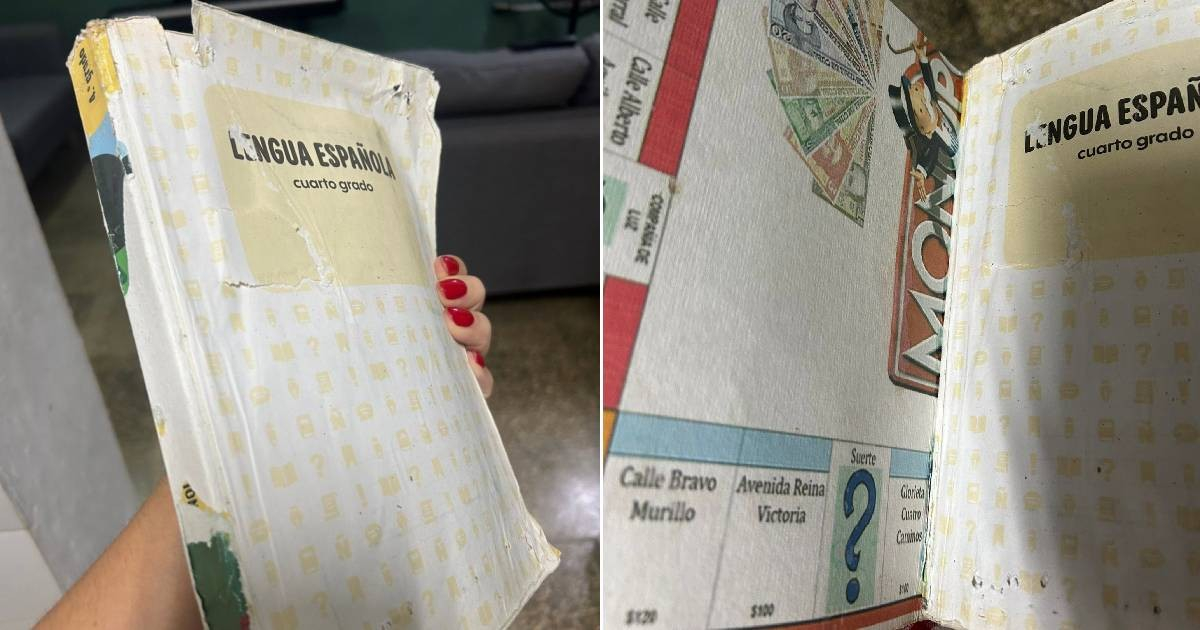
One of the most revealing moments of the account is the description of the textbook. Carracedo Velázquez received a fourth-grade Spanish Language textbook in such poor condition that it had no spine.
To repair it, he sacrificed the board from a Monopoly game and applied bookbinding skills he had learned by chance years ago. "It turns out that experience is now helping me restore the dignity to a fourth-grade Spanish Language book," he wrote.
The story also includes a family joke that unwittingly captures the gap between official rhetoric and reality: in first grade, Ema spent entire weeks trying to learn the national anthem to sing it at school.
Months later, sitting at home, she said: "I worked so hard to learn 'the morning song' and now no one sings it anymore." The reason: she always arrived after it had been sung.
The closing of the post is a scene that many Cuban families will recognize. The classroom delegate sent a welcome message to the fourth-grade WhatsApp group, and three messages later, requested assistance to install an additional fan in the classroom. The forum fell silent. Only Ema's father responded: "Let the excitement begin," accompanied by a sticker that said "fiestaaaaa."
The text by Carracedo Velázquez circulates in a context of unprecedented educational crisis: only 20% of students received new uniforms, the country has a shortage of at least 24,000 teachers, and power outages affected 70% of the territory at the beginning of the school year, according to data from Infobae and EFE.
That same day, a group of mothers blocked a street in Arroyo Naranjo, Havana, in protest against more than 48 hours without electricity and three days without drinking water.
The Minister of Education, Naima Ariatne Trujillo Barreto, had assured before the start that September 1st would be "a grand celebration in Cuba." Carracedo Velázquez chose another image for that day: arriving at the school sidewalk "distant, quiet, with a Mona Lisa smile."
Related videos:
Filed under: