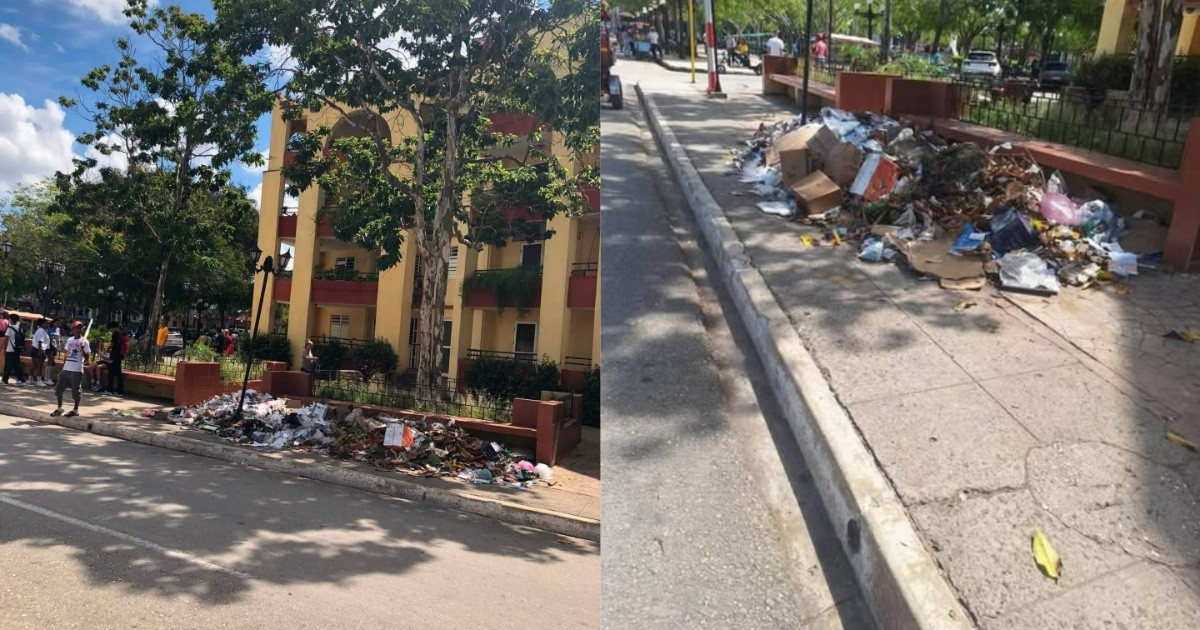
A Cuban resident abroad posted this week on Facebook a complaint accompanied by photographs showing large piles of garbage accumulated in the heart of Ciego de Ávila, in front of the Guiñol Theater, in one of the busiest areas of the so-called City of Portals.
Liubin Lima Manzano, the author of the publication, was emphatic from the start: "Gentlemen, because that place is not on the outskirts. It is not a hidden road. It is not a corner that no one reaches. It is the center of the city."
The images reveal crushed cardboard boxes, plastic bags, organic waste, and withered flowers scattered across sidewalks adorned with colonial mosaics, alongside green-painted columns and ancient wooden doors. Lima Manzano describes them as the most brutal symbol of the contrast between official propaganda and actual decay.
"We have a well-erected building with 12 floors and two gigantic flags, flags that should be enough to cover up what one of them caused," he wrote.
The author, observing his city from the distance of exile, points directly to the gap between the narrative circulating on social media and what happens on the streets: "What a beautiful country we have on social media… it's a pity that there is a real one, like the one in the photo, in real life."
Lima Manzano rejects participating in what he calls the construction of "a fantasy Cuba where problems vanish with a well-written publication." His conclusion is straightforward: "Normalizing crap is not progress."
The report is not an isolated case. The garbage crisis in Havana made headlines internationally earlier this year when it was revealed that only 44 of the 106 garbage collection trucks in the capital were operational, leaving as much as 23,814 m³ of garbage uncollected each day in a city that generates between 24,000 and 30,000 m³ daily. In Matanzas, only 11 out of 24 trucks were functioning due to a shortage of diesel.
Ciego de Ávila is not immune to this collapse. The official press acknowledged in April 2026 the existence of more than 150 micro-dumps in the city and announced a sweeping plan for over 200 kilometers of streets. In Morón, a municipality in the same province, the "Clean Route" project was launched at the beginning of the year to improve waste management. None of these initiatives have resolved the problem, as evidenced by the photos.
The pattern repeats across the entire island. Holguín, Cienfuegos, Bayamo, and Artemisa have been the scene of similar complaints in recent months. The causes are always the same: fuel shortages, deterioration of the vehicle fleet, lack of investment in infrastructure, and a shortage of containers.
At the end of 2025, Prime Minister Manuel Marrero Cruz admitted the failure of the institutions in the face of the waste crisis, without that admission resulting in visible improvements.
Lima Manzano concludes her text with a mix of sorrow and wounded pride: “The sadness of seeing my city from afar and discovering that, instead of missing it, sometimes I have to make an effort to recognize it first.”
Related videos:
Filed under: