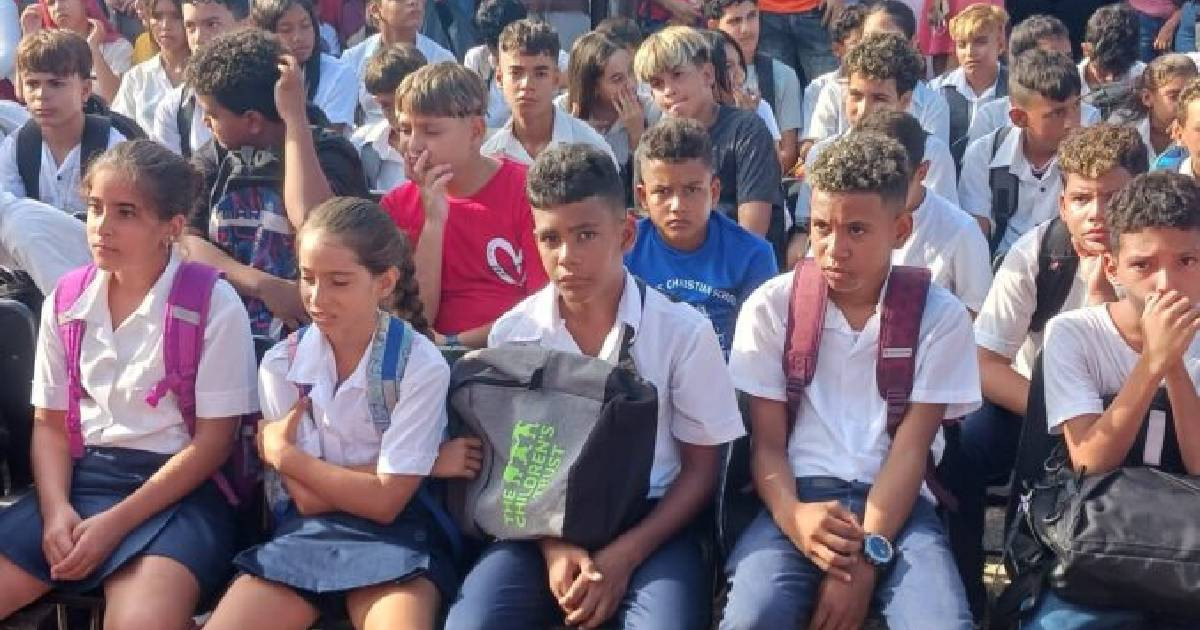
The provincial director of Education in Granma, Manuel Abelardo Ortiz Uriarte, visited most of the municipalities in that area to confirm the start of the 2026-2027 school year and stated that "there is joy in the schools" and "good attendance in classes," although he acknowledged that the fuel shortage complicated the distribution of materials "like never before."
"We have already visited eight municipalities in Granma by this Thursday. There is joy in the schools, good class attendance, and a commitment to this process is evident. A positive atmosphere is palpable in this regard," declared Ortiz according to a report from the station Radio Bayamo.
However, in the same message, the official acknowledged that delivering resources to the mountainous areas proved to be extraordinarily difficult.
"It has been very complex, unlike ever before, but thanks to the fact that we have not been alone. In the mountains, we used the available routes to deliver the missing materials," he explained.
To overcome the fuel shortage, authorities turned to both state and non-state economic actors and relied on the fact that the textbooks and curricula for the first and second levels of improvement were already available in the communities before the course began.
In Granma, 42 educational institutions with internal boarding systems serve 4,560 students, and the energy crisis has forced them to adjust their stay schedules, with some centers operating in cycles of 15 days every two or three months depending on their location.
The propaganda tone of the provincial authorities mirrors the narrative of the central government. President Miguel Díaz-Canel presided over the opening ceremony of the academic year at the University of Matanzas and described the decision to open classrooms during a crisis as "the most revolutionary."
Additionally, the Minister of Education, Naima Ariatne Trujillo Barreto, went on to describe the start as "a great celebration" despite acknowledging "tremendous difficulties."
The Cuban educational system has a deficit of at least 24,000 teachers, equivalent to 12.5% of the projected positions, while only 20% of students received new uniforms.
The economic context exacerbates the situation even further. A recent video showed that a basic school snack like bread, guava paste, and soda costs around 500 pesos, in a country where the average monthly salary was 7,074 pesos in April, according to the National Office of Statistics and Information.
The economist Javier Pérez Capdevila estimated in June that a person needs about 96,000 pesos per month to cover basic needs, of which 70,000 are solely for food, creating a gap that makes even school snacks inaccessible for most Cuban families.
While the official newspaper Granma romantized the recent start of the school year, it had to acknowledge that "material shortages, serious energy difficulties, and adversities of all kinds have aligned this time like never before, with a truly adverse effect on an education system."
The previous academic year, 2025-2026, was prematurely closed due to the energy crisis, a fact that the regime tends to gloss over while celebrating the start of the new school year as an achievement.
Related videos:
Filed under: