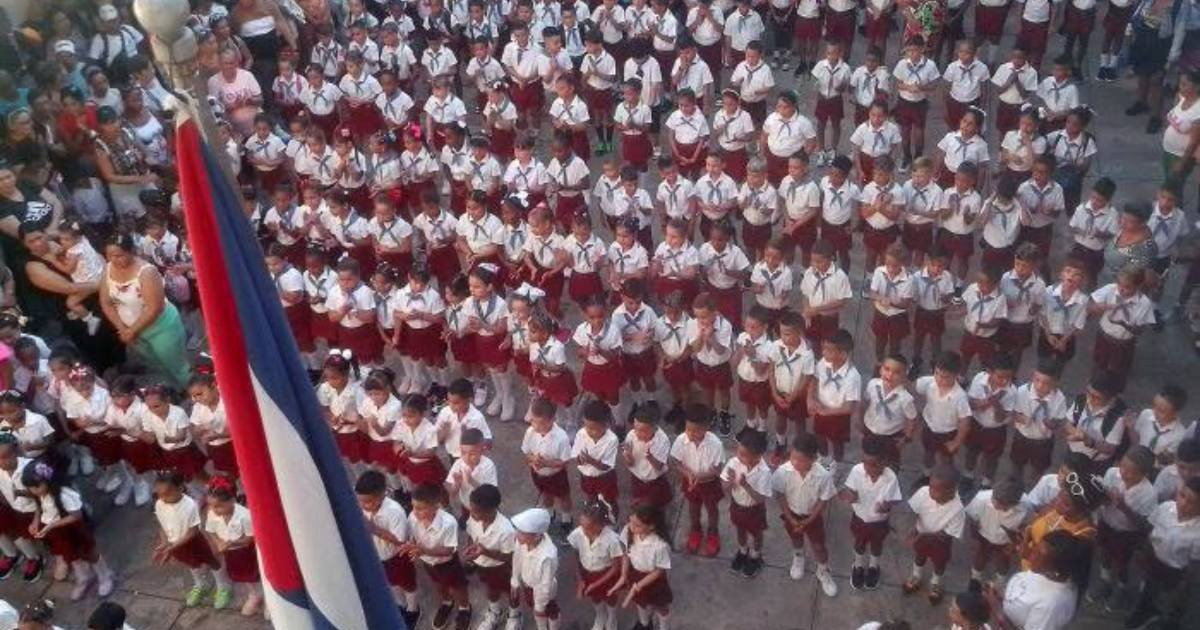
The official newspaper Granma published a post on Facebook titled "September Enchants Again" to celebrate the return to school scheduled for next Monday, while the reality of the Cuban educational system faces unprecedented shortcomings in decades.
The text of the official organ of the Communist Party acknowledges, between the lines, that "material shortages, serious energy difficulties, and adversities of all kinds have aligned this time like never before, having a truly adverse effect on an education system."
However, instead of addressing that crisis, the newspaper appeals to revolutionary epic, compares the current situation to the Literacy Campaign of the 1960s, and accuses the "self-confessed enemies of Cuba" of wanting to sabotage the start of classes.
The triumphalist narrative of the government clashes directly with the data. The education system has a deficit of at least 24,000 teachers, which corresponds to 12.5% of the anticipated positions, and the government has had to authorize the same teacher to teach classes in more than one institution to alleviate the shortfall.
The shortage of uniforms is another sign of the collapse: only 20% of students will receive new clothing at the beginning of the school year, as production reached between 2.2 and 2.3 million garments compared to the 3.6 million needed. In response, the regime has relaxed uniform requirements so that no student is excluded for not having one.
The World Food Program warned that 48.5% of Cuban children aged six to eleven do not receive food or snacks at school, a figure that starkly contrasts with the official narrative of education as a "conquest of the Revolution."
This is compounded by power outages of over twenty hours a day, collapse of transportation, widespread deterioration of infrastructures, and schools surrounded by garbage and sewage in Marianao, Holguín, and Santiago de Cuba, reported just before the start of the academic year.
In light of the energy and transportation crisis, the government announced hybrid and remote learning options for universities, a measure that the regime itself presented as an adaptation rather than a regression.
The official discourse has been markedly propagandistic on all fronts. The Minister of Education, Naima Ariatne Trujillo Barreto, stated that the start of the school year "will be a great celebration in Cuba," despite admitting in the same speech "tremendous difficulties."
The regime promoted the slogan "With Fidel in Every Classroom" to frame the return to classes, and a leader of the Communist Party even stated that starting classes was "a blow to the enemy".
Miguel Díaz-Canel posted a video on Facebook on Thursday denying that Cuba is in collapse and using the start of the school year as an argument, stating that more than 1.5 million children and adolescents will return to the classroom.
Days earlier, in an interview with the Brazilian newspaper Folha de S.Paulo, he stated: "No, we are not on the brink of a collapse," although he acknowledged that the country is going through "one of the most difficult moments."
Meanwhile, Cuban mothers responded with outrage to the official announcement, asking when their children will have proper conditions to study: without water, without snacks, and without enough teachers.
Related videos:
Filed under: