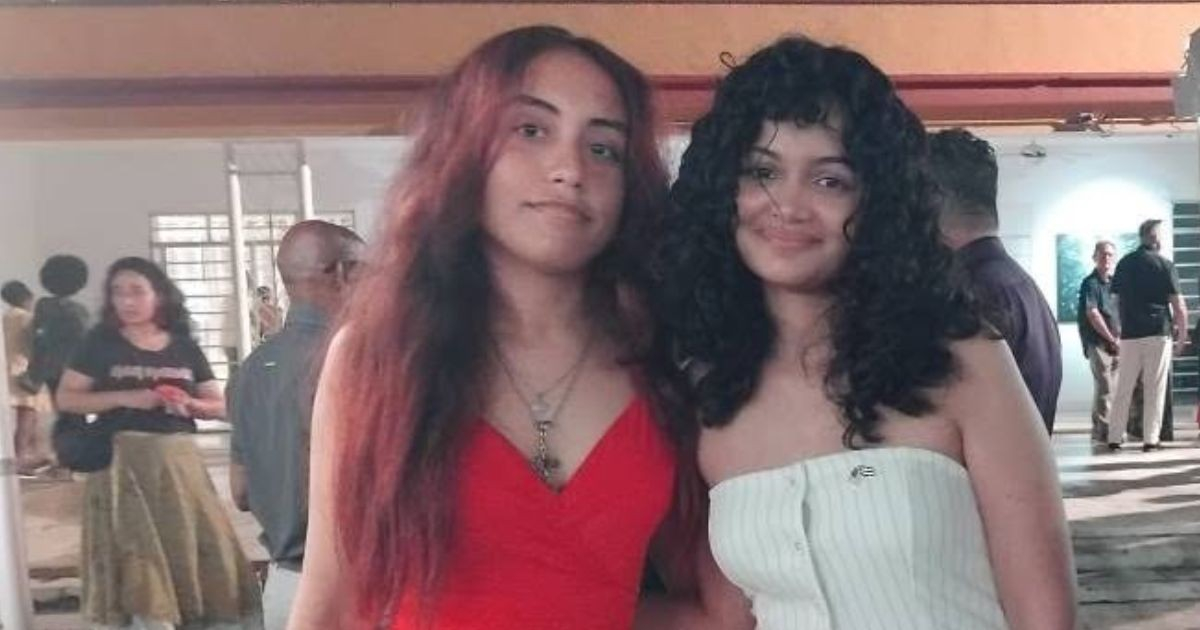
The independent Cuban journalist Yunia Figueredo reported this Friday that State Security agents showed up the previous day at the Foreign Languages Faculty (FLEX) of the University of Havana (UH) —where her daughter Beily Mariam Correa studies— to inquire about her enrollment. Furthermore, at noon on this September 4th, the local police chief arrived at her home to impose a new precautionary measure within the process being pursued against her for allegedly inciting protests in Jaimanitas.
In a public complaint addressed to the international community, Figueredo accurately described the two incidents that occurred within less than 24 hours: "Two State Security officers appeared yesterday at the foreign languages university, Flex, investigating my daughter Beily Mariam Correa's enrollment at that educational institution."
The new precautionary measure imposed on the journalist requires her to appear and sign at the police station on the 10th of each month.
Before leaving the residence, the police officer issued a warning that Figueredo quoted verbatim: he ordered him to maintain "zero relationship with the American embassy [of the U.S.]" and to "think of his daughters."
The journalist Yoe Suárez specified on Facebook that the investigation into Beily Mariam's enrollment was likely prompted by the young woman's participation in a countercultural art exhibition organized by the United States Embassy in Havana.
Suárez also noted that days before this Friday, Figueredo had already been summoned by the political police, which indicates that the harassment intensified in the days leading up to the imposition of the new measure.
The journalist herself framed these events within a context of sustained repression: "This new repressive measure joins the wave of repression that the regime has unleashed against my family and our journalistic work, in the name of freedom of expression and in defense of Human Rights since March. However, we make it clear that no intimidation will stop us in this fight that my husband and I, and now our daughter, are carrying on to see that bright day of freedom."
The pattern of harassment against Figueredo and her husband, the also independent journalist Frank Correa, intensified in March 2026, when she was arrested in Jaimanitas after participating in a protest against power outages, an operation that took place in front of their young daughters.
On July 2, 2026, Figueredo and Correa were once again detained in Jaimanitas as they were heading to a reception at the U.S. Embassy. According to the Cuban Observatory for Freedom of Expression of ICLEP, they were intercepted without a warrant, taken by police and State Security agents to the station at Tercera and 110 in Playa, interrogated, and held for several hours. In the following months, ICLEP documented new summonses, interrogations, threats, surveillance, and mobility restrictions against the couple.
Jaimanitas has become one of the most active protest hotspots in Havana during 2026, with recurring demonstrations driven by power outages lasting over 24 hours and shortages of water and food. At the end of August, neighbors blocked Fifth Avenue due to an extended power cut, and days later, Figueredo reported a militarization of the neighborhood out of fear of new protests.
The pressure on the families of journalists, activists, and opposition members is part of what Cubalex has identified as "repression by association," a pattern through which authorities extend threats, surveillance, and other reprisals to the family environment and support networks of individuals deemed critical of the Government. In an analysis published in June 2026, the organization described this practice as a systematic and selective repressive pattern.
For its part, the Cuban Observatory of Human Rights (OCDH) documented at least 1,949 repressive actions between January and June 2026. Among the most affected sectors were independent journalists, with 91 cases.
Related videos:
Filed under: