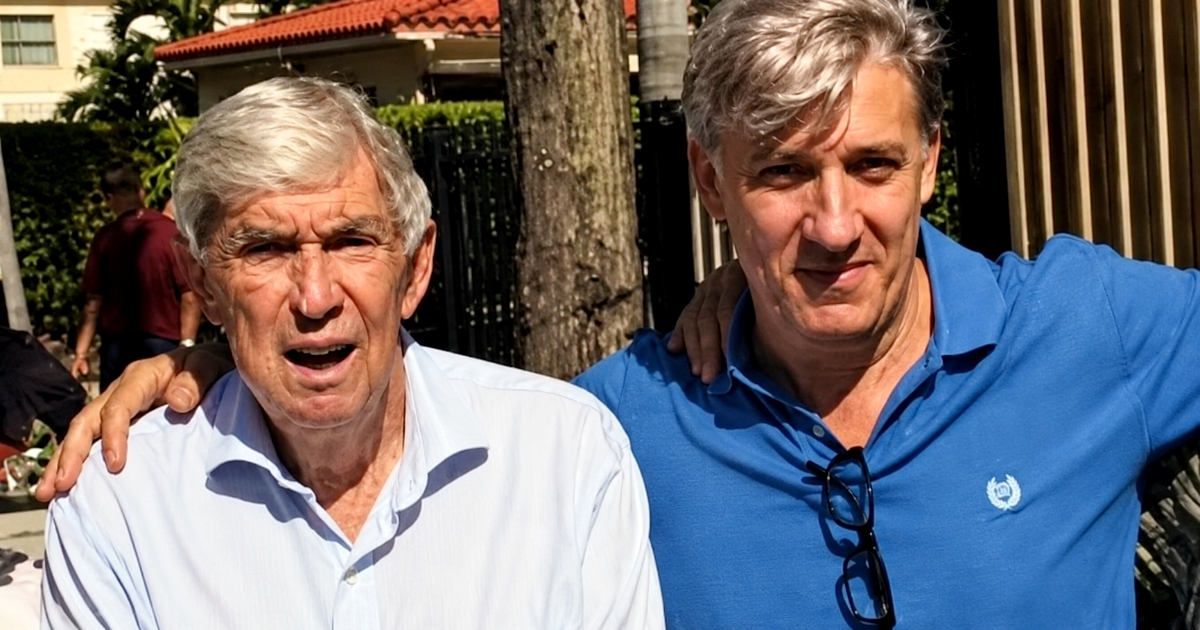
The suspicions regarding Fernando Armando Valdés Pérez, the Cuban-Guatemalan recently deported by the United States after being identified by authorities as an active member of Cuban intelligence, were present in the circle of Luis Posada Carriles long before the case came to light.
Some of the men close to the historic anti-Castro activist had been suspicious of Valdés's behavior for years, and even one of them claims that he reported his suspicions to the FBI around 2006.
The details are part of an investigation by journalist Nora Gámez Torres published by the Miami Herald, which reconstructs, based on testimonies from those close to Posada, how Valdés managed to infiltrate and remain for years in Cuban exile circles.
The Immigration and Customs Enforcement (ICE) claims that Valdés, 61, was an active member of Cuban intelligence tasked since at least the 1990s with infiltrating exile organizations.
Posada Carriles, a veteran of the Bay of Pigs and a former CIA collaborator, was for decades one of the most notorious and controversial anti-Castro activists in the Cuban exile community.
Cuba and Venezuela were linked to the 1976 attack on a Cuban Aviation aircraft that resulted in 73 fatalities, and the regime in Havana also held him accountable for other violent acts.
Posada, who was never convicted of terrorism in the United States, participated for decades in activities aimed at toppling Fidel Castro, making him a target of special interest for Cuban intelligence services.
Among those who began to distrust him were Orlando González, a friend of Posada and director of Rescate Jurídico, and Ernesto Abreu, who was also close to the anti-Castro activist.
A stranger who constantly appeared in the jail
The testimonies place some of the first warning signs in Panama, where Posada and three other men were imprisoned in 2000 after being accused of planning an attack against Castro during an Ibero-American summit.
Valdés began to frequently visit the detainees.
According to Abreu, he appeared practically out of nowhere saying that he wanted to help. González and Abreu were wondering why someone with no clear prior connection to the prisoners was visiting them so frequently and how he could afford certain expenses, including the purchase of food he brought to the prison.
González claims that he raised his concerns with the detainees themselves, including Posada, but his warnings were mostly disregarded.
One of the most striking episodes occurred when, according to testimonies gathered by Gámez Torres, Valdés allegedly encouraged Posada to escape from prison.
Abreu and González recall that Valdés claimed to have cut a fence along the perimeter and said that he could provide him with a weapon.
A suspicious arms deal in El Salvador
González recounted another incident that heightened his distrust.
According to his testimony, Valdés took him without prior notice to a meeting in El Salvador with men who introduced themselves as military personnel and who expressed their willingness to provide weapons for his anti-Castro activities.
González interpreted that situation as a possible trap.
These episodes were accompanied by behaviors that Posada's friends found difficult to explain.
Abreu recalled a night in a hotel in Central America when Valdés left in the early morning supposedly to run. Abreu decided to follow him and claimed to have seen him trying to make a call from a payphone.
When confronted, Valdés responded that he was trying to call his wife.
González recounted a similar situation while he was at Valdés's apartment in Guatemala. He saw him running down the street past midnight and later discovered a detail that strengthened his suspicions: the residence was located just two blocks from the Cuban consulate.
The suspicions reached the FBI
González maintains that his doubts about Valdés eventually reached the U.S. authorities.
According to a statement made to the Miami Herald, around 2006 he was arrested at Miami airport when returning from a trip to El Salvador and
González states that the federal investigators then asked him about the identity of a Cuban government official with whom he had met.
He interpreted that question as a sign that the authorities might already have information about Valdés.
The testimony now raises a question: if the FBI received those suspicions about two decades ago, what did they know then about Valdés and why did U.S. authorities take so many years to take action against him?
The Miami Herald notes that this is also one of the questions being asked now by Posada's former associates.
"I could have killed Luis."
González asserts that he not only warned his friends and the FBI, but also confronted Valdés directly.
The meeting took place during a visit to a hospital in Posada.
According to González's account, he told Valdés that he had communicated his suspicions to the federal authorities. The response he attributes to the now-deported individual was particularly unsettling.
Valdés would have said that if he were truly a Cuban spy, he could have killed both Posada and González himself.
González responded that an agent does not necessarily decide their objectives but rather follows orders, and he reproached him for managing to infiltrate exile organizations and associating with people from Cuban-American political circles.
Valdés's identification by U.S. authorities as a member of Cuban intelligence has now given a different meaning to those episodes that for years raised suspicions among some members of Posada's circle.
Valdés was arrested on July 10 at Miami International Airport during a joint operation by ICE, the FBI, and the Customs and Border Protection (CBP) office.
The United States deported him to Guatemala on August 7 for having concealed his ties to Cuban intelligence during his immigration proceedings.
The authorities have not announced criminal charges against Valdés for espionage or for acting as an agent of a foreign government.
Related videos:
Filed under: