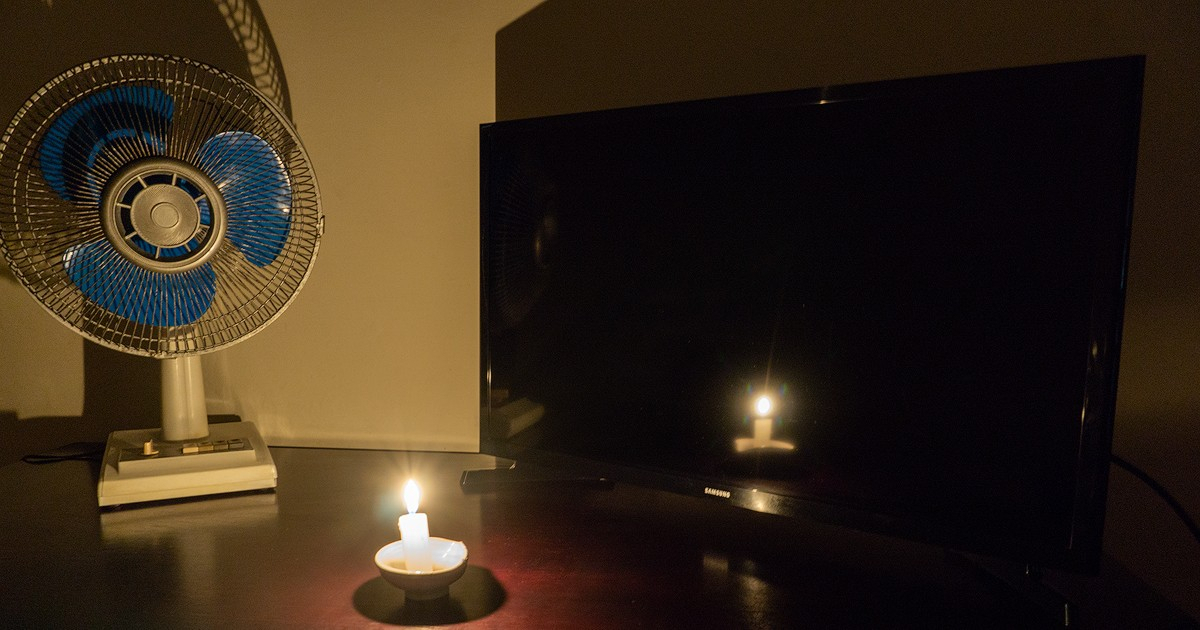
The official page of Unión Eléctrica predicts this Monday a power shortfall of 2,220 MW during the evening peak, which is equivalent to leaving approximately two-thirds of the country without electricity.
At 06:00 hours, the availability of the SEN was only 1,160 MW against a demand of 2,790 MW, with 1,630 MW already affected since early morning. By noon, the estimated impact is 1,600 MW.
The situation of the National Electroenergetic System (SEN) on Sunday was equally devastating.
"Yesterday, the service was disrupted due to a capacity deficit for 24 hours, and the disruption continued throughout the early morning hours. The maximum impact from the generation capacity deficit was 2,223 MW at 8:10 PM," the report states.
For the nighttime peak this Monday, the state entity projects an availability of 1,160 MW against a maximum demand of 3,350 MW, resulting in a deficit of 2,190 MW. The forecasted impact of 2,220 MW represents 66.3% of the total demand.
Several thermoelectric power plants remain out of service
Units five and six of the Mariel Thermal Power Plant, unit one of the Santa Cruz Thermal Power Plant, unit two of the Felton Thermal Power Plant, and unit six of the Renté Thermal Power Plant are currently out of operation.
The maintenance work is taking place on unit three of the CTE Santa Cruz, unit five of the CTE Nuevitas, and unit five of the CTE Renté. The limitations in thermal generation amount to 447 MW.
Photovoltaic solar energy contributed 3,476 MWh on Sunday, with a peak power of 540 MW at noon, but this is insufficient to offset the deficit during the peak consumption hours at night.
Last week left a grim outlook
On Sunday, a maximum impact of 2,125 MW was recorded, while last Tuesday the impact reached 2,310 MW, with 604 MW affected just in Havana. On Friday, some municipalities in the capital experienced interruptions lasting up to 35 hours and five minutes.
The decline is set against the worst energy year Cuba has experienced in decades. So far in 2026, the country has suffered at least seven total collapses of the National Electric System, the longest of which occurred on March 16, when the island was completely dark for 29 hours and 29 minutes.
The record deficit of the year was recorded on August 5 with 2,411 MW of impact, a mark that the system is dangerously close to matching.
Related videos:
Filed under: