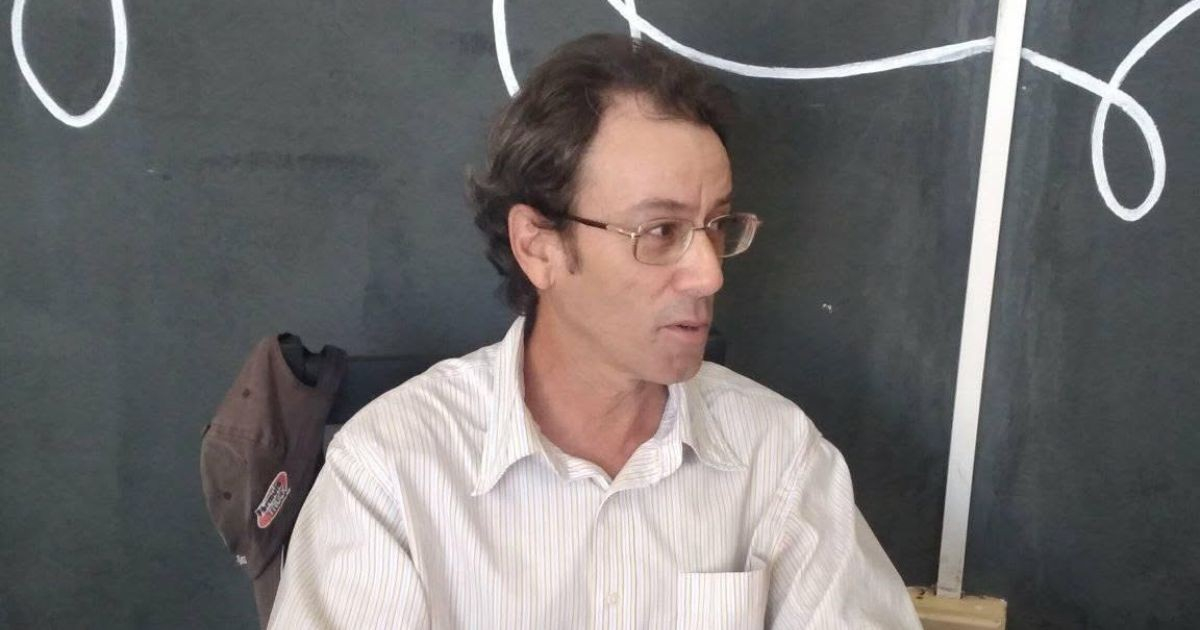
The Cuban poet and improviser Juan Carlos García Guridi published a poem this Sunday on his Facebook profile titled "Without Further Party", in which he demands justice for the independent writer and journalist José Gabriel Barrenechea Chávez, a political prisoner confined in the La Pendiente prison in Santa Clara.
The composition condenses in fourteen verses the outrage that the case has generated among writers, activists, and human rights organizations: "Barrenechea / is in prison, / what a situation / more sad and ugly! / If God plans / his absolution, / who without reason / sabotages it? / Shout his name / for he is a man / of high caliber. / With no other party / than having been born / to be free."
The poem arrives days after the Supreme People's Court upheld the six-year sentence against Barrenechea, closing the last ordinary legal avenue available for his defense.
The origin of the case dates back to November 2024, when residents of Encrucijada, Villa Clara, took to the streets banging pots and pans after more than 48 hours without electricity. Barrenechea, a collaborator for the independent media outlet 14ymedio, was arrested following the protest; Cubalex documented at least nine arbitrary detentions related to that demonstration.
In January 2026, the Provincial Popular Court of Villa Clara sentenced six individuals to a total of 34 years of deprivation of liberty (some without imprisonment) for the events in Encrucijada, with Barrenechea receiving six years under the charge of "public disorder." On July 28, 2026, the Supreme Court rejected the appeal for cassation and also upheld the sentences of three other protesters.
The court argued that the protest "exceeded constitutional protection by generating loud noises with metallic objects and obstructing pedestrian and vehicular passage." Cubalex deemed this reasoning abhorrent and pointed out that it contradicts General Comment No. 37 of the UN Human Rights Committee, which states that "the temporary interruption of traffic, noise, or chanting does not remove the peaceful character of a protest."
The human dimension of the case adds a layer of cruelty that is difficult to ignore. While Barrenechea was in detention, his mother, Zoila Esther Chávez Pérez, 84 years old, was dying of metastatic cancer. Authorities denied humanitarian permits; among activists, a phrase attributed to a prison official circulated: "The son will see his mother when she dies."
Zoila Esther passed away on May 4, 2025 without being able to see her son, and from prison, Barrenechea wrote a heartbreaking letter about it in which he expressed: "The guilt is mine. Because knowing the country I had to live in, I committed the grave crime of joining my neighbors in the civic demand for electrical power."
Throughout 2026, García Guridi —born in Batabanó, Mayabeque, in 1968— has established a voice of social protest through widely impactful compositions, including a décima about the accumulation of trash in Bejucal and the poem "Catarsis," where he wrote: "To endure in silence / is not worthy of a medal: / A poet who remains silent / dies but of silence."
The Barrenechea case has garnered the rejection of the Committee to Protect Journalists, the Human Rights Foundation, CIVICUS, and Prisoners Defenders, all of whom have called for his immediate release. Cubalex summarized it clearly: "Peaceful protest is not a crime. Therefore, we reiterate our demand for the immediate and unconditional release of José Gabriel Barrenechea Chávez and all individuals imprisoned in Cuba for exercising their rights."
Related videos:
Filed under: