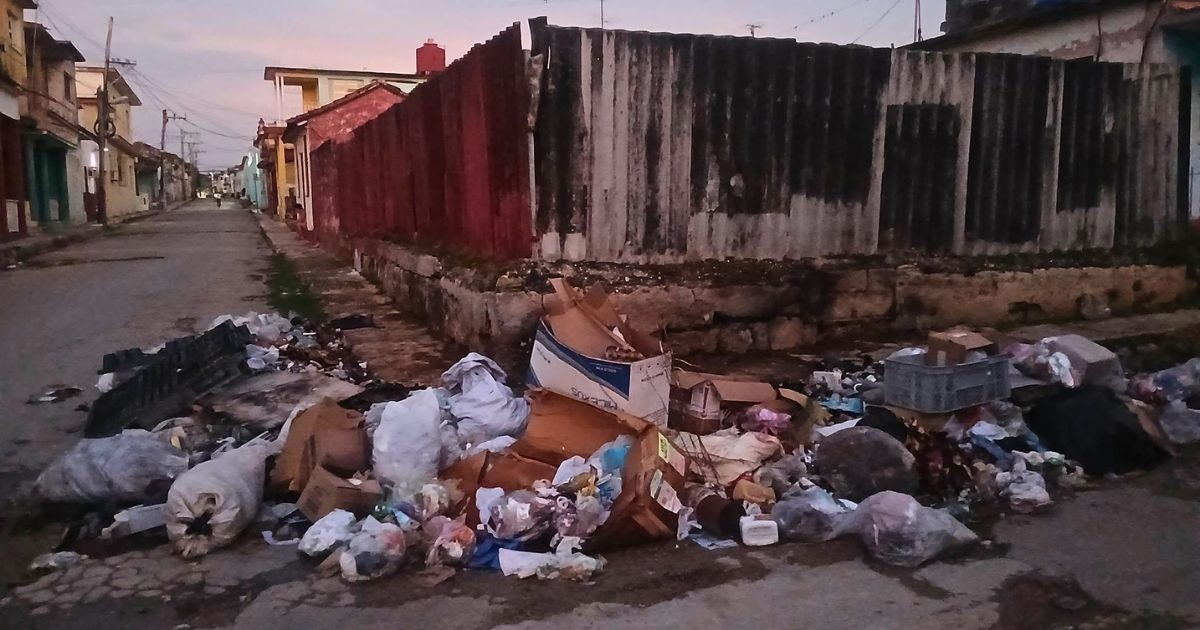
The Cuban poet and improviser Juan Carlos García Guridi published on Wednesday on his Facebook profile a décima espinela along with three photographs documenting the accumulation of waste at the corner of 15 and 8, in Bejucal, Mayabeque, and concludes with lines that summarize the neglect in which Cuba lives: «that we have become / a country of garbage».
The poem, published on August 26, describes that corner —located, according to the text itself, "a block from the Party"— as "almost a latrine corner / of proven excess" that "even if taken the wrong way / contaminates us all."
The three images accompanying the tenth depict mounds of black bags, cardboard, plastic, decomposed organic waste, and debris on worn pavement, in streets lined with houses featuring peeling facades and overhead electrical wires.
The post sparked a flurry of reactions among Cubans who identified the issue as national. One person who had been in Bejucal days earlier commented: “I am speechless. Last Saturday, I had the opportunity to pass through Bejucal, and I noticed that there was a microdump on every corner of the city. It is truly depressing.”
From Havana, an internet user pointed out that the situation does not respect neighborhoods: "In Havana, it’s entire blocks / Vedado, Playa, Miramar / No one escapes." Another, from Batabanó, described a garbage dump behind his house "that even a goat won't jump over and a stench that won't let you sleep." A third voice summarized the extent of the problem with a sharp statement: "All of Cuba is a garbage dump from Cape San Antonio to Cape Maisí and vice versa."
Several commentators rejected the official argument that attributes any shortcomings in the country to the U.S. embargo. "What does the blockade have to do with that filth? With wheelbarrows, carts, willing people, and assistance from municipal governments, they couldn't clean up the neighborhoods, towns, and cities. [...] That's a total abandonment of incredible proportions," wrote one of them.
The denunciation by García Guridi is the latest in a series of social critique poems that the author—born in Batabanó in 1968 and an investigator of the décima—has published throughout 2026. In July, his work "I ASK" addressed the loss of dignity and freedom with verses like "What have they done to us? I ask / that we lose day by day / dignity, joy [...]". And on August 21, he shared "Catharsis," where he declared: "Putting up with it silently / is not worthy of a medal".
The waste collection crisis depicted in the poem is supported by concrete figures. In February 2026, only 44 out of the 106 collection trucks in Havana were operational, leaving up to more than 20,000 cubic meters of garbage uncollected each day in the capital, according to reports that made it to the international press.
The accumulation of waste also has serious health consequences: the Ministry of Public Health warned in June 2026 about a possible dengue epidemic linked, among other factors, to the breeding grounds of the Aedes aegypti mosquito generated by trash heaps, with several serotypes of the virus circulating simultaneously in the country.
A netizen captured the collective sentiment with a historically charged comparison filled with bitterness: "If Cuba was ever an eternal Baraguá, today it is an Eternal Garbage Dump."
Related videos:
Filed under: