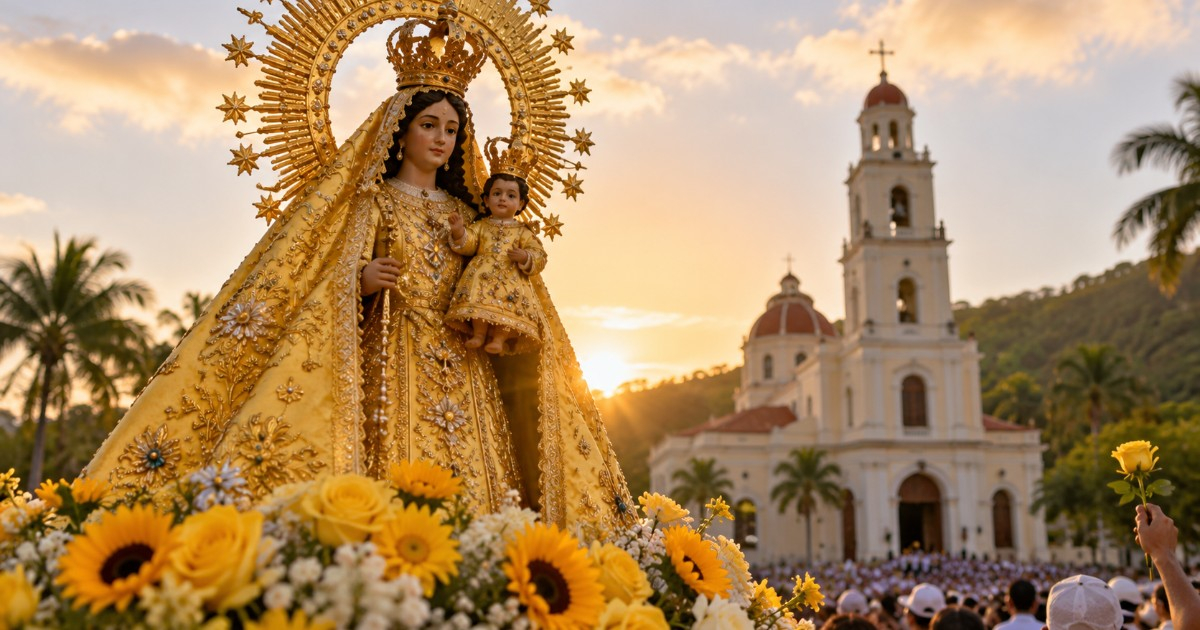
This Tuesday, millions of Cubans both on the Island and abroad celebrate the Day of the Virgin of Charity of El Cobre, the official patron saint of Cuba, a devotion that began over four centuries ago among the waters of eastern Cuba and today brings together believers from all religious traditions under the yellow color.
The story of this sacred figure begins in the early 17th century, when three men known as the Three Juanes were sailing through the bay of Nipe in search of salt for the copper mines in the region. They were Juan Moreno, an Afro-descendant boy, and the indigenous brothers Juan and Rodrigo de Hoyos. After a fierce storm, they found a small image of the Virgin Mary with the Child Jesus floating on the waters. The base of the figure had an inscription engraved: "I am the Virgin of Charity."
What astonished the three men the most, according to the traditional account, was that the image was completely dry despite having been in the sea.
The statue was first relocated to Barajagua and then to the town of El Cobre, where it established a devotion that has not waned since among miners, farmers, and residents of the eastern region.
During the independence wars of the 19th century, the mambises carried images of the Virgin as protection before entering into battle. At the end of the conflict, a group of veterans requested Pope Benedict XV to declare her the patroness of Cuba. The request was granted and on May 10, 1916, the Holy See officially proclaimed her the Principal Patroness of Cuba, a title that celebrates its 110th anniversary this year. In 1936, she was canonically crowned in Santiago de Cuba.
Three popes have made a pilgrimage to their sanctuary. John Paul II prayed before its image during his historic visit to Cuba in 1998. Benedict XVI traveled to El Cobre in 2012 to mark the 400th anniversary of its discovery. And in September 2015, Pope Francis visited the sanctuary and prayed for Cuba "to walk along the paths of justice, peace, freedom, and reconciliation."
Devotion also has a unique dimension in Cuban popular religiosity: the Virgin of Charity is syncretized with Ochún, the Yoruba orisha of love, sweetness, fertility, and rivers. This syncretism emerged during the colonial period, when African slaves identified their deities with figures from the Catholic saints to preserve their beliefs. Therefore, September 8th is a sacred date for both Catholics and practitioners of Afro-Cuban religions, and yellow—the color shared by both traditions—colors the celebrations.
The National Sanctuary of Our Lady of Charity of El Cobre, located about 20 kilometers from Santiago de Cuba, is one of the main pilgrimage centers in the Caribbean. Among its most famous offerings is the Nobel Prize in Literature medal that Ernest Hemingway donated in 1954 as a gesture of gratitude to the Cuban people.
Devotion crossed the sea with exile. In 1961, Luis Gutiérrez Areces secretly brought a replica of the image to Miami, which arrived in time for the first celebration of the patroness in that city before more than 30,000 exiles. Gutiérrez Areces passed away on July 22, 2026 at the age of 89, just a few weeks before this celebration, adding a special emotional weight to this year's event.
In Santiago de Cuba, the events of 2026 included continuous opening of the sanctuary from Monday afternoon, a midnight mass presided over by the archbishop, a morning mass, and a procession of the image at five in the afternoon under the motto "Charity Unites Us." In Miami, the program featured a rosary, procession, and solemn mass presided over by Archbishop Thomas Wenski. Diaspora communities in Madrid, Mexico City, Tampa, and New Jersey also celebrated masses and family gatherings in honor of the patroness.
The story of the Virgin of Charity of El Cobre, born amidst the waters of Nipe Bay over 400 years ago, continues to be passed down from generation to generation as one of the deepest connections that unites the Cuban people, no matter where they are.
Related videos:
Filed under: