
Related videos:
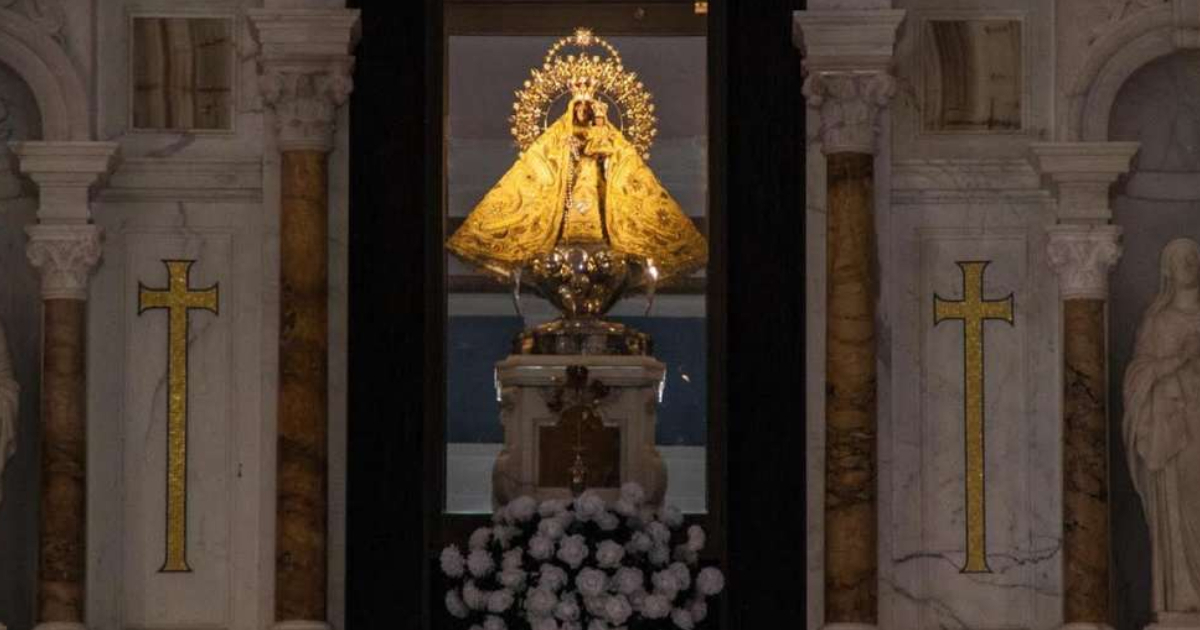
Cuba commemorates this year the 110 years since Pope Benedict XV officially declared the Virgen de la Caridad del Cobre as the Patroness of the nation, an anniversary that the Conference of Catholic Bishops of Cuba marked with a special publication on its official site.
The proclamation took place on May 10, 1916 through a papal rescript, responding to the formal request made by veterans of the Liberation Army —including Generals Jesús Rabí and Agustín Cebreco— which had been presented to the Holy See on September 24, 1915, highlighting the protection that the Virgin had provided to the mambises during the wars of independence.
In 2026, the date took on an additional significance: it coincided with Mother's Day in Cuba, which the bishops described as "a beautiful connection between faith, history, and that maternal love with which the Virgin of Charity of El Cobre has accompanied all the children of this land, weaving our deepest hopes, pouring balm of comfort on our most intimate wounds, and sheltering us under her gathering mantle."
The devotion to "Cachita" —as the Cubans affectionately call her— dates back to around 1612 or early 1613, when her image appeared floating in the Bay of Nipe, in what is now the province of Holguín, before three young men known as "the three Juans": the indigenous brothers Juan and Rodrigo de Hoyos, and the young Black boy Juan Moreno.
According to tradition, the image, about 40 centimeters tall, remained dry despite the storm and had an inscription: "I am the Virgin of Charity."
This account is based on the sworn testimony that Juan Moreno provided in 1687, when he was 85 years old and the sole survivor of the discovery, a document preserved in the General Archive of the Indies in Seville.
Since then, the image was moved to the Sanctuary of El Cobre, located on the Maboa hill, 27 kilometers from Santiago de Cuba, where it remains to this day and has received honors from successive popes.
The mambises invoked her on the battlefields, and many carried her image as a symbol of hope, which made the connection between the Virgin and national identity inseparable.
Devotion transcends Catholicism: in Cuban santería, known as Regla de Ocha, the Virgen de la Caridad is syncretized with Ochún, a Yoruba deity of fresh waters, love, and fertility, whose sacred color is golden yellow.
This syncretism emerged during colonial slavery, when the Yoruba Africans concealed their orishas beneath Catholic images to evade Spanish prohibitions.
In exile, devotion found its most visible expression in the Shrine of Charity in Miami, built between 1967 and 1973 along the shores of Biscayne Bay by the exiled Cuban community, with its stained glass windows symbolically oriented towards Cuba.
Every September 8, the liturgical feast of the Virgin is celebrated with processions and events throughout Cuba and in the diaspora, especially in Miami, where thousands of Cubans honor their patroness with flowers, candles, and yellow clothing.
The poem published by the Bishopric of Holguín to commemorate the anniversary concludes with a plea that encapsulates centuries of Cuban faith: "That if at one time the sorrowful cried out: 'Save Cuba!', we know that one day / you will make grace restore, / with your love, with your peace, with your guidance."
Filed under: