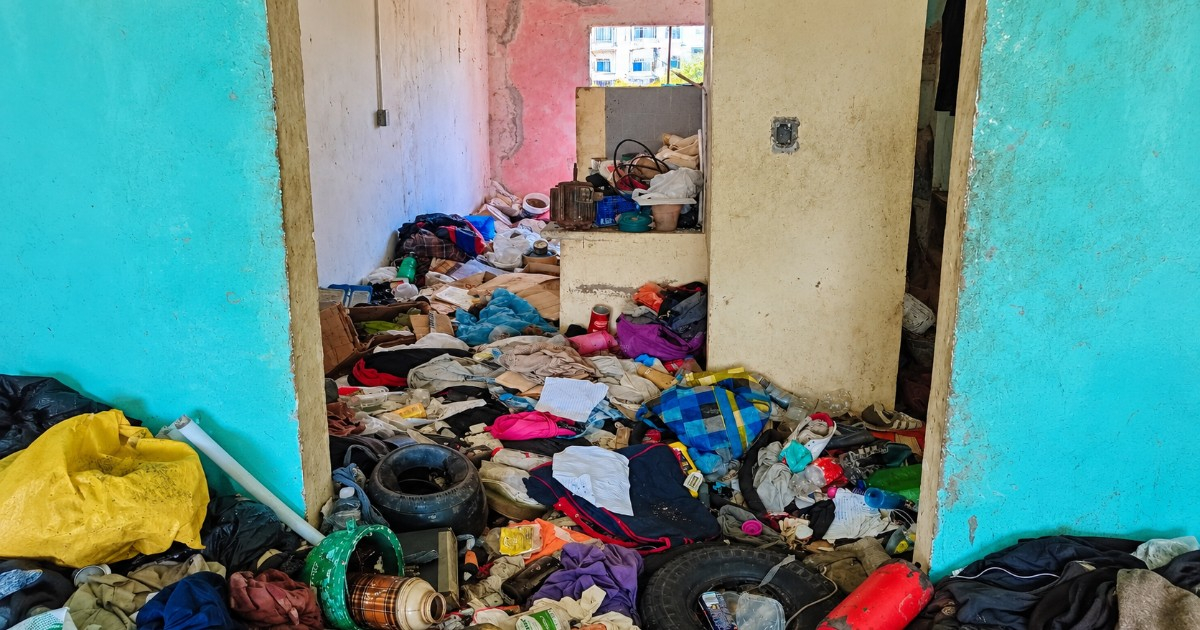
Residents of a building in the San Pedrito neighborhood, Santiago de Cuba, have been for six years demanding a response to the extreme unsanitary conditions caused by a neighbor's apartment, which, according to the images circulated, is overrun with garbage, dirty clothes, bottles, cardboard, tires, and other waste.
The report was published by journalist Yosmany Mayeta Labrada on his Facebook page, featuring photographs that show the interior of apartment 5 in building 37 on Alba Street, between Jesús María and Yarine, very close to the José Martí Polyclinic. In one of the images, a man can be seen lying amidst the waste.
The resident of the property is identified by neighbors and former coworkers as Iván Reyna, who worked as a dentist at the Frank País Polyclinic before falling ill.
"Iván Reyna was a very good dentist," wrote someone who claimed to have known him, adding that he does not have close relatives: his mother has passed away and he has a son in Mella.
Another former neighbor commented in the same vein: "He was a remarkable dentist; he was my neighbor when I lived in San Pedrito. He is not aggressive. Illnesses can't be bought, and anyone can get sick from nerves."
Various commentators linked the situation to the so-called Diogenes syndrome, a behavioral disorder characterized by extreme personal and social neglect, isolation, and compulsive accumulation of objects or trash.
Diogenes Syndrome, this is what it is called. It's sad to see a human being deteriorate like that," remarked an internet user.
The problem, however, is no longer limited to a single apartment. Residents of the building report rats, cockroaches, and other pests that are coming out of the apartment and invading neighboring homes, in addition to an unbearable smell that does not dissipate even with doors and windows closed.
"We have to stay closed 24 hours a day, and even so, the bad smell comes in," reported one of the affected individuals.
In the building live young children, the elderly, and other vulnerable individuals. Neighbors explain that they have not attempted to intervene on their own because they fear that Iván would react aggressively to any action taken without professional support.
The whistleblowers claim that the authorities of the Party and the Government of District 1 José Martí, as well as the health institutions in the area, have been aware of the situation for years but have not provided an effective solution.
His claim is clear: "We are not asking for them to take away the house. But one person cannot live in that dump, and we cannot continue living affected by those conditions."
The complaint triggered a chain of comments revealing that the phenomenon is not exclusive to San Pedrito. Neighbors pointed out similar cases in other parts of Santiago de Cuba: in Altamira, in front of the Water Office; in the 13 de Agosto building; and on G street in Mármol. "It's normal throughout Santiago de Cuba," summarized another commentator.
The case occurs in the context of a acute mental health crisis in Cuba, with only one psychiatric hospital for the entire province of Santiago and a chronic shortage of medications.
The neighbors are demanding a coordinated intervention from the General Directorate of Health of Santiago de Cuba, Social Work, and the municipal authorities, so that Iván can be evaluated by mental health professionals and receive the appropriate care.
The question they pose after six years of complaints is unavoidable: What are the authorities waiting for to take action?
Related videos:
Filed under: