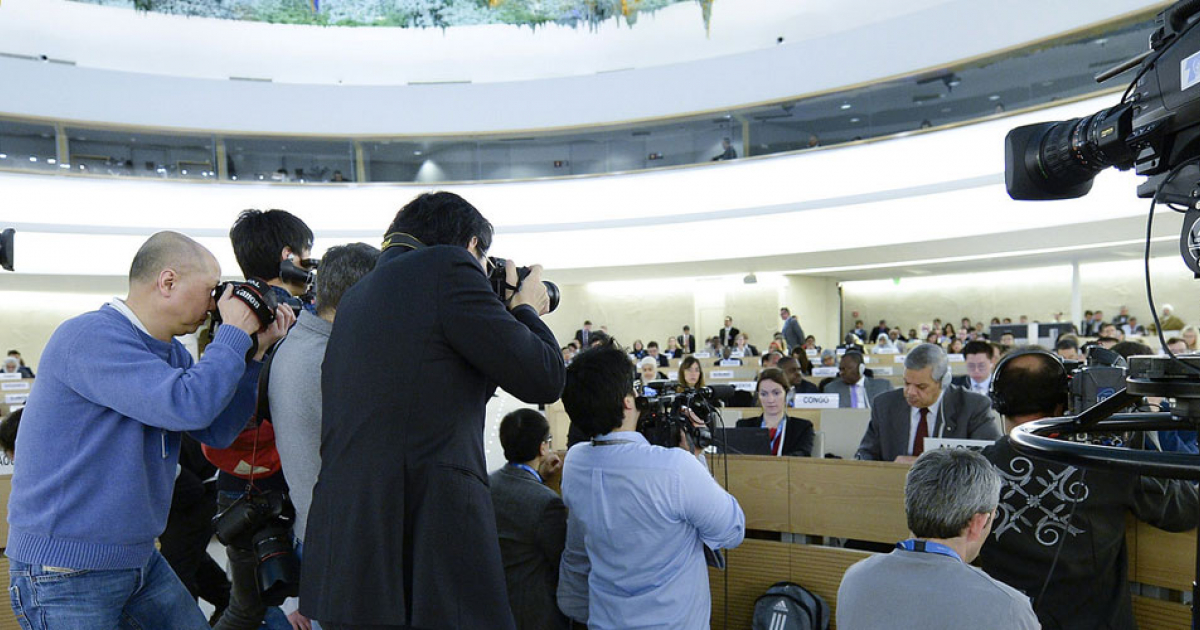
On September 9th, the United Nations Human Rights Council once again provided a troubling example of how institutions created to defend victims can end up serving as a mouthpiece for the arguments of their perpetrators.
That day, the new Special Rapporteur on the negative impacts of unilateral coercive measures, Zeina Jallad, presented the report on Cuba prepared by her predecessor, Alena Douhan, following her visit to the Island in November 2025. The document states that the U.S. sanctions and the so-called "overcompliance" with these measures have devastating effects on the Cuban population.
It is worth clarifying that on that day, a vote was not held to approve that report. There was an "interactive" dialogue. It was revealing that the European Union warned that not all unilateral restrictive measures can be treated the same: there are temporary, selective, and proportional sanctions that have been adopted precisely in response to serious violations of human rights or international law.
The issue is not about affirming or denying that certain sanctions can produce economic consequences. The problem lies in turning them into the fundamental explanation for a tragedy whose roots predate many of these measures: the destruction of freedoms, property, private initiative, the rule of law, and Cuba's democratic institutions.
It is also legitimate and very necessary to examine who produces these reports. Alena Douhan developed her career as a professor at Belarusian State University, a public institution in a country that has been ruled for decades by a dictator: Alexander Lukashenko, a friend of the Castro regime.
Official documents from the United Nations also show that her mandate received support particularly from that university and financial contributions from governments such as China and Russia. This alone does not prove that Douhan received orders from those governments, but it raises reasonable questions about her independence, especially when the main focus of her work is to fight sanctions imposed on regimes like those.
Her successor, Zeina Jallad, also takes on the position amid controversy. She is the director of the Palestine Land Studies Center at the American University of Beirut and has a long history linked to the Palestinian issue. Various publications have reported her statements describing Hamas as a “resistance movement” and arguing that before discussing October 7, one should talk about what occurred prior. It is perfectly legitimate to denounce Israeli excesses; what is concerning is that a human rights advocate does not express an equally unequivocal condemnation of the deliberate killing of civilians, the kidnapping of hostages, and the terrorism committed by Hamas.
This imbalance helps explain the growing discredit of certain United Nations bodies. In the Cuban case, presenting U.S. sanctions as the essential cause of misery is akin to blaming chemotherapy for the pain of a cancer patient while ignoring the tumor that is killing them.
If Cuba were a democracy; if there were free elections, separation of powers, an independent press, and respect for the freedoms of expression, association, assembly, and protest; if the thirty articles of the Universal Declaration of Human Rights were fully respected, sanctions aimed at politically pressuring that country would be indefensible. It would be like administering chemotherapy to a healthy person.
But Cuba is not a healthy nation. For more than six decades, a single-party system has existed that prohibits political alternation, represses opposition, incarcerates dissenters, and severely restricts fundamental freedoms. In these circumstances, selective sanctions against leaders, repressive entities, and economic structures controlled by the regime do not necessarily constitute aggression against the people; they are legitimate instruments of pressure on those who prevent the people from exercising their rights.
Naturally, any sanctions policy must be accompanied by direct humanitarian aid to the most vulnerable populations (food, medicine, hygiene products, and other essential items). The United States is doing this and must maintain and increase it. Removing all external pressure while the coercive apparatus remains intact would mean benefiting the regime at the expense of the victims.
The fundamental question should be a different one: why do certain international institutions meticulously examine the consequences of sanctions, but devote overwhelmingly less energy to demanding that the regime release political prisoners, legalize parties, allow independent press, and call for free elections?
It becomes even more incomprehensible when democratic Western governments end up supporting narratives that favor a dictatorship allied with the most authoritarian forces on the planet. The Cuban regime maintains close ties with Moscow, Beijing, Tehran, and other dictatorships opposing the liberal democratic order. For decades, it has portrayed political pluralism, market economy, and representative institutions as the worst of this world.
A human rights institution loses its moral authority when it appears more concerned with the tools used to pressure a dictatorship than with the victims of that dictatorship.
The United Nations remain necessary, as does its Human Rights Council. However, they must regain their focus on defending democracy and human rights. That is precisely why their institutions need to be held accountable; they must be required to do their jobs properly and be criticized when they do not.
Human rights cannot depend on who the violator is or who is applying the pressure. If an international organization firmly condemns an injustice committed by a democracy, it must do so with the same vigor when the perpetrators are the regimes of Cuba, Russia, Belarus, Venezuela, Nicaragua, Iran, or any other dictatorship.
When impartiality disappears, credibility vanishes as well. And without credibility, a Human Rights Council risks becoming not a moral tribunal that condemns oppressors, but rather a stage for their excuses.
The dictator Díaz-Canel applauded the report by Alena Douhan, which justifies them and presents it as a show of solidarity from the "world" with their criminal dictatorship. However, the truth is that with each passing day, they are more isolated while solidarity with political prisoners and with those of us who fight for the democratization of our homeland grows.
Alena Douhan entered Cuba because she is a friend whom the Cuban communists trust. When it comes to impartial and objective rapporteurs, the regime denies them entry into the country. The list of those who have not been granted permission to visit the Island is extensive.
Related videos:
Filed under:
Opinion article: Las declaraciones y opiniones expresadas en este artículo son de exclusiva responsabilidad de su autor y no representan necesariamente el punto de vista de CiberCuba.