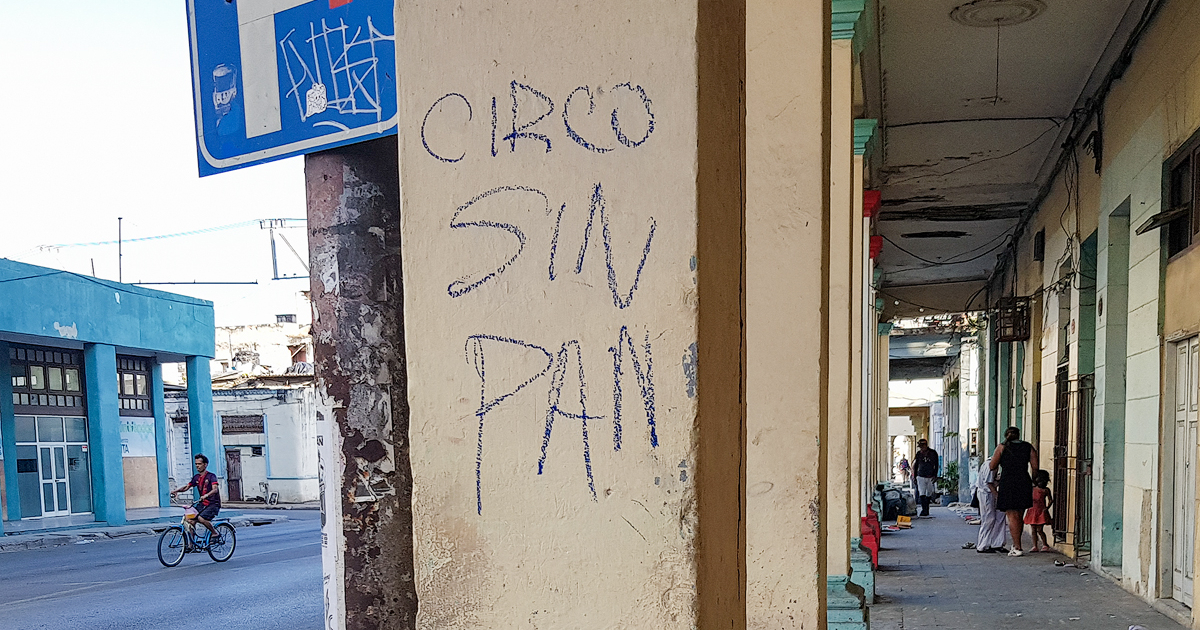
Bread has been, for decades, one of those foods inseparable from the daily life of Cubans. It is present at breakfast, in the snacks of children and young people, in the quick meals of workers, and at the table of any family. Therefore, talking about bread in Cuba also means discussing the challenges faced by a population that each day struggles more to obtain basic food items. The question today seems unavoidable: who has taken our daily bread?
The bread from the bodega still reaches the community as part of the regulated family basket, but it no longer arrives consistently. While in some areas it is distributed daily, in others it only comes twice a week. And when it does arrive, it does not meet the needs of those who are waiting for it. Often, it is a small loaf, low in weight, and of poor quality, far from the staple food that accompanied the daily breakfasts of Cuban families for many years.
State bakeries do not exclusively produce for bodegas. They also have the responsibility of making bread for schools, boarding schools, maternity homes, hospitals, and other institutions. However, producing does not mean supplying. The quantities are insufficient, and the quality also faces the challenges that the food industry encounters.
The shortage of flour and other raw materials, power outages, and challenges in keeping equipment operational have made bread production an increasingly difficult task. In some state bakeries, cooperative arrangements have also been established with non-state actors. In these cases, the state mainly provides flour and salt, while the private sector must ensure other necessary inputs for production, including oil, yeast, and the core ingredients. These arrangements have allowed for a certain level of production to be maintained, but they do not resolve the overall supply issue.
Due to the difficulty of buying pre-made bread daily, some Cuban mothers have had to seek alternative ways to ensure their children's breakfast. They purchase flour from Mipymes and, based on their knowledge and resources, bake rolls, breads, or cookies at home. If they don’t know how to make bread, they turn to frying, puddings, or other simpler preparations. It's not a solution, but a survival strategy to cope with shortages. Because any of these alternatives also require eggs, sugar, oil, flour, and electricity.
Meanwhile, private bakeries have been occupying an increasingly larger space. There are small round breads, rolls, long loaves, and other varieties that provide an alternative to the scarce regulated bread. However, they are not immune to the crisis either. Power outages and the lack of raw materials also affect their production and make their service inconsistent.
Particular bread is much more expensive, and the variety and quality depend on how much each Cuban can afford to pay. Thus, a food item that should be routine becomes for many families an expense that has to be carefully budgeted.
On the other hand, there is a paradox: producing bread can be a profitable business today. The demand is guaranteed because Cubans continue to need bread every day. Those who can obtain flour, electricity, and the other resources to produce consistently find a practically secure market. However, not everyone can access that market.
There are also marked differences between Havana and the municipalities in the interior of the country. Prices, size, quality, and even the frequency with which products appear can vary. Not all Cubans have the same access to purchase a specific type of bread, nor do they receive the regulated bread with the same regularity.
The problem, then, is not that Cubans have stopped needing bread. On the contrary, bread remains an essential part of their diet. What has changed is the system's ability to ensure its availability.
Our daily bread no longer seems to be a basic right, but rather a product that depends on where one lives, how much money one has, and how much one can obtain, because the prevailing regime on the island has eliminated the full right to daily bread that is accessible and of good quality in Cuba.
Related videos:
Filed under:
Opinion article: Las declaraciones y opiniones expresadas en este artículo son de exclusiva responsabilidad de su autor y no representan necesariamente el punto de vista de CiberCuba.