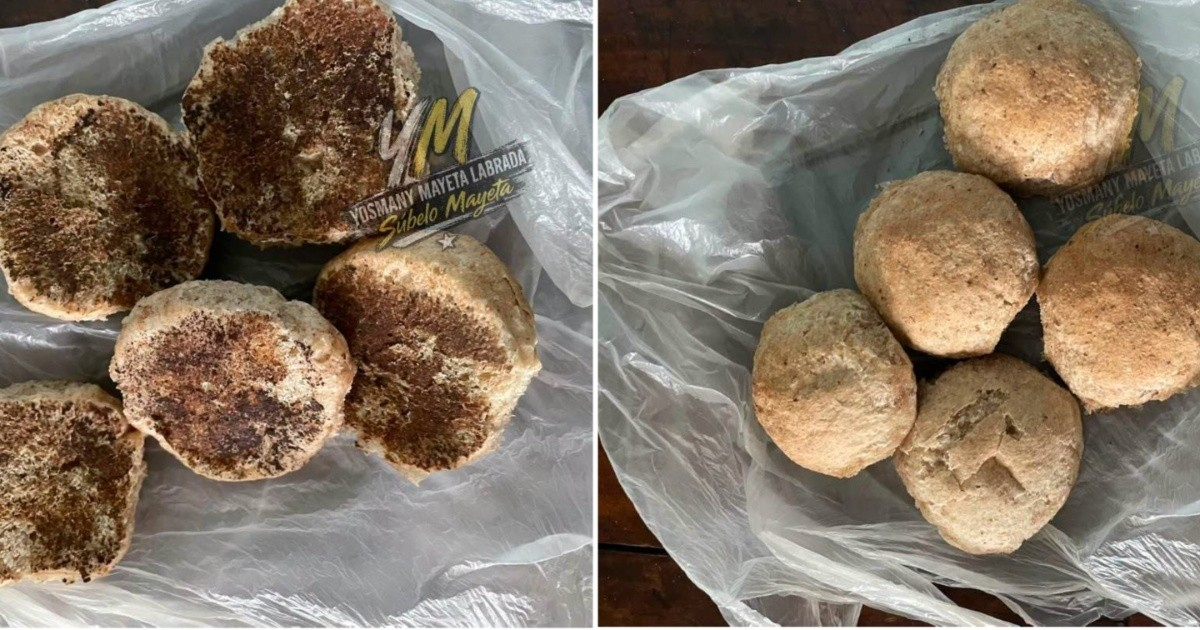
The independent journalist Yosmany Mayeta Labrada published new photographs on Saturday documenting the poor quality of bread distributed to families in Santiago through the ration book, in direct response to an official page that attempted to discredit his previous reports on the same issue.
The images, shared on their Facebook profile, show loaves of bread with extensive dark areas, clear deterioration, flattened shapes, and irregular baking. Some photographs display the interior of the product with spots that indicate its poor condition; others reveal a texture and appearance that hardly correspond to food suitable for consumption.
The post emerged in response to the page "Santiago de Cuba hoy," an official media outlet that had referred to a previous complaint by Mayeta about the quality of bread as a "brete" — meaning deception — and even labeled the content with the hashtags #NoticiaFalsa and #fakenews.
The journalist firmly rejected that characterization: "What is not valid is that, without having proven that the images are false or that the testimony was fabricated, they casually label it as fake news."
Mayeta also highlighted the difference between her work and that of state media: “There is a fundamental difference between them and us: we do not have to defend any institution. Our commitment is to the people who speak out.”
Far from backing down in the face of official pressure, the journalist challenged "Santiago de Cuba hoy" to engage in real verification journalism: "If you really want to do verification journalism, you have a magnificent opportunity: step away from Facebook, visit stores and bakeries, ask consumers, investigate the conditions of production, storage, and distribution, and publish the results."
The new images are not an isolated incident. In August, residents of the Cuabitas neighborhood reported the distribution of misshapen bread with large dark spots through the ration book, and in June, Cubans reported moldy bread with a sour smell at the La Indiana bakery, also in Santiago de Cuba.
The crisis has structural roots. The Minister of Food Industry, Alberto López Díaz, admitted in June that out of more than six contracted wheat vessels for 2026, only one from the previous year had arrived along with two recent shipments, and that a batch of 5,000 tons of flour was withdrawn before departing for the island. Cuba needs around 20,000 tons of flour monthly to sustain the regulated bread, a figure that the actual supply is very far from reaching.
The mills in Guantánamo and Santiago de Cuba remained inactive for a good part of the year, relying on irregular shipments from Havana. In light of the scarcity, bread in the informal market reached prices of up to 700 CUP per bag in Santiago de Cuba, a figure that burdens the budgets of lower-income families.
Mayeta summarized the essence of the matter with precision: "The problem here is not that someone publishes an uncomfortable photograph. The problem is that in Santiago de Cuba, there are families receiving bread whose quality gives rise to these complaints, and that some seem more concerned with discrediting the messenger than with finding out what is being placed on the table of the people in Santiago."
His conclusion was straightforward: "Bread is not 'brete'. Hunger is not 'fake news'. And the complaints of the people from Santiago cannot be erased with a hashtag."
Related videos:
Filed under: