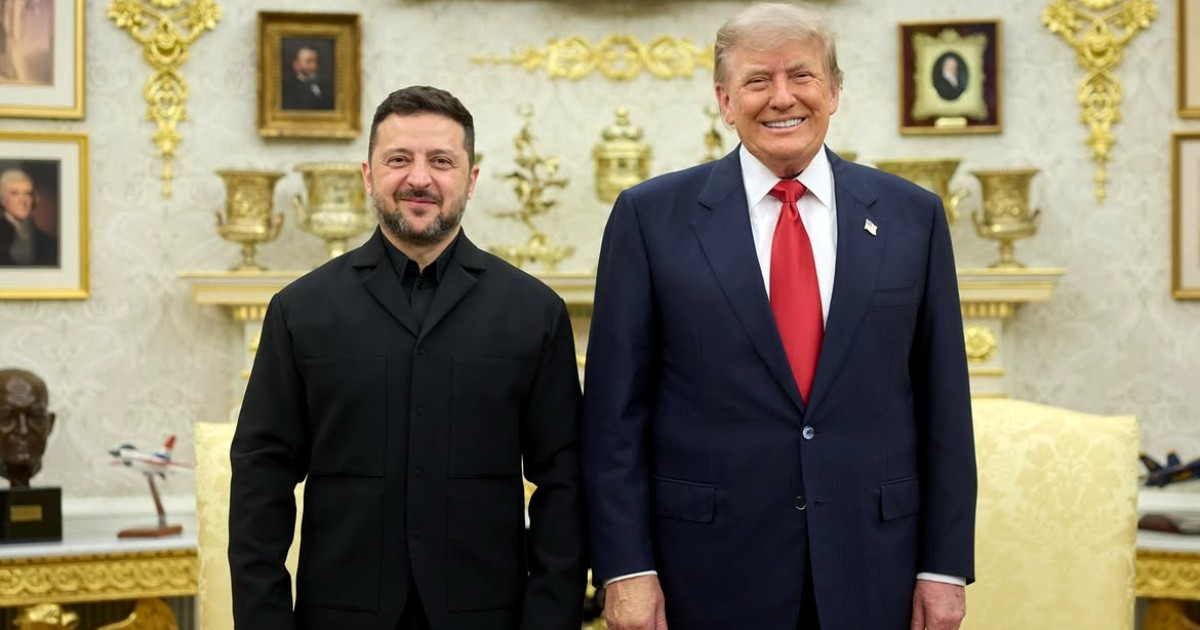
The President of the United States, Donald Trump, declared this Sunday that he contacted his Ukrainian counterpart, Volodímir Zelenski, urging him to put an end to the attacks on Russian diesel infrastructure, warning that these offensives are causing a fuel shortage that harms global markets.
According to EFE's report, Trump made the statements to the media while attending a golf tournament at his resort in Doonbeg, Ireland, during a 48-hour visit to the country.
"Zelensky has to do one thing. He needs to stop targeting diesel fuel in Russia. He can go after other targets, but not diesel fuel, because it's causing a shortage of diesel," the American president stated.
Trump also dismissed the idea that the supply crisis is related to the conflict in the Middle East and pointed directly to the war between Kyiv and Moscow as its cause: "This is happening because of what is going on between Russia and Ukraine. There are many other targets. Do not attack diesel fuel because that is harming the world."
The statements came a day after Zelenski announced a series of strikes on Russian territory: two chemical plants and a drone factory in the regions of Perm, Samara, and Rostov, as well as an oil depot, a radar station, and a Pantsir-S2 air defense system.
Among the objectives achieved was the Tolyattikauchuk plant, located in the city of Toliatti, one of the largest facilities in the Russian petrochemical complex.
According to the Ukrainian General Staff, the synthetic rubber produced there is used, among other purposes, for the manufacturing of solid fuel for tactical and ballistic missiles, which makes that facility a target of direct military value for Kyiv.
Russian air defenses claimed to have shot down 230 Ukrainian drones during that day, and official sources from Moscow reported one death and several injuries in at least three regions.
Trump's request comes at a time of intense diplomatic activity surrounding the conflict. At the beginning of September, U.S. envoys Steve Witkoff and Jared Kushner visited Moscow and Kiev in an attempt to revive peace negotiations, achieving a 72-hour truce in airstrikes over the capitals, which, however, did not result in concrete advancements.
The Ukrainian campaign against Russian energy infrastructure has intensified throughout 2026, yielding tangible consequences in international markets. In July, Russia completely banned diesel exports following Ukrainian attacks on its refineries, which drove prices to record levels: diesel refining margins reached 102 dollars per barrel in August, with fuel prices trading 48% higher than they were a year earlier.
The International Energy Agency warned during that period that Russian diesel exports had halved within weeks, a contraction that affected European and global markets.
Trump's direct pressure on Ukraine's military strategy signifies a strain between Washington and Kiev at a time when attacks on energy infrastructure are one of Ukraine's primary tools of pressure against Moscow, and peace negotiations remain stalled.
Related videos:
Filed under: