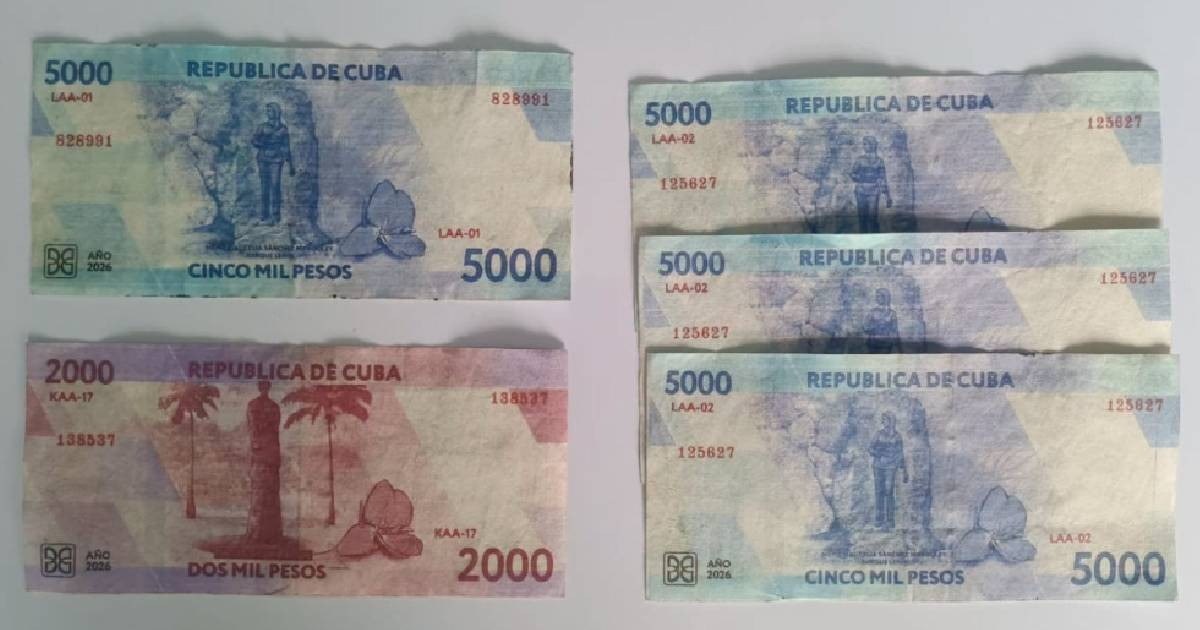
Six individuals were detained in Manzanillo, Granma province, accused of possessing and intending to use counterfeit banknotes in denominations of 2,000 and 5,000 Cuban pesos (CUP), according to information released this Tuesday through the official profile “Entérate con Aytana Alama” on Facebook.
According to the publication, the detainees were identified while trying to settle payments with counterfeit bills in recreational centers in the municipality: a café located across from the children's hospital, establishments around Céspedes Park, and the Sky Club, all high-traffic locations.
"Counterfeit bills of the 2,000 and 5,000 peso series are in circulation. Recently, the police arrested six individuals in Manzanillo who were in possession of this fake currency," warned the profile, which also shared images of the confiscated bills corresponding to series LAA-01 and LAA-02 (5,000 CUP) and KAA-17 (2,000 CUP).
The case adds to a series of alerts regarding counterfeits of the new high-denomination banknotes that the Banco Central de Cuba (BCC) began circulating on April 1, 2026, first in Havana and then gradually across the rest of the country.
These denominations, the highest in the history of the Cuban peso, were issued to combat inflation and the shortage of cash that is suffocating the island's economy, according to the BCC.
The 5,000 CUP bill features the image of Celia Sánchez Manduley, while the 2,000 CUP bill features Mariana Grajales Cuello, marking the first time that Cuban banknotes include female figures from national history.
Just weeks after its release, reports of counterfeiting began to surface. The most recent incident occurred in mid-August in Guantánamo, where two young individuals were arrested after attempting to pay with a counterfeit 2,000 CUP bill during the San Joaquín festivities. It was a self-employed worker who detected the irregularity and alerted the authorities.
The pattern repeats every time the BCC issues new denominations: counterfeiters replicate them in a short time, taking advantage of the fact that the public does not always know the security features of the newly introduced bills. The BCC has urged citizens to verify the series, numbering, and security features before accepting any bill.
Meanwhile, also in August, alerts emerged regarding the counterfeiting of 500 CUP bills, identifiable by irregularities in printing, color, or texture.
In July, a different method was documented in Guantánamo: genuine 200 CUP bills altered to resemble 1,000 CUP bills, which can be detected by holding them up to the light.
The Cuban Penal Code punishes the forgery, alteration, introduction, or circulation of currency with penalties of four to 10 years of imprisonment, making these cases crimes of considerable seriousness for those who are convicted.
Related videos:
Filed under: