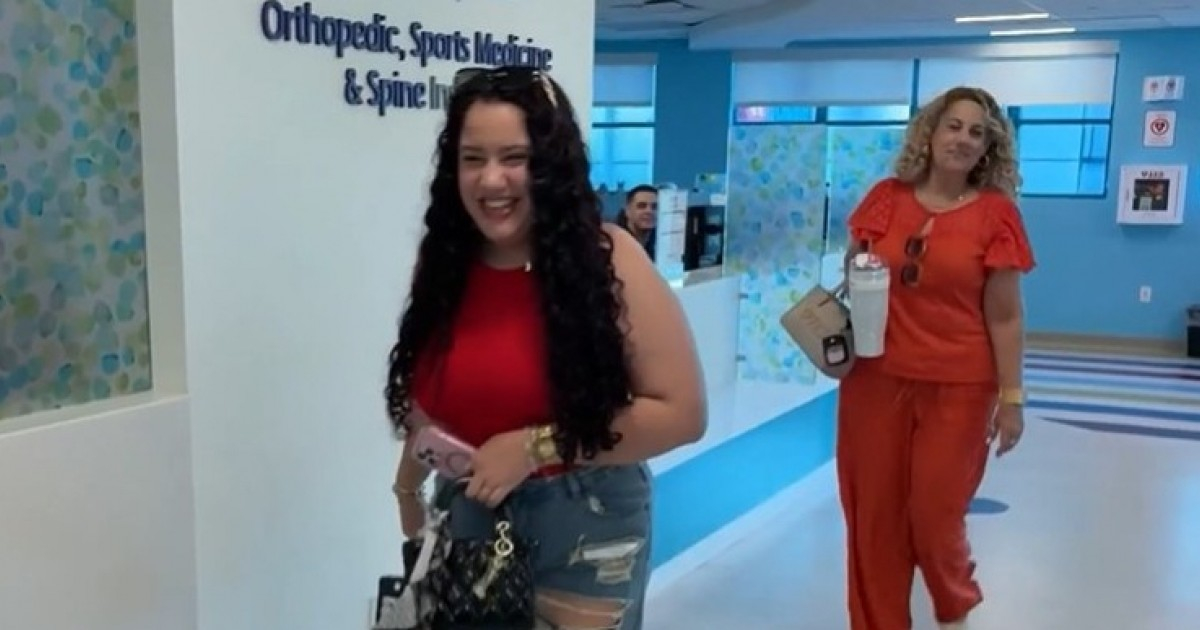
Elienay Sabina, an 18-year-old Cuban girl, spent five years relying on a crutch to walk and, in the worst moments, confined to a wheelchair. She suffered from upper femoral epiphysiolysis, a serious condition in the hip that mainly occurs in adolescents.
None of the various hip surgeries performed on her in Cuba resolved her problem, and the doctors on the Island either avoided or were unable to carry out the procedure she actually needed.
The solution came in Miami, where a specialized team restored mobility with a technology that had never been seen in South Florida.
"I went to many doctors who told me it wasn't possible. That it was a surgery that existed, but they were afraid to perform it," the young woman told Telemundo 51, which documented the case in its special segment “Your Health”.
Elienay was treated at the Nicklaus Children's Hospital in Miami, where the team from the Institute of Orthopedics, Sports Medicine, and Spine performed what the hospital itself described as the first total pediatric hip replacement guided by mixed-reality-assisted surgery in the entire South Florida region.
"This serious hip condition occurs in adolescents when the front part of the thigh bone slips at the hip joint. The injury caused severe deterioration of the hip, making her dependent on crutches for mobility, and she could only walk short distances. Total hip replacements are uncommon in pediatric patients because children are still growing and developing," the health institution's statement clarifies.
The procedure was led by Dr. Thomas J. Utset-Ward, a pediatric orthopedic oncologic surgeon who is regarded as one of only ten specialists in the United States dedicated exclusively to bone tumors and complex orthopedic conditions in children and adolescents.
Mixed reality technology combines the real world with 3D digital images during operations. The surgeon visualizes anatomical models in three dimensions, allowing for precise measurement and placement of the implant, as well as conducting predictive analyses. All of this reduces operating time and improves long-term outcomes.
"It allows us to plan the surgery in advance and see, through special lenses, augmented reality," Uset-Ward explained.
Elienay's intervention lasted between 10 and 11 hours; the main challenge was that her legs were of different lengths. But it was a success: a week later, she was able to say goodbye to the crutch.
The changes in her life were immediate and profound: she can now walk without any support, ride a bicycle, and even drive a car, activities that had seemed impossible to her for years.
Elienay's case is not isolated. It is part of a documented pattern of Cuban families seeking medical treatments in Miami that the health system on the Island cannot provide, whether due to shortages of supplies, lack of advanced technology, or absence of specialists.
Nicklaus Children's Hospital has become a referral center for Cuban patients with complex medical conditions. Among other cases, there is a teenager who regained almost all of his vision thanks to an innovative treatment in Miami, and a girl who learned to walk again with prosthetics after losing her legs in Cuba in an alleged case of medical negligence.
Related videos:
Filed under: