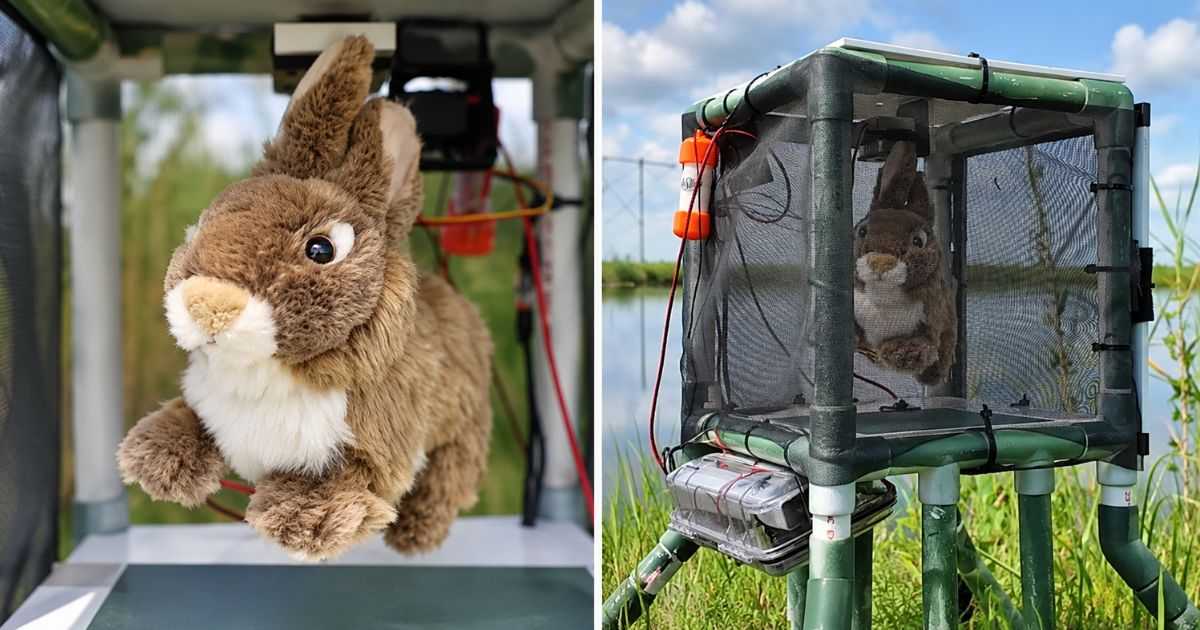
Some 90 robotic rabbits capable of emitting heat, scents, vibrations, and movement are being deployed in the Everglades as part of an experiment aimed at attracting the invasive Burmese pythons and facilitating their location and capture.
The initiative has been developed by researchers from the University of Florida in collaboration with the company REWYLD, and it is funded by the South Florida Water Management District, reported Telemundo 51.
At first glance, the devices appear to be toy rabbits; however, they are designed to mimic the various signals that snakes use to detect their prey and lure them to a point where they can be located more easily.
"We are trying to replicate that by creating the smell, the movement, the visual signals, the vibrations in the ground, and the heat signatures," explained Robert McCleery, a professor at the University of Florida and the principal investigator of the project.
The objective stems from one of the biggest challenges faced by those who work to remove pythons from the Everglades: locating them in a vast ecosystem with dense vegetation.
Bayo Hernández, a python hunter in southern Florida, explained that he can spend about five hours a day just searching for them.
The strategy seeks to reverse that dynamic: instead of covering large areas in an attempt to locate the snake, researchers aim to get the python to come closer to the lure.
Each of the 90 devices can be configured with different combinations of heat, scent, vibrations, and movement to determine which ones are most effective.
The equipment was also built to withstand the challenging conditions of the Everglades, including heavy rain and flooding.
Researchers hope that the technology can be used in the future not only in the areas where pythons are already established but also in regions where they could potentially expand.
For now, the field tests depend on the warmer months of the year. The team aims to raise approximately $200,000 to convert a building at the University of Florida into a laboratory that will allow for year-round experimentation and refinement of the system.
Artificial intelligence to detect pythons
The experiment includes another technological component. REWYLD is working on a system of artificial intelligence capable of recognizing when a python is approaching the rabbit and alerting the hunters in the vicinity.
Jean Paul De Desrochers from REWYLD explained that the technology aims to identify the reptile, keep its attention on the lure, and subsequently send an alert with its location.
The behavior observed so far has also surprised the researchers. Pythons do not necessarily attack rabbits immediately.
"We have seen them arrive, sit there, and wait. They don't try to bite them," McCleery stated.
That wait can be especially useful, as it gives hunters the necessary time to move to the location and retrieve the animal.
An invasive species that Florida is trying to contain
Burmese pythons have been a major problem for the wildlife in the Everglades for years.
The University of Florida notes that these invasive snakes have contributed to significant declines in native mammal populations in certain areas, and their Project Hopper program is specifically developing these lures to enhance their detection and removal.
De Desrochers estimated for Telemundo that there could be around 300,000 pythons in Miami-Dade, Broward, and Palm Beach, although accurately estimating the population of such a hard-to-locate species poses a challenge.
Florida has been using various strategies for years in an attempt to reduce its presence.
In July, a new edition of the Florida Python Challenge began, which offered a prize of $10,000 to the person who captured the most specimens.
This year's edition ended with a new record of pythons captured by the competition winner, reflecting the efforts made by the authorities to remove these invasive reptiles from the ecosystem.
Days later, the winner himself shared how he was able to locate and capture enough snakes to win the grand prize.
Related videos:
Filed under: