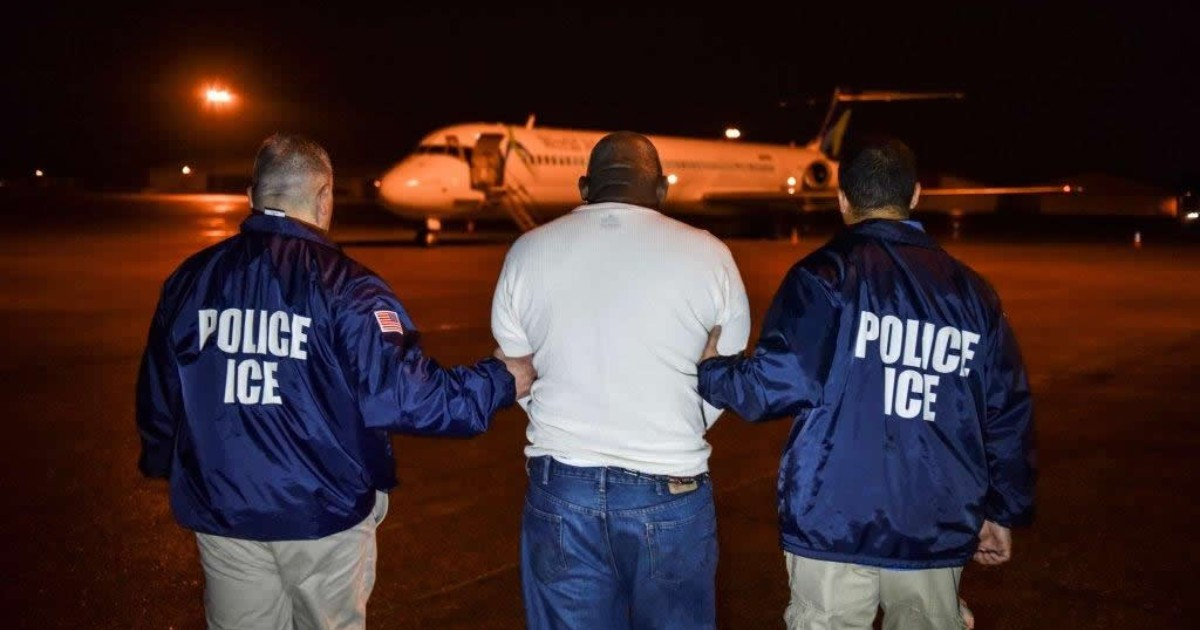
The detentions of immigrants by the Immigration and Customs Enforcement (ICE) set a new record in August 2026, with nearly 51,000 arrests; however, actual deportations remained virtually unchanged, according to preliminary government data reviewed by Reuters.
The paradox reveals the real limits—legal, logistical, and diplomatic—that the Trump administration faces in its ambition to carry out the largest mass deportation program in history.
Although August was the third consecutive month in which the ICE exceeded its own records for arrests, the rate of expulsions remained around 1,200 people per day, practically the same figure recorded in May, when there were about 19,000 fewer arrests. In other words, making more arrests has not meant deporting more.
The central explanation lies in the profile of those being detained. In July, individuals with criminal records accounted for less than a quarter of the arrests, compared to nearly 60% in December 2024, the month prior to the start of Trump's second term. An increasing number of detainees do not have deportation orders, criminal charges, or convictions. Many have pending asylum applications or active cases in court, which prevents their immediate expulsion.
Los arrestos del ICE, las deportaciones y los obstáculos legales que enfrenta la administración Trump son parte de un panorama migratorio en constante cambio. Sigue toda la actualidad en nuestra sección de
"They have deep roots in the United States and are more likely to quickly find a lawyer through their American relatives, in addition to being more aware of their rights," explained Julia Gelatt, associate director of the Migration Policy Institute.
Among those affected by this increasingly extensive network of arrests are immigrants detected at airports through information provided by the Transportation Security Administration (TSA). More than 1,200 people have been arrested through this method as of early June.
In addition to legal obstacles, there are logistical ones. "Getting people to board planes is really difficult, and the actual number of available planes has historically been a bottleneck," noted Blas Nuñez-Neto, a former official in the Biden administration.
The Trump administration signed an agreement to acquire six Boeing 737 aircraft intended for deportations, but these planes are still undergoing checks by the Federal Aviation Administration (FAA) and are not operational. Current flights frequently take off without being fully booked, and receiving countries impose their own restrictions: recent flights to the Haitian city of Cap-Haïtien transported only 57 people, according to the human rights group Human Rights First.
Current and former officials indicated that ICE agents are under increasing pressure from the White House to achieve a target of 3,000 daily arrests, although the Department of Homeland Security (DHS) denied that formal quotas exist. In June, Trump instructed ICE agents on Truth Social to "do everything in their power to achieve the critically important goal of carrying out the largest mass deportation program in history."
The White House spokesperson, Lauren Bis, dismissed the analysis by Reuters, calling it a "false version," and stated that "thanks to President Trump's strict immigration control policies, three million undocumented immigrants have left the United States."
For the Cuban community, the situation is especially critical: the arrests of Cubans increased by 463% between the end of 2024 and the beginning of 2026, and more than 42,000 Cubans have pending final deportation orders in the United States. From January to August, 882 were deported in 31 air operations.
Related videos:
Filed under: