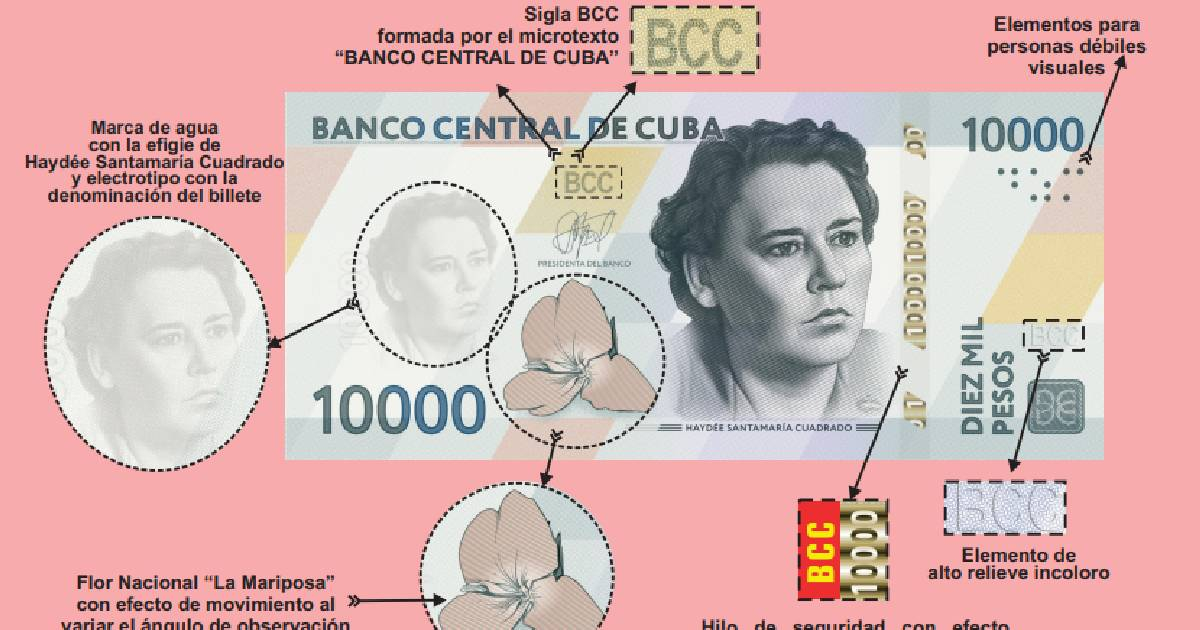
The Cuban economist Pedro Monreal warned this Wednesday that the issuance of 10,000 and 20,000 Cuban peso bills is not an economic solution, but rather evidence of a structural crisis: the Cuban peso has ceased to function as a unit of value for labor.
The Cuban economist Pedro Monreal warned this Wednesday that, although the introduction of 10,000 and 20,000 Cuban peso bills may be operationally justified in light of inflation, the high denomination of these bills contrasts sharply with low labor incomes and reflects, in his view, a structural crisis in which the Cuban peso is losing relevance as a unit of account for labor.
Monreal published on Tuesday his analysis titled "When a bill is worth much more than a month of work," in response to the announcement from the Banco Central de Cuba (BCC) to incorporate these denominations — the highest issued so far on the Island — starting this Wednesday.
The economist's central argument is based on a comparison: according to the figures he cites in his analysis, the Cuban minimum wage is around 3,210 CUP per month, and the average state salary barely exceeds 7,000 CUP, meaning a single 20,000 peso bill is equivalent to nearly three average paychecks.
"The 'technical solution' ends up taking precedence over economic and political logic. When work loses incentives, the structural crisis becomes permanent," wrote Monreal on his X account.
The economist points out that in stable economies, the exact opposite occurs: the highest denomination bill represents only a fraction of the average monthly income. He provides the example of the 100-dollar bill compared to an average income of around 6,000 dollars in the United States, or the 10,000 yen bill facing an income of about 400,000 in Japan.
"When the highest denomination bill far exceeds the monthly salary, it often reflects chronic inflation, monetary duality, or a dollarized circuit, rather than a payment system anchored in labor," he warned.
For Monreal, the gap reflects the type of economic circuit the Cuban monetary system is adjusting to: "The monetary cone is adapting to a trade anchored in dollars—remittances, currency markets, and informal prices—not to a demand based on salaries and pensions."
The economist also questioned the scope of the package of 176 economic measures approved by the National Assembly in June, presented by Prime Minister Manuel Marrero Cruz.
According to Monreal, that package "manages the duality, but does not anchor the CUP to the results of the work," as it proposes successive devaluations, currency exchange houses, and greater partial dollarization without addressing the disconnection between the peso and labor income.
The president of BCC, Juana Lilia Delgado Portal, justified the issuance of the new banknotes stating that it responds to the "current conditions of prices and monetary circulation."
The 10,000 CUP bill features the image of Haydée Santamaría and is predominantly in gray and green; the 20,000 CUP bill displays the image of Vilma Espín in yellow and brown. The distribution began in Havana and will gradually extend to the rest of the country.
The popular reaction on social media was one of irony and frustration. "I imagine they will now pay salaries every three months," wrote one user. Another phrase that circulated was: "Now we are almost Colombians."
The context worsens Monreal's diagnosis: this Wednesday, the dollar in the informal Cuban market reached 700 CUP, a new historical record, while the official inflation rate stood at 20.70% annually in July, although independent economists estimate it to be around 70% when including the informal market.
This is the second expansion of the monetary cone in less than six months: the 2,000 and 5,000 CUP bills began to circulate on April 1, also in response to the cash shortage. A study by economist Javier Pérez Capdevila recently estimated that 96,060 CUP per month is the minimum expenditure necessary to meet basic needs of a person in Cuba.
Related videos:
Filed under: