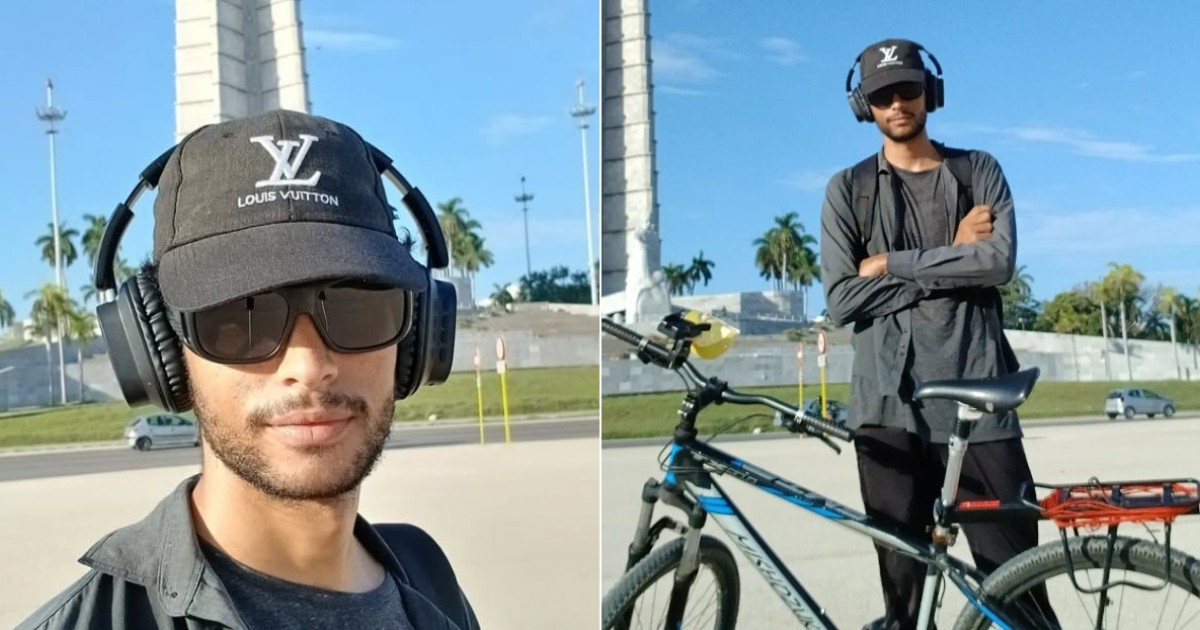
A 20-year-old Cuban youth recounted how he was intercepted by a security officer in just five minutes while taking pictures in the Plaza de la Revolución, an incident that sparked a wave of indignation among hundreds of Cubans who identified with the experience.
Rey Barranco García, an acting student, shared on that he had made a delivery near the square and decided to take some photos in front of the obelisk of the monument for his personal profile.
What followed was brief but revealing. Not five minutes had passed when an officer approached to ask him what he was doing there. His first question was: Are you a tourist or Cuban?
When he responded that he was Cuban, the officer continued the interrogation by asking if he was a student. Rey explained his situation, showed him the photos, and said that he was leaving. The matter didn't escalate, but the young man wanted to share a reflection.
"If I had given him a Colombian accent and told him I'm from Colombia, he surely would have taken more photos of me," he wrote.
His conclusion was even more bitter: "Now my duty is to learn in which places in Cuba I cannot be for being Cuban."
The comments on the post turned the anecdote into a collective catalog of exclusions. One internet user recalled that at the Capitol in Havana, "tourists could sit on the steps, but we Cubans weren't allowed."
Another person pointed out that in Tarará, Cubans from the community are treated "as if they were going to plant a bomb," and that there are similar stories in Varadero. A third individual claimed: "We feel like outsiders in our own land. The only country in the world where foreigners are treated better than nationals."
Another commentator summed it up with irony: "If he had been Colombian, he would have even offered him a rental home, cigars, rum, and everything else." And a user recalled something that many experienced: "We spent years unable to rent a hotel room, even if we had the money."
That last comment refers to a policy implemented by the Cuban regime from the early 1990s until 2008, during which island citizens were prohibited from staying in hotels and accessing tourist areas reserved for foreigners, a practice popularly known as "tourist apartheid." Raúl Castro lifted this prohibition in March 2008, although practical barriers never completely disappeared for many, as for a significant number of Cubans, access to these facilities remained prohibitive due to their high costs in relation to salaries.
Years later, the reports of discrimination against Cuban citizens have persisted, and there have been many cases reported in recent years: Cubans denied entry to the Hotel Capri, in Havana; beach umbrellas reserved "only for foreigners" in Mar Azul; a journalist expelled from the Starfish Guardalavaca hotel, in Holguín, despite having a paid reservation, and Havana hotels that only admit Cubans from Monday to Friday, reserving weekends for foreign tourists.
The case of Rey Barranco García adds a dimension that none of those episodes had, as it did not take place in a hotel or on a private beach, but in the most emblematic public space of the country, the very same place where the regime holds its parades and proclaims its slogans of equality.
Related videos:
Filed under: