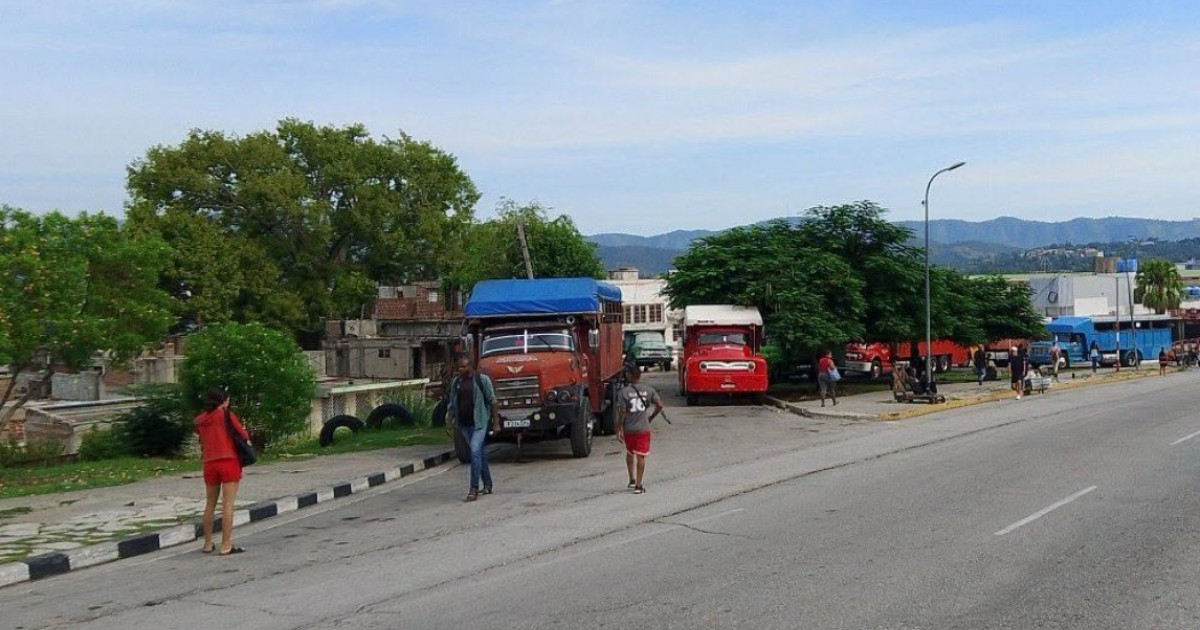
About twenty buses and private trucks are lined up to transport passengers. Despite the need to travel, most residents cannot afford it: the fares exceed one thousand pesos per trip. Meanwhile, state transportation is notably absent.
This is how the newspaper Sierra Maestra described the situation at the intermunicipal terminal on Calle 4, in Santiago de Cuba. In a post shared on Facebook, it collected complaints from several users regarding the extremely high prices of private transporters.
"I haven't found any that charge less than a thousand pesos," lamented a woman trying to travel to Palma Soriano. And although she found two or three vehicles heading to that destination, all had the same price, with no possibility of negotiation.
Another citizen reported that the fare is charged for the entire destination, regardless of how many kilometers the passenger travels. "You pay for the destination, not by segments; even if you want to go to La República —about four kilometers from the city— you have to pay whatever they ask," he explained.
Faced with the inability to pay, the man chose to walk and pointed out that the issue is not just the limited availability: "It's the astronomical fares, overcrowding, and even the mistreatment."
The post sparked a debate on social media, where most commenters pointed directly to the Cuban state as responsible for the crisis. One question was repeatedly asked: "A lot of criticism towards the private sector, but where is the state to provide competition?"
Several internet users criticized the regime. "Public transportation is the government's responsibility; they should provide buses at affordable prices and the problem would be solved," wrote one.
Another person noted a revealing paradox: "The trucks are private, but the buses are rented, meaning they belong to the government. The management carried out by the one who rents them, I believe the government could do it; but it's like a way to shirk responsibilities."
A third party defended the private operators. "That's the government's fault for not paying what the ticket is worth. The truck drivers only charge the minimum to cover maintenance and fuel costs, something that the country does not guarantee at a reduced price."
The rejection of the official narrative was explicit. "It's not the lack of oil, it's not the blockade, it's the absence of a government direction that cares for its people," wrote an internet user.
Another user condemned the state abandonment: "This is how Cuba is; they left everything in the hands of individuals, and today the government of the province of Santiago de Cuba doesn't guarantee any transportation."
The most widely shared conclusion was this: "The system is what has generated the crisis."
Passenger transportation in Cuba is going through one of its worst phases in decades, with routes halted, a shortage of fuel, and a decline in the vehicle fleet that has accumulated over the years.
State services dropped by 93% between January and September 2025, decreasing from transporting 40.2 million passengers to just 900,000, according to data from the National Office of Statistics and Information.
The Ministry of Transport implemented new cuts that came into effect on June 18, reducing frequencies of buses, trains, and ferries throughout the country.
The Prime Minister Manuel Marrero Cruz blamed the United States for the "energy blockade" as the cause of the crisis and promised that the government would continue "implementing alternatives," but the Cubans reject that narrative and directly point out the regime's management.
In Santiago de Cuba, going to work in private transportation can cost up to 5,000 pesos per month, and interprovincial trips from the city are priced between 15,000 and 35,000 pesos in the informal market.
Related videos:
Filed under: