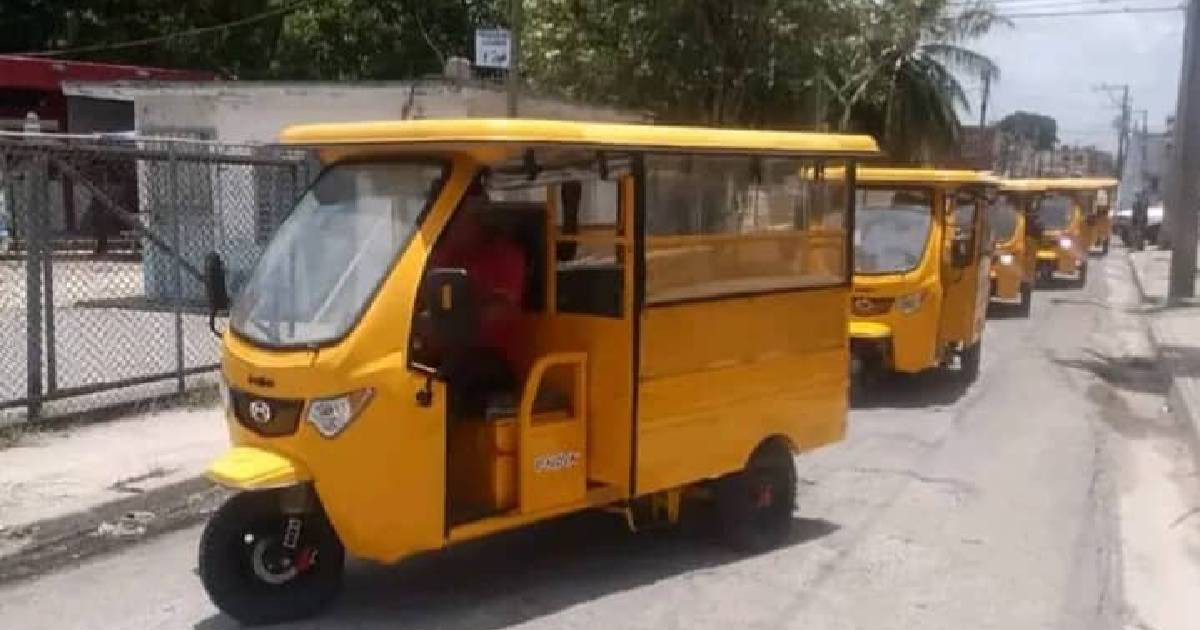
The 20 electric tricycles for passenger transportation in the city of Las Tunas have been out of service for two weeks, and there is no estimated date for their return, confirmed Alexander Osorio Peña, Operations Director of the Taxi Agency Cuba in the area.
The origin of the problem is the standstill of the charging base for these vehicles due to the lack of a component of the physical grounding system known as a suppressor, a part that has not been obtainable anywhere in the country.
Osorio explained that they managed to acquire a unit, but the installation failed, revealed the digital site Tiempo 21, from the provincial broadcaster.
"We managed to buy one, but when the specialists from Copextel went to install it, they found that it was not compatible," the official added.
The search extended nationwide without results. "Both we and the Copextel colleagues have searched all over Cuba and we couldn't find the device, which forces us to hire the services of a private company to import it and restore the activity," he added.
Importing through a private entity is, for now, the only possible way, although there is no defined timeline.
There is a second charging station, recently inaugurated, but it cannot resolve the emergency either, as it was originally designed for urban transport tricycles and later reassigned for transporting patients undergoing hemodialysis, a service to which Las Tunas incorporated 10 Dongfeng electric taxis in July.
The energy capacity limitations of that facility prevent it from taking in the load of the 20 disabled tricycles, although the executive indicated that work is being done to expand it in order to accommodate the vehicles there in the future.
The inability to find a suppressor anywhere in Cuba, a low-cost yet difficult-to-access part, highlights the logistical fragility upon which the only real urban transport available to a significant portion of the population in Tunas relies.
The paralysis hits hard in a city where public transport is at its breaking point. In recent years, electric tricycles have become the main alternative for mobility for the people of Tunera.
In March, the municipality formalized its entry into passenger transportation with fares of 50 pesos within the municipality and 10 pesos per kilometer to the borders, in addition to eight official pick-up points.
The dependence on tricycles as a substitute for the collapsed urban transport system is echoed in other provinces. In Matanzas, fares doubled overnight, reaching 300 pesos per trip, prompting the government to intervene to lower the prices following user complaints.
In Sancti Spíritus, the authorities announced that starting in August they would be stricter with tricycles operating without legalization, evidence of a system that first tolerated informal proliferation and is now trying to regulate it without addressing the infrastructure problems.
Related videos:
Filed under: