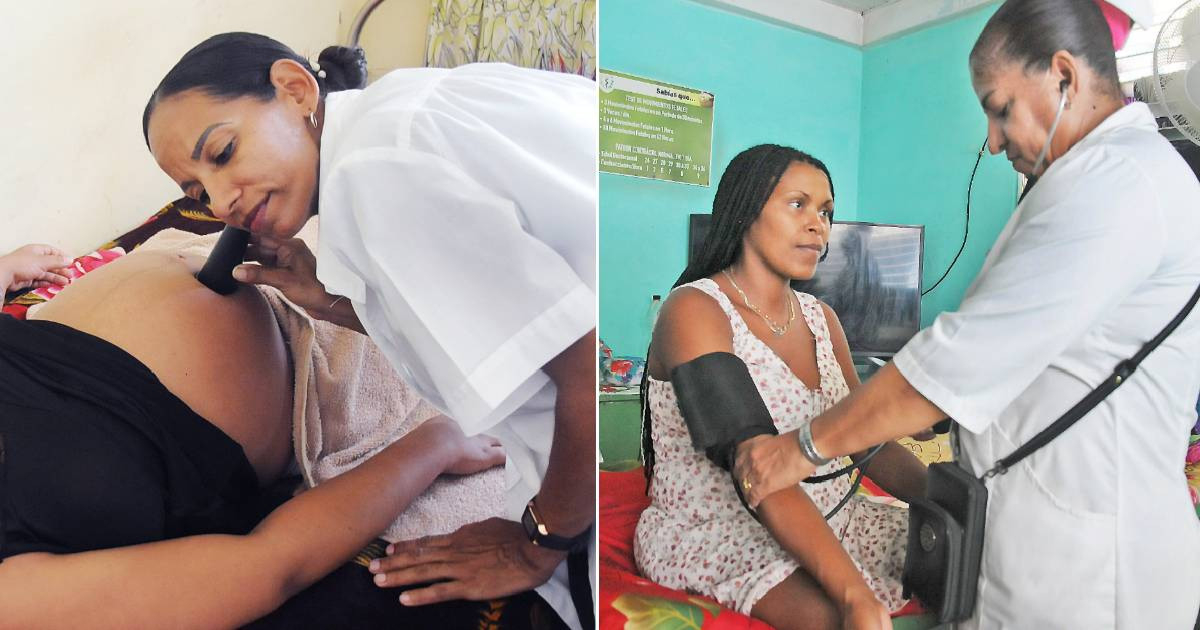
The official newspaper Venceremos presented the maternal home Captain Cristina Pérez Pérez, in the city of Guantánamo, as a comprehensive care space for pregnant women, two weeks after the province reported an infant mortality rate of 14 per 1,000 live births.
The report described the center as a place of "serenity, tranquility, and cleanliness," where expectant mothers have access to five assorted menus, visits from changüí groups, and manicure services.
The director of the institution, Dr. Yunaisi González Torres, assured that the patients have access to "all the medication treatments, reagents for their analyses, and the possibility of studies at each stage of their gestational progression."
One of the 61 pregnant women cared for at the home at the time of publication, Mercedes Milagros Borot Márquez, 24 years old, stated that "here we have a total guarantee of carrying the pregnancy to a happy conclusion."
However, the expectant mother herself contrasted her situation with the conditions faced by pregnant women outside the institution by mentioning the long lines to obtain medical appointments, the lack of medications and reagents for tests, and the high prices of so-called "mobile pharmacies," in addition to questioning the quality assurance of those products.
“Here, on the other hand, we have everything, tranquility and even greater stability in the electricity service, which rotates every four to six hours,” emphasized another expectant mother, Irislaidis Leyva Rodríguez, noting the presence of an emergency generator and solar panels.
The unfolding of these conditions occurs in a particularly delicate context for maternal and child care in Guantánamo. At the end of the first eight months of the year, the province reported 14 infant deaths for every 1,000 live births, a rate higher than the national average of 9.9 recorded in 2025, which was the highest in more than two decades.
At the beginning of September, Yoel Pérez García, the first secretary of the Communist Party in Guantánamo, demanded "immediate" measures to reverse the "unfavorable" situation of the Maternal and Child Health Program during a meeting held via audioconference.
The alarm wasn't new either. In May 2025, the province had accumulated a child mortality rate of 13.94 per 1,000 live births, nearly double the national average at that time.
The political response from the Party included a call to "encourage the protagonism and participation of the Party's members in the daily activities of health centers," without any announcement of specific material solutions in that information.
The deterioration of the indicators is part of a national health crisis. In July, Vice Prime Minister Eduardo Martínez Díaz acknowledged that health indicators had fallen to unprecedented levels and that over 100,000 people were waiting for surgery, including more than 10,000 children.
It was also noted that the survival rate of children with cancer had decreased from 85% to 65% due to the shortage of medications.
In August, South Korea and the United Nations Children's Fund (Unicef) donated 213,000 bottles of prenatal supplements intended for approximately 30,430 pregnant women in Cuba, with funding of one million dollars from the South Korean government.
International aid contrasts sharply with the self-sufficiency depicted by the official newspaper in its description of the conditions of the maternity home.
The Ministry of Public Health itself acknowledged in 2025 that Cuba was experiencing "one of the most complex moments for the Maternal and Child Care Program since its inception."
In this context, the celebration of the conditions of a specific center brings back to the forefront the gap between the official narrative on care for pregnant women and the indicators faced by the province.
Related videos:
Filed under: