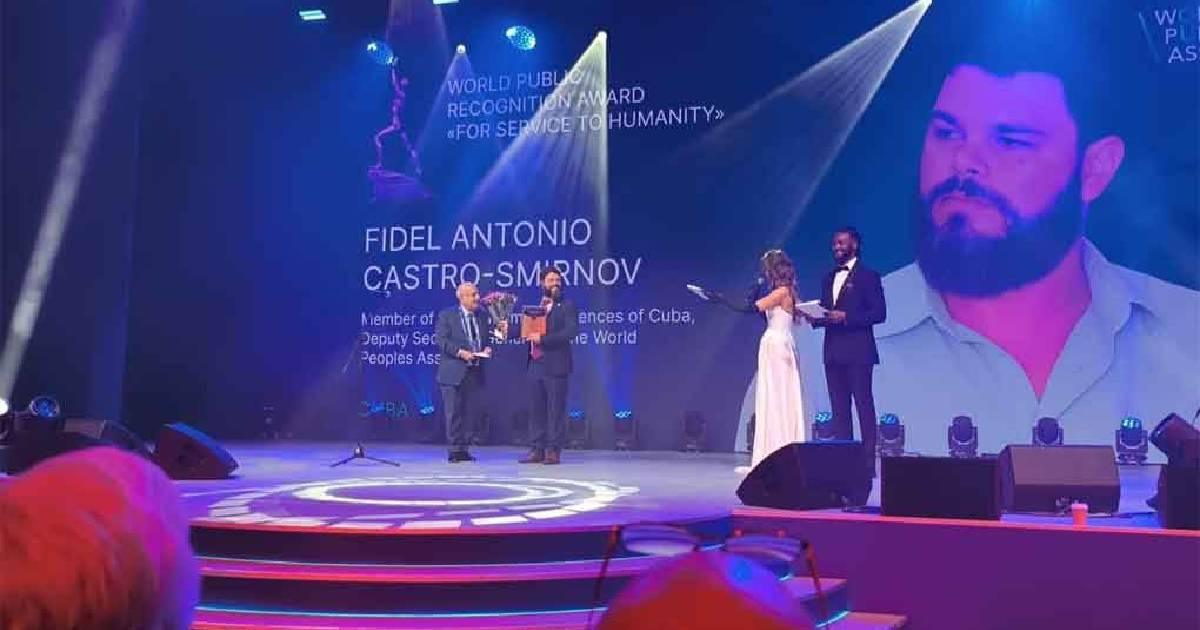
The doctor in Biology and Physical Sciences Fidel Antonio Castro Smirnov, grandson of the Cuban dictator Fidel Castro (1926-2016), received the World Public Recognition Award "In Service to Humanity" this Saturday in Moscow, as reported by the official news agency Prensa Latina.
The gala ceremony held at the World Trade Center in the Russian capital marked the closing of the Second Global Public Assembly "New World: Values that Unite," a forum that brought together more than 5,000 delegates from 150 countries over two days.
The Assembly of the Peoples of the World, an organization based in Moscow linked to Russian public diplomacy, is the entity that awarded the honor.
Castro Smirnov was one of seven international awardees. The other recipients were Ali Nasser Mohammed (Yemen), Vladimir Yakunin (Russia), Tokon Mamytov (Kyrgyzstan), Lindiwe Nonceba Sisulu (South Africa), Lisa Sotilis (Greece), and Marcos César Pontes (Brazil).
The award recognizes statesmen, scientists, and cultural figures whose careers represent, according to the organizers, an example of service to society, the strengthening of peace, and the protection of human dignity.
In his acceptance speech, Castro Smirnov linked the concept of dignity to concrete material conditions. "It takes material form in a school that opens its doors, in a hospital that can truly care for its patients, in a laboratory that can import the equipment it needs, in an electrical grid that keeps a family's lights on day and night," he stated.
In an implicit reference to the U.S. embargo against Cuba, the scientist added that "when something is denied to a people, not due to real scarcity but by the decision of others, dignity stops being a philosophical concept and becomes a concrete wound."
At the same event, Castro Smirnov was elected vice president of the World Assembly of Peoples, a position that adds to his role as a senior researcher at InSTEC (Higher Institute of Technologies and Applied Sciences) and as a scholar at the Academy of Sciences of Cuba.
René González Barrios, a retired colonel of the Revolutionary Armed Forces and director of the Fidel Castro Center, was also part of the Cuban delegation and led the high-level panel "Culture, New Media, and Social Diplomacy: Building Transparent Trust Between Peoples," the source clarified.
The award comes against the backdrop of an intense international agenda for the dictator's grandson, coinciding with the centenary of Fidel Castro's birth. In recent months, Castro Smirnov has participated in events in London, Moscow, and Gijón, Spain, where he has combined his scientific profile with the defense of the revolutionary legacy.
One of her most controversial statements was made in an interview with the broadcaster teleSUR from Birán, in the province of Holguín, where she described Fidel Castro as a "scientist" whose object of study was a nation, while also acknowledging that his "experiments often had irreversible consequences."
He also asserted that "all Cubans want to be like Fidel", a statement that was widely rejected by nationals living inside and outside the island.
These words unleashed a wave of criticism; numerous Cubans referenced the scientific metaphor to point out that, with so many experiments, "the object of study is completely destroyed", referring to the calamitous situation in the country.
Related videos:
Filed under: