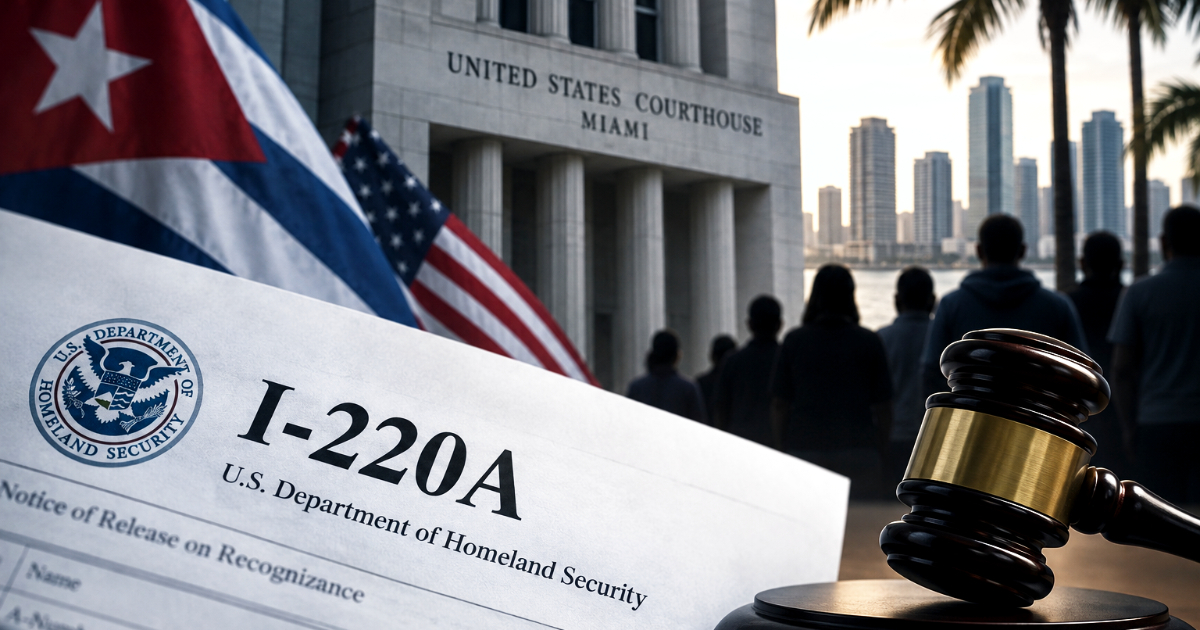
The demand of 992 Cubans with form I-220A continues to progress in a federal court in Miami, but there is still no decision that would classify that document as a parole or that would automatically pave the way to residency under the Cuban Adjustment Act.
Since federal judge Jacqueline Becerra rejected on September 10 the attempt by the U.S. Government to dismiss the case, several significant developments have occurred that provide insight into what comes next in the litigation Bello-Rubio v. Noem.
One of the main events occurred on September 18, when the lawyers for the 992 plaintiffs submitted a second amended version of the complaint.
Becerra had ordered this modification to explicitly address a matter that may be fundamental: under what authority of immigration law were these Cubans originally detained before being released with an I-220A.
The discussion is important because the plaintiffs question the way they were processed and released by the immigration authorities and seek to have those circumstances legally recognized as a parole.
The Government argues, on the contrary, that an I-220A does not equate to a parole and that the latter immigration benefit must be granted on an individual basis.
The new version of the complaint has already been filed with the court, although its full content is not freely available in the public databases consulted.
The judge is considering consolidating several cases regarding I-220A
Another significant development may impact how this legal battle unfolds.
Becerra urged the parties to express their views on the possibility of consolidating Bello-Rubio with three other related lawsuits involving Cubans who received I-220A: Morejon, Echazabal-Verdecia, and Cabrera Mollinedo.
The plaintiffs' lawyers submitted their response on September 15, and the Government did the same on the 18th. It is now up to the judge to decide what to do.
The possible consolidation of the cases does not mean that the plaintiffs have won nor that there is already a favorable decision for Cubans with I-220A. This is a procedural matter that could allow lawsuits with related legal issues to be examined together.
The government will have until October 9th
The schedule of the case has also changed.
After the hearing on September 10, Becerra had asked the Government to respond to two other important issues: the lawyers' attempt to turn the process into a class action lawsuit and the request for certain protections for the plaintiffs while the litigation continues.
The Government requested more time to respond. The plaintiffs' lawyers did not oppose the request, and Becerra granted the extension.
The new deadline is October 9, 2026. This date will be one of the upcoming important milestones in the process.
The discussion regarding the class action lawsuit is particularly interesting because the case began with 992 plaintiffs, but their attorneys are seeking for a potential decision to impact a much larger group of Cubans prosecuted under similar circumstances.
Becerra has not yet approved that request.
What does all of this mean for Cubans with I-220A?
For now, the immigration situation of Cubans with I-220A has not changed as a result of this case.
The decision on September 10 was significant because Becerra rejected the government's attempt to close the lawsuit and allowed it to continue.
But the judge still has not determined that an I-220A is equivalent to a parole, has not granted permanent residency to the 992 plaintiffs, and has not decided that all Cubans with that document are included in the process.
The legal battle continues precisely to address some of those issues.
As reported earlier by CiberCuba, the lawyers advocating for the case have urged caution and warned that even a favorable decision would not automatically mean permanent residency for all affected individuals.
Each person would also have to meet the additional requirements established by immigration legislation.
A battle that goes beyond the 992 plaintiffs
The case has generated immense interest because the discussion could have consequences beyond the individuals directly involved in the lawsuit.
The proponents of the litigation have estimated that between 500,000 and 600,000 Cubans may be in the United States in a similar immigration situation.
Furthermore, Bello-Rubio is not the only legal proceeding related to the I-220A currently taking place in Florida.
Other lawsuits are raising similar issues regarding how immigration authorities processed and released Cubans who arrived at the border.
Precisely for that reason, Becerra has proposed the possibility of combining several of those cases.
What comes next?
The next moment to watch will be October 9, when the new deadline granted to the Government to present its arguments on outstanding issues expires.
We will also have to wait for Becerra's decision regarding the potential consolidation of the four lawsuits.
Afterward, the court will need to continue examining the applicants' requests and the government's arguments before addressing the issue at the heart of this entire battle.
For thousands of Cubans with I-220A, the question remains the same: whether the circumstances under which they were detained and subsequently released can be recognized as a parole that allows them to apply for residency under the Cuban Adjustment Act.
For now, that question remains unanswered.
Related videos:
Filed under: