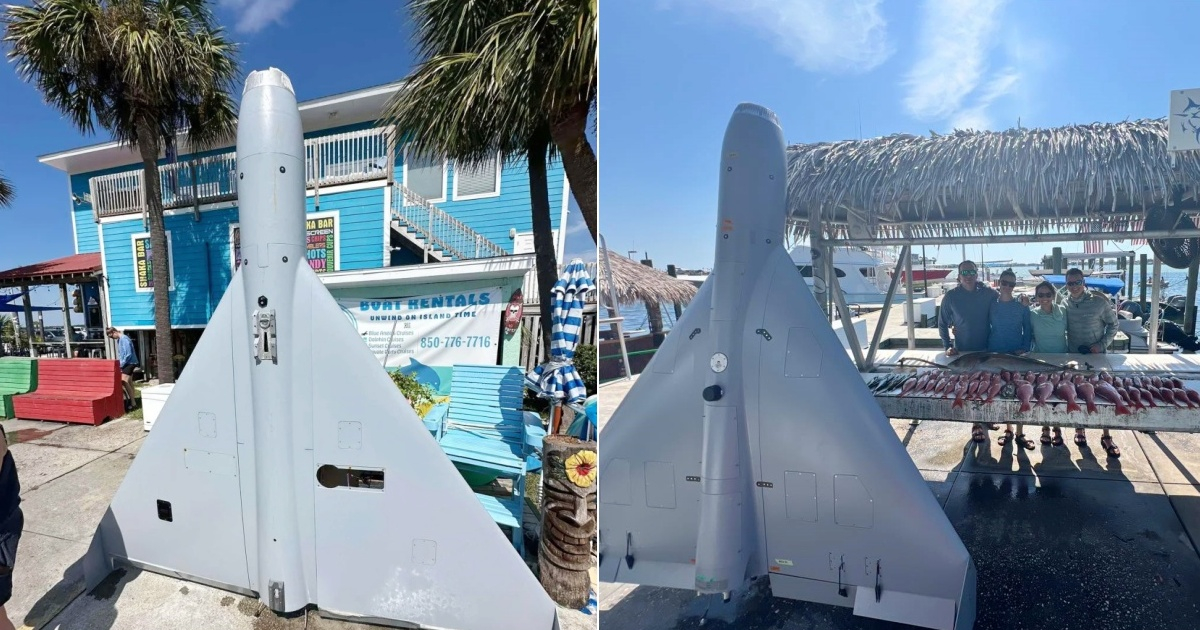
A group of fishermen from Florida encountered something very different from the usual red snapper and trout of the Gulf of America last Saturday: a military drone similar to those used by Iran, floating off the coast of Pensacola, Florida.
Captain Daniel Arsenault shared the unusual discovery with humor.
“Amazing six-hour journey today with this team! If anyone is looking for their drone, please call Hot Spots!”, wrote Hot Spots Charters on social media alongside a photo where the gray device, with its stabilizing fins visible, appeared prominently next to the catch of the day: red snappers, other fish, and squid.
Arsenault explained to CNN that the encounter was completely coincidental: “We were sailing offshore and saw it floating.”
According to aviation photographer Charlie Green's account to The War Zone, Arsenault spotted the object in the distance and decided to approach it to investigate.
Its passengers later helped it board the device. The crew tried to notify local authorities, and ultimately an agency, whose identity Green did not know, took charge of the drone.
The images showed the artifact taking up a large part of the vessel's bow and lacking the front section, the engine, and the rear propeller.
In the comments section of their Facebook post, Hot Spots Charters clarified shortly after, in the same casual tone: "The black SUV trucks came to pick up their drone, all good!"
"Isn't that about mandatory catch and release?" an internet user asked sarcastically.
What kind of drone is it?
The defense-focused site The War Zone identified the device as a possible FLM-136, belonging to the same family of systems that led to the development of the LUCAS (Low-Cost Uncrewed Combat Attack System) used by the U.S. Armed Forces and derived through reverse engineering from the design of the Iranian drone Shahed-136.
The FLM-136, manufactured by the company SpektreWorks, based in Arizona, was originally created as a target drone designed to mimic one-way attack munitions such as the Shahed-136 during drills and tests. This design later served as the foundation for the development of the LUCAS weapon.
The FLM-136 measures 2.9 meters in length, has a wingspan of 2.5 meters, and weighs approximately 32 kilograms.
The original Shahed-136 is a one-time-use loitering munition with a delta wing design and rear propeller, supplied by Iran to Russia starting in 2022, which Moscow has extensively used in Ukraine under the name Geran-2 to attack energy infrastructure and cities.
According to The War Zone, the absence of certain components is consistent with the damage that can occur when a device of this type hits the water.
The U.S. Air Force announced in late 2025 that it had developed its own clone through reverse engineering.
In February 2026, during Operation Epic Fury against Iran, the United States Central Command (CENTCOM) confirmed the first combat use of LUCAS. The War Zone indicates its operational debut on February 28, the first day of the operation.
The system is also noted for its relatively low cost. Captain Tim Hawkins of the Navy, spokesperson for CENTCOM, estimated each LUCAS platform at approximately $35,000 and described it as a cost-effective and scalable weapon compared to other American long-range strike systems.
According to CENTCOM, these drones have a wide range, can operate autonomously, and beyond the operator's visual line. Additionally, they support various launch methods, including catapults, rocket-assisted takeoff, and ground-based platforms or those mounted on vehicles.
Eglin Base and the failed test
The discovery was not a minor geographical coincidence. The Eglin Air Force Base, home to the 96th Test Wing and one of the main weapons testing centers in the U.S., is located in the northwest of Florida.
The unit is responsible for testing and evaluating weapons launched from aircraft, navigation and guidance systems, command and control systems, as well as systems linked to the Air Force Special Operations Command.
His testing ground over the Gulf is massive: it encompasses approximately 120,000 square miles (over 310,000 square kilometers) of airspace over the water, stretching from northwest Florida to the Keys.
This includes 724 square miles (approximately 1,875 square kilometers) of land with dozens of specific testing and training areas.
A spokesperson for Eglin initially confirmed to The War Zone that the base had recently lost a drone during a test, although at that time he could not confirm that it was the same device found by the fishermen.
The base later provided a much more precise detail: on September 17, three days before the discovery, a LUCAS unmanned aerial system crashed into the water during scheduled routine tests at the Eglin firing range.
The Air Force added that the aircraft had been recovered and was once again in the possession of the Department, although no further details were provided.
Losing and recovering drones in these waters is, in fact, not an exceptional occurrence. The War Zone notes that the Air Force has a small number of vessels measuring approximately 36.5 meters in length intended for recovering downed drones during live-fire exercises or devices that need to be rescued from the sea.
These vessels, operated by hired crews, retrieve around 100 drones each year.
In 2021, another remarkable incident occurred in Florida: treasure hunters found a BQM-167A, a high-performance target drone of the U.S. Air Force that had washed ashore on a beach in Palm Beach County.
From imitating the Shahed to becoming a weapon
The origin of the FLM-136 helps explain why a device from this family might have been tested at Eglin.
The model was initially conceived as an aerial target capable of reproducing the characteristics of unidirectional attack munitions, particularly the Iranian Shahed-136, to train and assess systems designed to neutralize that threat.
The experience of Ukraine and the confrontations with Iran have turned these relatively inexpensive drones into an increasing challenge for air defenses. The United States is therefore developing various capabilities against unmanned aerial systems (C-UAS).
Eglin has played a significant role in that effort. Among the technologies tested there are the laser-guided APKWS rockets used from fighters to take down drones, a program whose air-to-air tests began in 2019.
The development of LUCAS also continues towards systems capable of cooperating in swarms, a capability that requires large controlled airspaces for testing, such as those available over the waters of the Gulf.
The strategic context
The incident occurs during a time of intense activity surrounding military drones in the United States.
The president Donald Trump signed an executive order in June 2025 aimed at accelerating the development, testing, and domestic production of drones, as the U.S. government has promoted a significant expansion of the military use of these systems.
The Shahed model also has a dimension directly related to Cuba.
In July 2026, the organization United Against a Nuclear Iran (UANI) displayed a replica of the Shahed-136 in Miami to raise awareness about intelligence reports indicating that the Cuban regime may have acquired over 300 drones from Russia and Iran since 2023, sparking intense political debate in the U.S.
After that exhibition, Trump promised to take action regarding possible Iranian drones in Cuba, while analysts debated whether Havana has the real capacity to employ those systems against the United States.
Related videos:
Filed under: