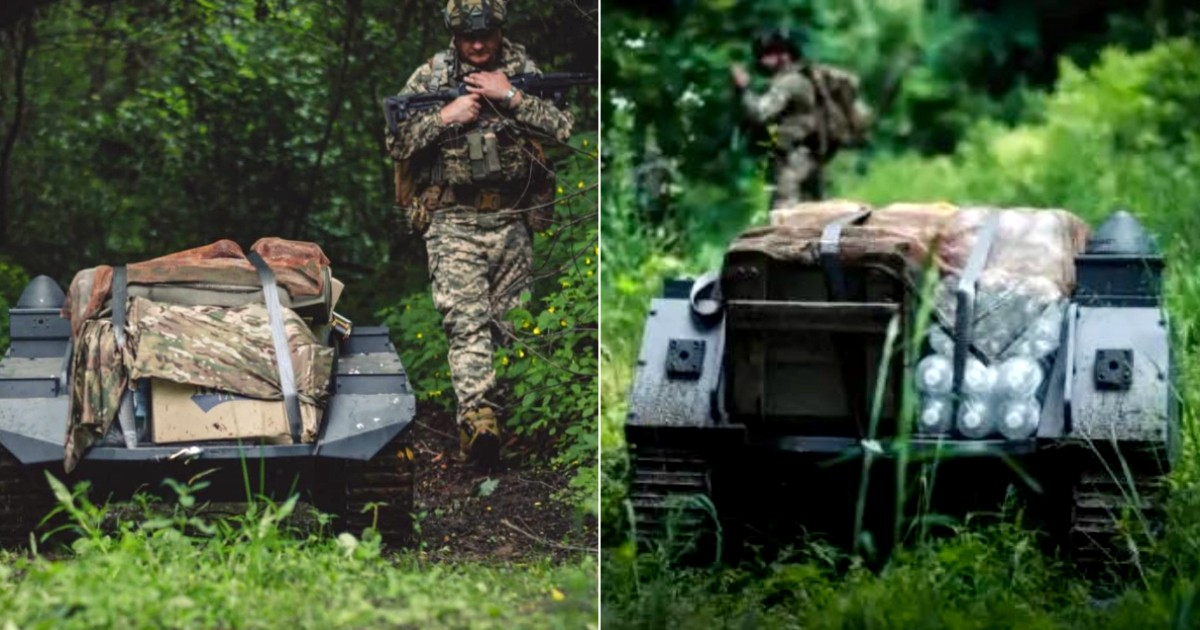
The Third Army Corps of Ukraine set an unprecedented milestone in modern warfare by deploying kamikaze ground robots behind Russian lines using heavy bomber drones, as part of Operation Vivaldi in the northern Donetsk oblast.
The commander of the corps, Lieutenant General Andrii Biletskyi, described the maneuver as a world first: «The Third Army Corps was the first in the world to start deploying ground robotic systems. Our heavy bomber drones deliver suicide ground drones over 10 kilometers behind enemy lines».
The Ukrainian outlet RBC Ukraine clarified that the aerial delivery of ground robots was not entirely new for the Ukrainian forces, but pointed out that it was “the first time that it has been used for unmanned kamikaze ground robotic systems at such a distance.”
According to the report from Newsweek, the tactic involved launching a wave of unmanned ground vehicles (UGVs) and drones ahead of the infantry, more than ten kilometers deep into the Russian tactical rear, to strike command posts, communication centers, logistics, crossings, and enemy reserves before the assault troops advanced.
While the robots sowed chaos in the Russian rear, the Ukrainian air defense and electronic warfare systems created what the Corps itself referred to as a "protective dome," which suppressed enemy drones and prevented Moscow from detecting the operational plan.
"The blinded enemy could not reveal the plan for the operation, and our units entrenched themselves at the liberated borders," the Third Corps stated in a message on Telegram.
The philosophy behind the deployment was summarized in another statement from the Corps: «Infantry wins wars, but we protect our infantry, so the robots go in first against the enemy».
This second phase of Operation Vivaldi, confirmed on Sunday, also yielded concrete territorial results: three localities northwest of Lyman—Shandryholove, Derylove, and Drobysheve—came under Ukrainian control, adding about 19 square miles that were liberated.
Biletskyi stated in over 800 Russian soldiers eliminated during this phase, with total losses—dead, injured, and captured—exceeding 3,000 personnel.
Since the beginning of Operation Vivaldi, the Institute for the Study of War (ISW) confirmed the liberation of 125 square kilometers of Ukrainian territory, of which 50 km² were vacated. Biletskyi added that his forces are simultaneously wearing down three Russian armies: the 20th, the 25th, and the First Tank.
The strategic objective of the operation, carried out during the summer of 2026, was to halt the Russian advance north of Lyman that threatened to encircle the so-called "Fortress Belt," the group of heavily fortified cities—Sloviansk, Kramatorsk, Druzhkivka, and Kostiantynivka—that form the central axis of Ukraine's defense in the Donbas.
This deployment is part of a broader trend: Ukraine has made ground robots a cornerstone of its combat doctrine, with over 22,000 missions carried out in the first three months of 2026 and the Ministry of Defense acquiring 25,000 ground robotic systems in the first half of the year.
In April, President Volodimir Zelenski had already announced that for the first time in the war, an enemy position was taken exclusively with unmanned platforms, without infantry and without our own casualties.
The military analyst Giorgi Revishvili warned, however, that Ukraine's local successes will not change the Kremlin's maximalist demands. "Consequently, there are few prospects for real negotiations, at least until next spring," he noted to Newsweek.
The retired Australian general Mick Ryan was more extensive in his assessment: "We could be nearing, or in the midst of, a shift towards a new phase of this war."
Related videos:
Filed under: