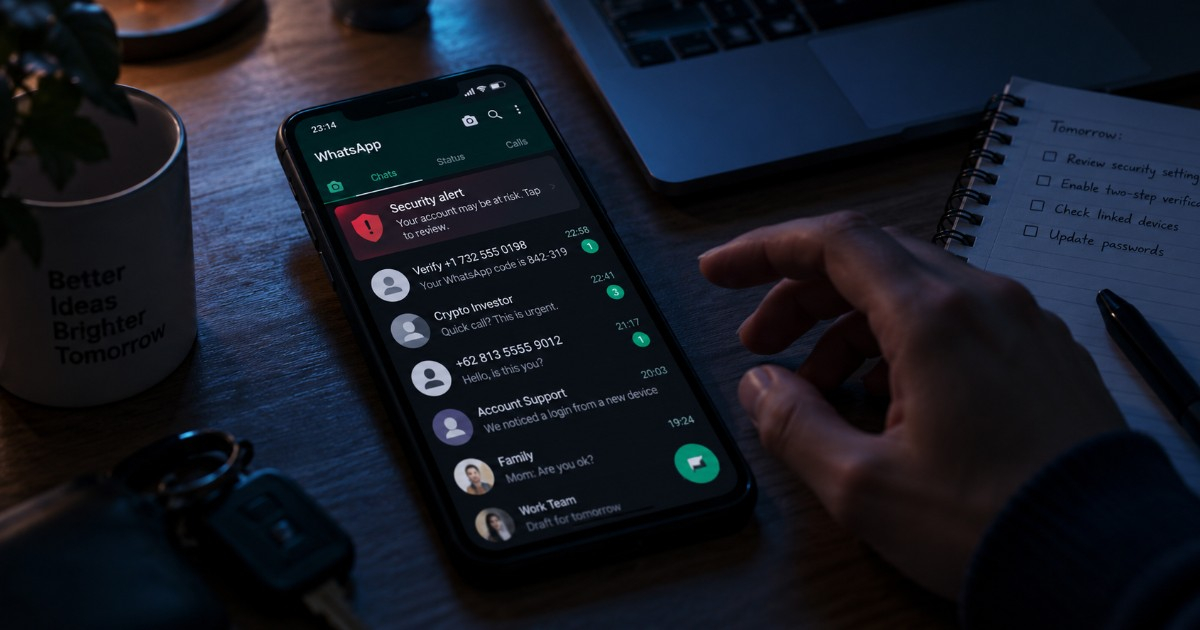
Criminals who manage to take over WhatsApp accounts are using their victims' identities to request transfers from family and friends, a scam technique known as “tarjeteo”, which authorities in Sancti Spíritus identify as one of the main forms of digital fraud currently detected in the area.
The phenomenon was addressed by the official news portal Cubadebate, based on information from the Technical Investigations Directorate (DTI) of the Ministry of the Interior and specific cases of individuals who were exposed to different variants of these scams.
The lieutenant colonel Sonlit Fernández Montiel, head of Information and Analysis of the DTI in Sancti Spíritus, stated that the procedure they are encountering most in technology-supported fraud is precisely the hijacking of WhatsApp accounts.
"The most commonly used method today, that is, in the operational mode with the use of technology, is hacking into WhatsApp accounts," he explained.
The so-called "tarjeteo" involves taking control of someone else's account and exploiting the trust that already exists between that person and their contacts.
Whoever receives a message later sees the number, the name, and the photograph of someone familiar, so they may not suspect that a scammer is behind the conversation.
One of the cases presented is that of a man identified by the fictitious name Antonio. When he tried to access WhatsApp, he discovered that he had lost access, while his contacts began receiving messages in which he was supposedly asking for money.
The false interlocutor proposed that a transfer be made and promised to subsequently deliver the equivalent in cash.
Some acquaintances trusted and sent amounts of 30,000, 40,000 pesos and other sums thinking they were helping their friend.
The authorities also described mechanisms used to gain access to accounts. One of them starts with product advertisements on social media: the victim contacts a supposed seller and ends up receiving a link presented as part of the purchasing process.
Fernández stated that some of these links can be used to compromise the application. «When you click on the link, it has a malicious program that hacks the application, and once the scammer takes over the account, they start asking for money in your name,» he affirmed.
The specialist indicated that in other cases, the victims themselves end up providing personal information or data related to their phone that facilitates unauthorized access.
In light of these operations, the main recommendation is to verify through a secondary method any unexpected request for money. A phone call, video call, or in-person check can reveal that the person writing from an apparently known account is not actually its owner.
Scams are not limited to WhatsApp hijacking. The report also describes fake sales, fraudulent currency operations, and requests for advances on products that are never delivered.
One case involved a 65-year-old woman, referred to by the fictional name Ana, who found a supposed small and medium-sized enterprise on Facebook that claimed to sell and install solar energy systems.
After contacting the alleged sellers, she received a call assuring her that the panels, batteries, and inverters were already on their way to her home and that she only needed to make the payment: about 3,000 dollars via Zelle. The woman decided to wait before transferring the money. The supposed installers never arrived, and after checking the situation, she avoided handing over the 3,000 dollars.
That type of deception related to energy equipment has appeared in other cases. In July, a man publicly exposed how an alleged scammer was trying to take over his WhatsApp account by using the sale of solar panels as bait. He recorded the conversation while the interlocutor attempted to guide him to the linked devices option in the app.
Another variant detected by the DTI simply involves advertising nonexistent motor vehicles, homes, clothing, or other products on social media and demanding an advance payment before finalizing the supposed deal.
"The alleged scammer always asks for an advance," warned Owen Hernández Rodríguez, head of the DTI agency in Sancti Spíritus.
The same principle applies to currency exchange operations: the victim transfers Cuban pesos with the expectation of receiving foreign currency afterwards, but the second part of the exchange never takes place.
Investigations have even identified a scheme that preys on the fear of family members of incarcerated individuals. The scammer calls pretending to be a prison official, fabricates a fight, misconduct, or damage to some equipment, and requests a transfer to supposedly resolve the issue.
According to the authorities, this variant was mainly detected between late 2025 and the beginning of this year.
The DTI indicated that many of those investigated for these actions are young individuals without a criminal record, but with knowledge of computer science, social media, and digital telecommunications.
Hernández also clarified that the investigated cases do not necessarily point to a single organized structure: "They are individual scammers."
Sancti Spíritus, Trinidad, Cabaiguán, and Yaguajay are among the territories in the province with the highest number of reports, although authorities assert that these crimes have been recorded in all of its municipalities.
The researchers also warned that identifying the owner of a phone line or a bank card does not always allow for determining who carried out the fraud.
Some of the media used are registered in the names of people who emigrated or even deceased individuals, which necessitates reconstructing communications and financial transactions.
Cases have multiplied throughout 2026. In August, a Cuban resident in the United States reported losing $1,900 after criminals took over a friend's WhatsApp account and impersonated her to request transfers.
In May, another victim claimed to have lost 70,000 pesos after transferring them to a compromised WhatsApp account, convinced that she was speaking with an acquaintance who would later return the cash to her.
This issue led Bandec to warn in April about types of fraud through WhatsApp that could compromise accounts and cause financial losses. Among the techniques described was getting the victim to provide codes used to register or link their account on another device.
Related videos:
Filed under: