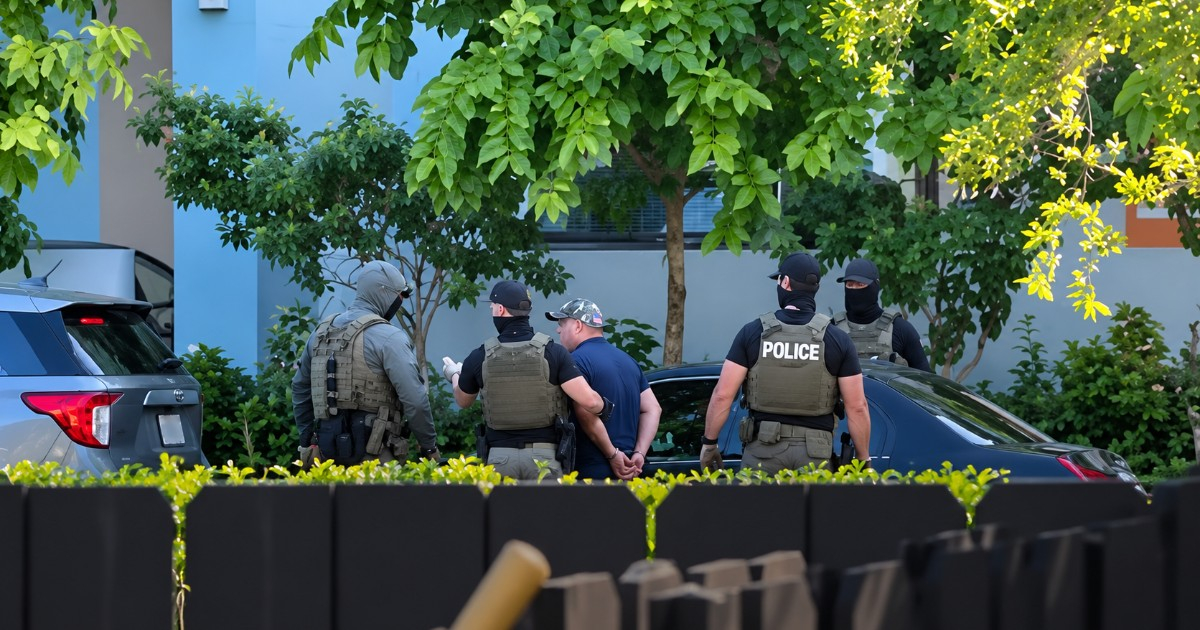
The pressure on the Doral government to end its collaboration agreement with the Immigration and Customs Enforcement (ICE) increased this Tuesday when former lawmakers, community leaders, and the mayor of South Miami gathered to demand that the city withdraw from the federal 287(g) program.
According to reported by CBS News Miami, the participants rejected the argument from Doral authorities that the city had no choice but to enter into the agreement, which grants local police departments certain collaborative functions in enforcing federal immigration laws.
The claim raised focuses specifically on the 287(g) agreement between the Doral Police and ICE, and while terminating that agreement would not prevent federal agents from conducting their own immigration operations in the city, it would indeed end the local participation outlined under that mechanism.
One of the arguments raised during the meeting was the case of South Miami, which did not sign the 287(g) agreement. Its mayor, Javier Fernández, stated that the city has not faced any repercussions from that decision.
Among those who participated was former federal representative Joe García, who launched a strong critique of the decision made by Doral: "They could have chosen to show compassion and they chose to be cruel," he stated.
The former congressman also questioned how local leaders are now trying to dissociate themselves from the consequences of the migration policy implemented in the city.
The controversy arises at a time when residents continue to report on social media the presence and operations of ICE agents in various locations in Doral, a city where approximately 70% of the population was born outside of the United States.
The mayor of Doral, Christi Fraga, has insisted that the municipal government does not have the authority to prevent ICE from enforcing federal law within the city.
However, the debate also takes place amid a growing economic and social impact attributed to the fear caused by the operations.
Businesses in Doral have reported significant drops in their sales, as employees and residents avoid leaving their homes for fear of encountering immigration agents.
One of the most notable cases is that of a restaurant that claimed to have experienced a 70% drop in its sales. Other establishments have reported losses of employees, including those with work permits and ongoing immigration processes.
Fraga has publicly acknowledged that there is "a lot of fear" among parts of the community, although he has pointed out that the Doral Police do not lead the federal raids and that the city does not receive prior notification about when and where ICE will conduct its operations.
Concern about the consequences of the arrests has also sparked private assistance initiatives.
This week, for example, activist Carlos Eduardo Espina contributed $50,000 to establish an emergency fund for families in Doral who have lost their primary breadwinner due to an ICE detention or deportation.
The fund, managed by LULAC, offers up to $1,000 per household to cover basic needs such as rent, food, utilities, and childcare.
El acuerdo 287(g) de Doral con ICE es solo uno de los muchos frentes del debate migratorio en Estados Unidos. Sigue toda la actualidad sobre políticas, deportaciones y derechos en nuestra sección de
Related videos:
Filed under: