The independent American outlet Belly of the Beast published an extensive investigation on the failed armed operation of February 25, in which ten men departed from the Florida Keys with weapons and tactical gear with the aim of landing in Cuba, promoting an uprising, and inciting U.S. intervention.
The report, authored by journalist Reed Lindsay and published in collaboration with Drop Site News and Miami New Times, reconstructs the preparation for the operation, the confrontation with the Border Guard Troops, and its consequences based on documents, evidence collected by Cuban authorities, and interviews with family members, individuals connected to the group, and four of the five survivors who remain incarcerated on the island.
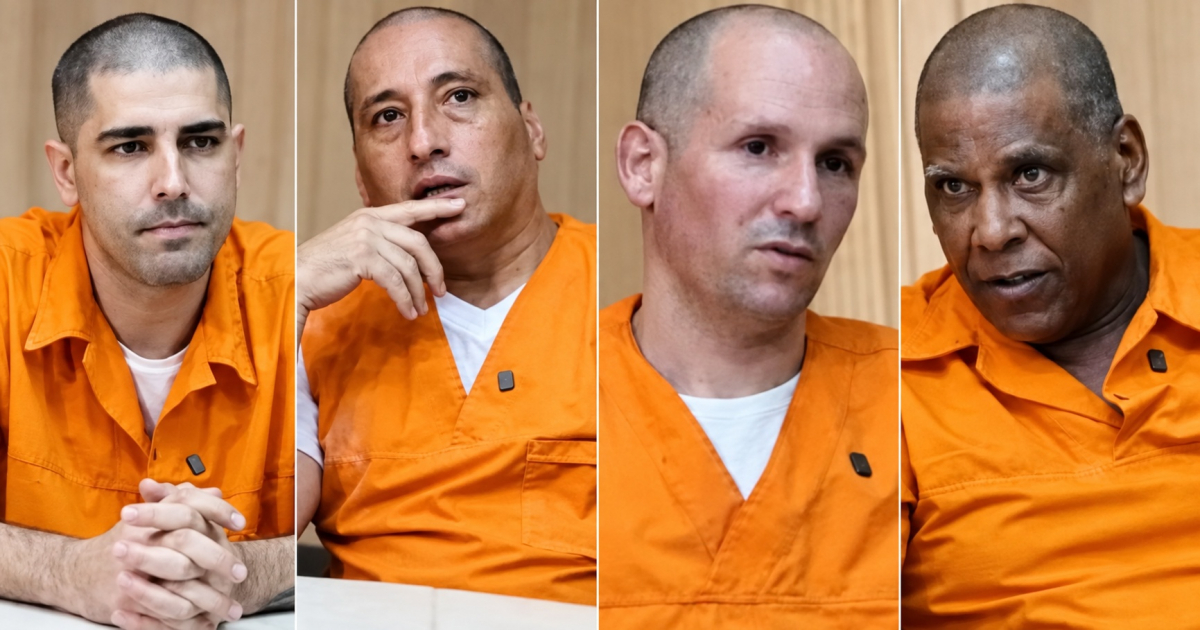
The testimonies of José Manuel Rodríguez Castelló, Christian Ernesto Acosta Guevara, Leordán Enrique Cruz Gómez, and Conrado Galindo Sariol represent, according to the media, the first public account of the operation provided by its own participants.
The interviews reveal four different viewpoints regarding an operation that resulted in five deaths and the incarceration of the five survivors.
- Conrado Galindo Sariol asserts that he never wanted to participate.
- Christian Ernesto Acosta Guevara regrets and describes the mission as "madness."
- Leordán Enrique Cruz Gómez continues to advocate for political change in Cuba, but acknowledges the naivety and shortcomings of the operation.
- José Manuel Rodríguez Castelló maintains almost intact the determination that, according to his account, led him months earlier to respond to a call on TikTok.
Four detainees interviewed under the custody of the MININT
The interviews took place in July in a conference room of a facility belonging to the Department of International Relations of the Ministry of the Interior (MININT) in Havana.
The four men were transported wearing orange uniforms and handcuffed. The individual conversations lasted between 30 and 55 minutes and took place without their lawyers, but in the presence of Edward Robert Campbell, the prosecutor of the case, and Colonel Francisco Estrada Portales, who is responsible for the MININT investigations into crimes against State Security.
The detainees stated that they voluntarily agreed to the interviews and assured that they did not receive any promises in return.
Belly of the Beast warns, however, that it could not independently verify those claims and did not have the opportunity to conduct follow-up interviews. These circumstances represent a significant limitation when assessing the testimonies gathered under the custody of Cuban authorities.
The access of detainees to legal representation has also been unequal.
Rodríguez said he had not yet found a lawyer willing to take on his case; Cruz claimed he had not requested one; Acosta stated he had met several times with his lawyer; and Galindo had legal representation since March, according to his wife.
The fifth survivor, Amijail Sánchez González, was not interviewed. The outlet notes that it could not determine whether he refused to participate or if the Cuban authorities did not allow him to do so.
Despite the circumstances under which the interviews were conducted, the journalists report that some detainees openly criticized the Cuban government and alleged mistreatment.
The objective: To provoke a rebellion and request an intervention from the United States
One of the most explicit testimonies is that of José Manuel Rodríguez Castelló, a 33-year-old truck driver residing in Nashville, Tennessee.
Rodríguez mentioned that he got in touch with Raúl Quevedo, who is in charge of the account "La Nueva Cuba," through TikTok.
“They were looking for people who had the courage to join an armed uprising in Cuba,” he explained.
According to Rodríguez, the ultimate purpose of the mission was clearly defined:
"The action plan was straightforward: to provoke the Cuban people to rise up with arms, take control of a province for 72 hours, and request military intervention from the U.S. government."
The testimony of Leordán Enrique Cruz Gómez provides more details.
According to their account, they intended to take a police station in Cárdenas, Matanzas, and try to get the population to take to the streets. Cuban authorities maintain a slightly different version: that the target was a police station in Santa Marta and the nearby border guard unit in Varadero.
Cruz acknowledged the enormous disparity between their aspirations and the resources available to them.
“It is illogical to think that ten men could declare war on a country. It would be absurd,” he stated.
"But we were aware of the social discontent. We knew that people wanted something to happen. Perhaps a spark," he added.
Cruz explained that the images of the crisis he was seeing from the United States helped convince him to take action.
"It had become almost unbearable. There was a constant bombardment on social media. Everything we saw: mothers with children searching for food in the trash, buildings collapsing, all those crises. Perhaps that made the situation feel more serious," he pointed out.
Recruitment through social media and training in Florida
Christian Ernesto Acosta Guevara, the owner of a moving company in Austin, Texas, also joined the group via TikTok.
Acosta got in touch with Pavel Alling Peña, who had created the "Movimiento Cardumen" account in May 2025.
"I wrote a comment expressing my wish for Cuba to prosper and become more liberal. It was then that he contacted me," he recalled. "He asked me if I wanted a free Cuba. I told him yes, and I hoped it would happen someday."
Later, Alling told him about people who were preparing for a "military intervention" in Cuba.
"He asked me if I was willing to join them, and I told him it wasn't a problem, just let me know where," Acosta recounted. "He replied, 'Come to my house, and I'll take you with me.'"
The men began to gather and train at a farm in LaBelle, near Fort Myers.
Acosta, Rodríguez, and Cruz stated that they practiced there during the months leading up to the operation.
The four interviewees linked the property to Maritza Lugo Fernández, Cuban exiled activist and leader of the 30th of November Party.
Lugo acknowledged having accessed the estate and allowing Sánchez González to use it, with whom he had a romantic relationship, but he denies having organized or financed the operation.
Rodríguez assured that the members personally purchased their material.
“Nobody paid us anything,” he stated. “We self-financed. We bought our own bullets, our own rifles, our own military equipment,” he added.
About Lugo, Rodríguez stated that he was frequently at the farm and assisted with logistical matters, but insisted that he did not take part in the planning of the incursion or in acquiring the weapons.
Lugo rejects the Cuban government's accusations that she was the intellectual author.
"The Castro regime has constantly accused me: of being a terrorist, of financing things," he stated. "What could I possibly finance? I live on Social Security. I receive 700 dollars a month, which is not enough for anything. I try to save. I do odd jobs. My family helps me if I need anything extra. But I have no money to finance absolutely anything."
He also described the operation as reckless.
"They are very good people who did something outrageous," he said. "They went far beyond the bounds of normalcy, because what they did was pure madness. Who in their right mind could think that ten men could accomplish anything against a dictatorship like that?"
"It wasn't the right time. It wasn't the right organization."
Raúl Quevedo, who was in contact with several members of the group but did not participate in the trip, refused to explain to the media what his exact relationship with them had been.
"I have nothing to say about it," he replied. "The more you talk, the more your enemy will know about you."
Quevedo considered it "feasible" to overthrow the Cuban government if sufficient resources are available, but he was very critical of the operation undertaken by the ten men.
“It was not the right time. It was not the right organization. It was disorganized,” he stated.
"For something like this, you need to have a plan, a structure, a plan B and a plan C, and an escape plan. If you don't have that, even with just ten people, you're lost. And it's a shame because they were good people," he added.
Two vessels, 25 firearms, and approximately 13,000 cartridges
The ten men set sail from Marathon in the Florida Keys after sunset on February 24.
According to Cuban authorities, they were carrying 25 firearms —14 long guns and 11 pistols— around 13,000 ammunition rounds, more than 100 magazines, homemade bombs, Molotov cocktails, bulletproof vests, uniforms, helmets, knives, night vision equipment, a drone, a Starlink terminal, and medical supplies.
Initially, they traveled on two vessels. One of them suffered a malfunction during the journey, so they transferred the weapons and equipment to El Tornado, a 24-foot Pro-Line vessel registered in Florida with the number FL7726SH.
The breakdown delayed the journey and frustrated the purpose of getting closer to Cuba during the night.
“We knew that if the daylight caught up with us, there was a possibility that they would see us,” Cruz admitted.
The Tornado ended up running aground in shallow waters while trying to hide near a small islet.
It was then that the Cuban vessel appeared.
The survivors admit that the first shot came from their boat
One of the most significant details from the report is that the four survivors interviewed agreed that the first shot in the confrontation came from El Tornado.
Rodríguez, who maintained an openly critical stance towards the Cuban government during the interview, explicitly acknowledged it: “One of us fired first. I have to admit it.”
Rodríguez, Cruz, and Galindo stated that they do not know who fired that shot.
Acosta, on the other hand, directly pointed to Amijail Sánchez González.
“Amijail grabbed a magazine for the Chinese-made AK-47 he had and opened fire on the Border Guards. That was when the shooting began. I don’t know exactly what happened because at that moment I got scared and threw myself to the floor of the boat so that I wouldn’t get hit by the gunfire,” he recounted.
Acosta also described the difference between the training sessions conducted in Florida and being in an actual fight.
“At that moment, the only thing that came to my mind was to leave the weapon by my side and lie down in the boat,” he said. “I got scared. I always used to say on the farm that shooting at a target, at a bullseye, is not the same as facing real people who are shooting at you.”
Cruz presented an equally chaotic picture of those moments.
"We were throwing up [from the nausea]," he recalled. "We were wet, cold, and exhausted. It prevented us from thinking clearly. It paralyzed us."
According to Cruz, when he finally managed to get a rifle, he was shot.
Five dead during and after the confrontation
In the exchange of gunfire, Ledián Padrón Guevara, Héctor Duani Cruz Correa, and Pavel Alling Peña died aboard El Tornado.
Michel Ortega Casanova died during the evacuation, and Roberto Álvarez Ávila passed away on March 4 due to complications arising from his injuries.
Nine of the ten members of the expedition were shot. On the Cuban side, the captain of the border guard vessel was shot in the abdomen.
Cuban investigators recorded 23 bullet impacts on El Tornado and 14 on the Cuban patrol boat.
According to witnesses, the confrontation ended when Cruz raised an arm in a gesture of surrender.
Galindo stated that one of the border guards continued shooting and that it was the wounded Cuban captain himself who ordered to stop firing.
"The captain shouted at him, he shouted loudly," Galindo assured. "If the captain had let him continue, he would have killed us all."
As the months went by, Cruz acknowledged the shortcomings of the operation.
"Perhaps the idea was somewhat naive because we hadn't prepared for all possible situations," he admitted. "We weren't prepared to confront the Cuban border guards," he added.
Rodríguez agreed on that point: “We had no training to confront the Cuban Coast Guard.”
The different version of Conrado Galindo
The account of Conrado Galindo Sariol, a 59-year-old permanent resident of Miami, differs significantly from those of others.
Galindo claims that he was initially hired for $500 to record and edit videos of the training at the farm and that he did not intend to travel to Cuba.
According to his version, Lugo later communicated to him: “There is a change of plans. You are going to Cuba.”
Galindo claims that he protested and that Lugo and Roberto Álvarez Ávila threatened him, in addition to taking his phone and residency card.
Lugo completely denies this version and claims that the statements made by the detainees were obtained under coercion.
"Everything they say is a lie, and I don't blame them," he stated. "What are they supposed to say? They want to save their lives, and they are being forced to say those things."
Reports of mistreatment while in custody
After the confrontation, the survivors were taken to the Arnaldo Milián Castro Provincial Hospital in Santa Clara.
Cruz had to undergo surgery for a bullet wound that damaged his radial nerve and caused significant bleeding. He was later subjected to a second procedure at a military hospital in Havana.
Cruz described the medical care received as "very professional and humane."
They were later transferred to Villa Marista and subsequently to a maximum-security section of Combinado del Este.
Galindo stated that he received kicks to his legs on the day he arrived at prison. Rodríguez claimed that he was threatened and that a Border Guard agent intentionally stepped on his injured leg shortly after the shooting.
However, the report introduces an important nuance: Rodríguez, Acosta, and Cruz stated that they did not suffer any other physical harm or torture during their detention.
The situation reported in the case of Amijail Sánchez González is more serious.
Lugo stated that Sánchez's relatives in Cuba informed him that he had been repeatedly beaten, that he lost hearing in one ear, and that he sustained injuries to an arm and ribs.
Cuban authorities deny that Sánchez suffered physical mistreatment during his detention.
In June, family members and activists had already reported isolation, threats, and psychological pressure against those detained.
Six people remain imprisoned
The five survivors —Rodríguez Castelló, Acosta Guevara, Cruz Gómez, Galindo Sariol, and Sánchez González— remain in provisional custody.
Duniel Hernández Santos is also in custody, identified by Cuban authorities as the alleged contact on land who was to assist the group after their landing.
In total, at least six people remain incarcerated in connection with the case.
According to prosecutor Edward Robert Campbell, cited in the report, the charges could result in up to 30 years in prison or even the death penalty, although Cuba has not carried out an execution since 2003.
Campbell also noted that the Prosecutor's Office was considering the possibility of prosecuting Maritza Lugo in absentia. The trial still does not have a confirmed date.
The FBI traveled to Cuba to investigate the case
The report also provides new details about the U.S. investigation.
According to Cuban authorities, on March 31, a delegation from the FBI traveled to Cuba and stayed for two and a half days receiving information about the case.
The agents, accompanied by U.S. representatives, inspected El Tornado and the Cuban patrol vessel involved in the confrontation. They also held brief meetings with the detainees and collected their fingerprints and DNA samples.
Cuban authorities claim that they requested information from Washington about how the expedition was organized and funded from U.S. territory.
The U.S. Coast Guard declined to respond to the media regarding El Tornado and referred the questions to the State Department. The State Department, in turn, referred them to the FBI, which sent them back to the State Department.
"It was madness": Regret after the failure
The statements made months after the operation reveal deep differences among the survivors.
Christian Acosta is the one who expresses the most explicit remorse. He described the operation as "insanity" and issued a warning to other Cubans who might consider similar actions.
"The advice I would give to other Cubans is to stop consuming so much garbage [on social media]. Keep your jobs and don't come to Cuba to do anything, because it won't end well," he stated. "The Cuban people and the armed forces are well-trained to prevent an intervention."
Cruz maintains his desire for political change in Cuba, but questions the way it was attempted and acknowledges that an armed operation would require many more resources.
"I am convinced that everyone in Cuba wants change," he said. "We still face many of the same problems we encountered in the 1950s, and those issues will inevitably lead to revolutionary movements fighting for a just cause."
Rodríguez Castelló, on the other hand, did not express any remorse for having participated.
He expressed his sorrow for the deaths of his companions, the suffering caused to their families, and "having failed all those Cubans who long for a free Cuba," but he continued to defend the necessity of ending the Cuban political system.
His most emphatic statement came when he referred to the possibility of the United States offering fuel to Cuba in exchange for its release.
“If they told me they would send a tanker to Cuba in exchange for José Manuel’s release, I would prefer to rot in prison rather than let a single drop of oil enter this country,” he said, referring to himself.
Related videos:
Filed under: