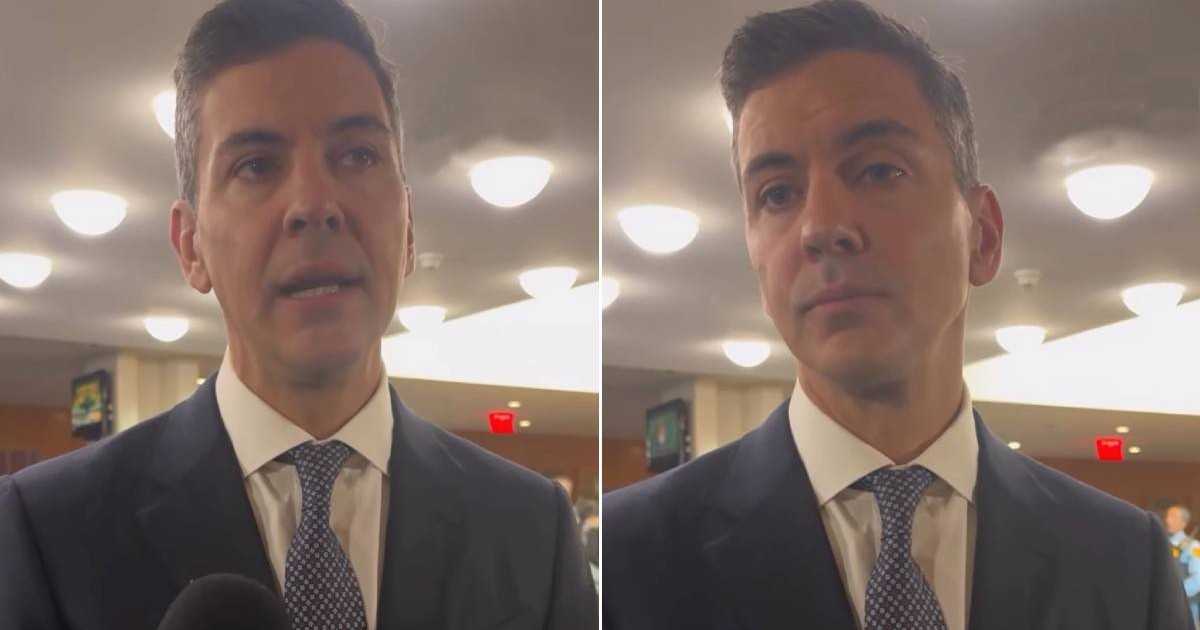
The president of Paraguay, Santiago Peña, called this Wednesday for a “democratic transition” for Cuba, Venezuela, Nicaragua, and Haiti on the sidelines of the UN General Assembly in New York, in an interview with Martí Noticias where he also defended his recent visit to Caracas.
"What we want for Venezuela, which is this democratic transition, is the same as what we want for Nicaragua, the same as what we want for Cuba, and the same as what we want for Haiti, which are countries that have unfortunately been suffering for a long time," the president stated.
Peña emphasized that Paraguay does not intend to be a passive spectator in the face of these crises: "Paraguay wants to take an active role and not be a mere observer."
The Paraguayan president supported his offer of mediation based on his country's own experience, which lived under the dictatorship of Alfredo Stroessner for 35 years, until 1989. "We believe that today there is an opportunity to carry out a transition. Paraguay experienced this 35 years ago, after a 35-year dictatorship, and we believe that we have the commitment, the tools, the experience, the knowledge, and the will to help the Venezuelan people," he declared.
The statements come days after Peña traveled to Caracas on September 19 to meet with the acting president of Venezuela, Delcy Rodríguez, at the Miraflores Palace, marking the first high-level meeting between both countries after nearly 20 months of diplomatic break.
Peña defended his trip to Caracas and asserted that he did not go to "validate a regime," but to take a "second step" toward a political solution that would allow for Venezuela's reintegration into the international community and Mercosur. After the meeting, the foreign ministers of both countries signed a joint statement to advance the normalization of bilateral relations.
The leader also spoke out about the case of María Corina Machado, the Venezuelan opposition leader who has been blocked from returning to her country for months.
On Tuesday, she attempted to return three times in less than 24 hours from Panama—once by sea and twice by air—without success, according to her team. This adds up to at least seven failed attempts to return to Venezuela since June 2026.
"There are fundamental elements. One is, of course, the release of all political prisoners, the opening of borders to allow for return, including the case of María Corina," Peña demanded.
Regarding the celebration of elections in Venezuela, the Paraguayan president was categorical: "The call for elections is a very, very important step." He noted that the specific date depends on the internal dialogue within the Venezuelan National Assembly between the government and the opposition parties.
Paraguay has consistently maintained a critical stance toward the regimes of Cuba, Venezuela, and Nicaragua in international forums.
Voted against the annual resolution on the U.S. embargo against Cuba in October 2025 and cast that same vote in the extraordinary UN session in July 2026, alongside the United States, Argentina, and Israel, among other countries.
"It is important to understand that this will be a complex process, where wounds are still open, and we believe, I firmly believe, that there is a path forward and we must advance on that path," concluded Peña, who also called in his speech before the General Assembly for the next Secretary-General of the UN to come from Latin America and the Caribbean.
Related videos:
Filed under: