
Related videos:
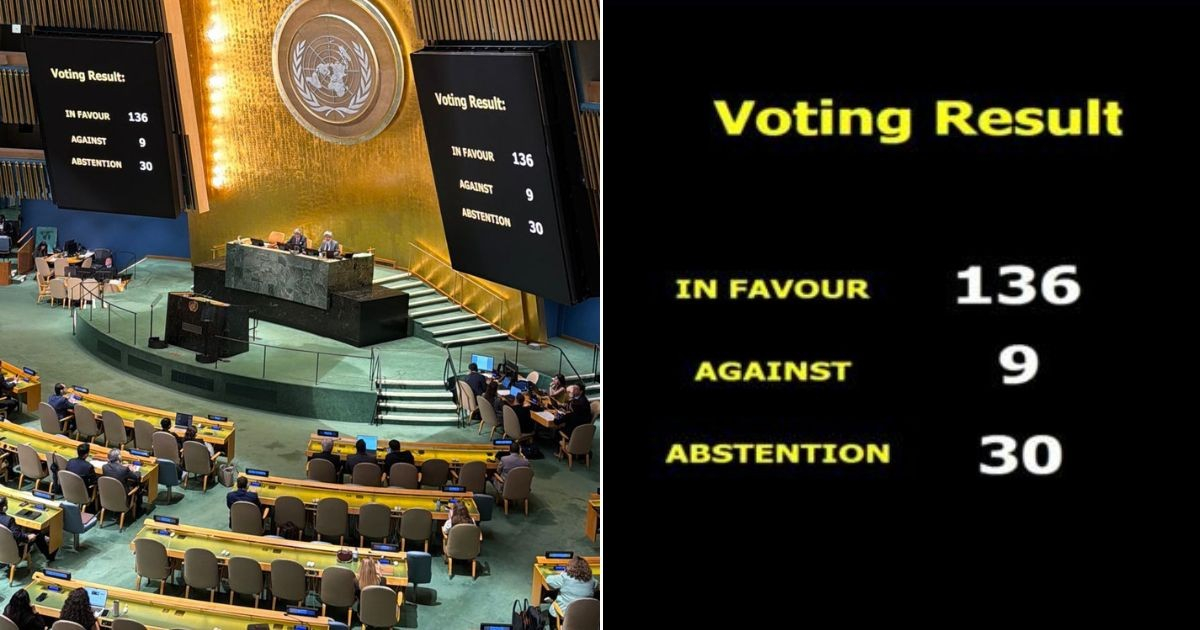
The United Nations General Assembly approved this Tuesday the opening of an urgent debate requested by the Cuban regime regarding the U.S. embargo, with 136 votes in favor, nine against, and 30 abstentions.
This is the first time Cuba has resorted to this extraordinary mechanism, distinct from the annual vote held every October.
The vote neither lifts nor modifies the embargo; it only authorizes the holding of a debate under Agenda Item 38 of the UN agenda, titled "The necessity of ending the economic, commercial, and financial blockade imposed by the United States of America against Cuba."
The nine countries that refused to open the debate were United States, Argentina, Costa Rica, Israel, Morocco, Czech Republic, North Macedonia, Paraguay, and Ukraine.
Before the vote, the American delegate attempted to halt the process with an intervention that, according to the Cuban delegation, exceeded the procedural nature of the session.
The chancellor Bruno Rodríguez Parrilla, who led the delegation of the Havana regime, raised three points of order and accused the presidency of the Assembly of failing to call the representative from Washington to order.
"I am surprised that the presidency of the Assembly has not called the delegate from the United States of America to order, who is making a substantive intervention that in no way has a procedural nature," Rodríguez Parrilla pointed out from the podium during yet another circus act.
The diplomatic context leading up to the debate was characterized by intense pressure from Washington.
According to a leaked cable signed by Secretary of State Marco Rubio and published by The Nation on July 2, the Department of State instructed its embassies to pressure governments around the world and block the opening of the debate, categorizing countries into three groups with differentiated guidelines.
Despite this pressure, the result was favorable for the Cuban regime, although the support from 136 nations is noticeably lower than the 165 votes Cuba received in the annual vote of October 2025, the worst record in over three decades, reflecting the partial effect of the U.S. diplomatic campaign.
The regime seized the outcome to project a narrative of international victimhood.
Miguel Díaz-Canel stated on X that "each vote demonstrates a sense of justice and courage, overcoming strong pressures from the previous days, and the blatant lies of the U.S. delegate to sabotage it."
What the Cuban leader omitted is that Havana has accumulated over 30 consecutive favorable votes in the UN without implementing any structural reforms or improving the human rights situation on the island, where the energy crisis, food scarcity, and political repression remain the daily reality for millions of Cubans.
The U.S. claims to have offered 100 million dollars in humanitarian aid to Cuba, the distribution of which, according to Washington, has been hindered by the Cuban authorities themselves by requiring that the funds pass through independent channels such as non-governmental organizations and churches.
Filed under: