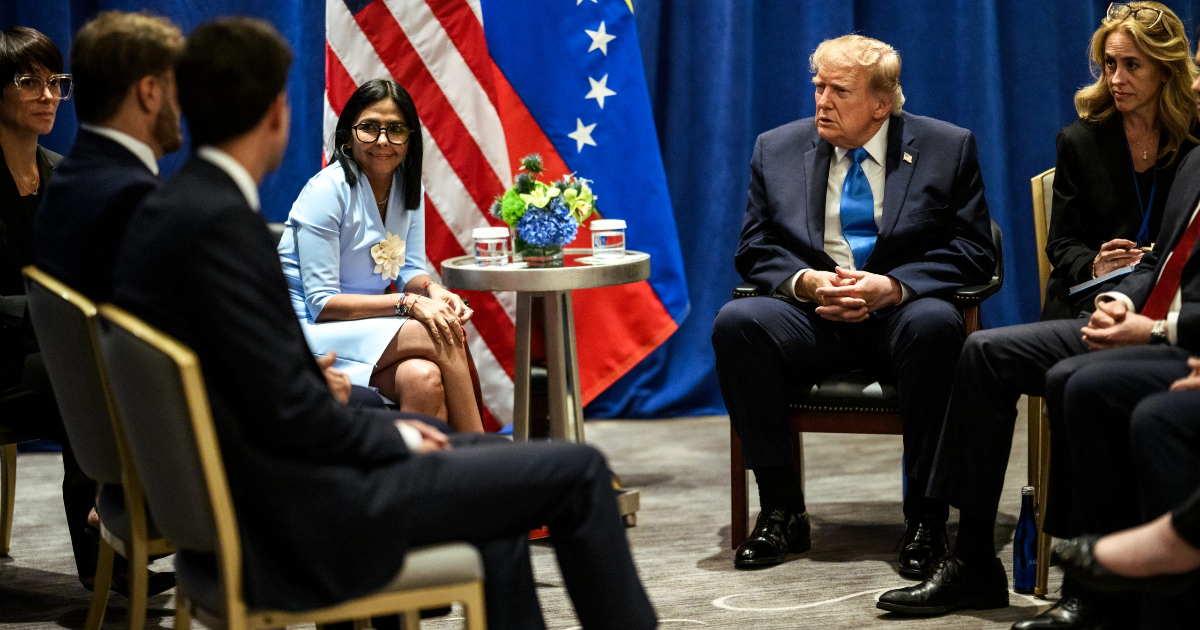
A survey conducted before the meeting between President Donald Trump and Interim President Delcy Rodríguez indicated that 91% of the Venezuelans surveyed opposed that meeting, which ultimately took place this Wednesday in New York alongside the UN General Assembly.
The survey, conducted by the Venezuelan firm Meganálisis between September 15 and 19 and published by El Nuevo Herald, questioned 1,627 adults across Venezuela. 91% disapproved of the meeting, compared to 4% who supported it and 5% who were unsure of their response.
The rejection indicated by the survey was not limited to the meeting. Ninety-four percent of respondents stated that they would not feel represented by Rodríguez at the UN General Assembly, while only three percent replied affirmatively.
The meeting between Trump and Rodríguez took place on Wednesday at the Lotte New York Palace Hotel and lasted approximately 15 minutes. It was the first in-person contact between a U.S. president and a Venezuelan leader in more than eleven years.
Rodríguez described the meeting as "historic" and stated that issues related to energy, mining, and security were discussed during the conversation.
On his part, the U.S. Secretary of State, Marco Rubio, indicated that among the main issues discussed were the restructuring of Venezuela's sovereign debt, economic stabilization and a transition to free elections.
The State Department clarified, through its spokesperson Natalia Molano, that the meeting does not imply recognition of legitimacy for the chavista government and that “Washington's strategy has not changed.”
The survey also revealed a wide rejection of the controversial oil agreement signed on August 28 between Washington and Caracas, presented by Trump as “the largest oil agreement in history.” The pact entails the development over 25 years of 17 strategic fields with proven reserves of approximately 65 billion barrels.
According to Meganálisis, 80% of respondents did not support that agreement, compared to 13% who expressed support.
A previous survey by the same firm, conducted in late August with 1,129 adults through telephone interviews, also recorded a significant drop in Trump's approval among the Venezuelans surveyed.
According to that study, his approval rating fell from 92% in January, following the capture of Nicolás Maduro, to 21% by the end of August, while disapproval increased from 6% to 69% during the same period.
Seventy percent of the participants in that survey believed that Trump captured Maduro "to take over the country's oil," while 9% responded that he did it "to free the Venezuelans."
The results of Meganálisis also reflect a strong demand for political change in Venezuela. Eighty-eight percent rated the departure of Chavismo from power as "very urgent," and seventy-nine percent prioritized the holding of presidential elections over any other electoral process.
In a hypothetical electoral scenario presented by the polling company, María Corina Machado received 61% of the voting intention, compared to the 3% obtained by Rodríguez.
Machado had previously warned that the oil agreement between the United States and Venezuela should be signed with "a serious and democratic government." The opposition leader also pointed out that, technically, it would take about 40 weeks from the appointment of a new National Electoral Council to organize the elections.
After meeting with Trump, Rodríguez assured the UN General Assembly that "there will be elections in Venezuela", although she did not announce a date or provide a specific electoral calendar.
The data from Meganálisis provide a snapshot of public opinion prior to the meeting in New York: they show a strong rejection of both the meeting and Rodríguez’s representation at the UN, as well as the oil agreement reached between Washington and Caracas.
Related videos:
Filed under: