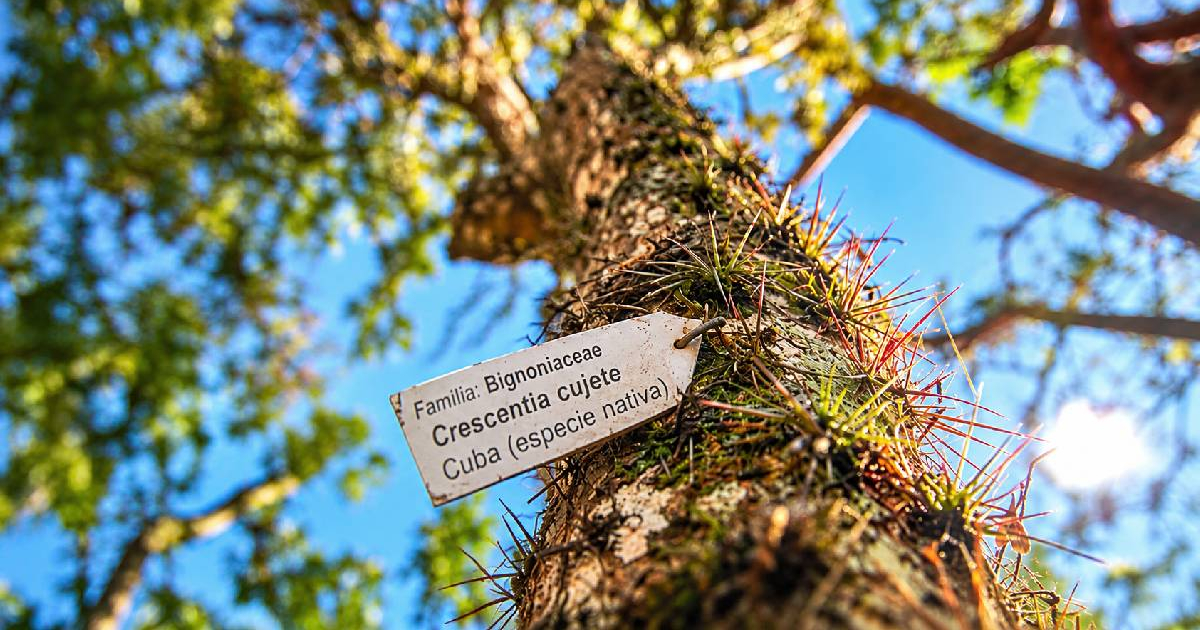
Cuba has just published the second edition of the Catalog of the Plants of Cuba, a work that brings together, for the first time in the country's history, a complete inventory of its vascular and non-vascular flora, with a total of 8,392 documented taxa of plants.
According to a press release from the Group of Specialists in Cuban Plants of the International Union for Conservation of Nature (IUCN), the work arises from the need for a taxonomic standard that unifies the criteria used in the study and conservation of the national flora.
The catalog recognizes 349 families, 2,073 genera, and 8,232 species, surpassing the previous edition, which only covered vascular plants, detailed the state media Cubadebate.
Of the 8,392 total taxa, 6,961 are native, and of these, 3,019 are endemic, which represents 43.4% of the native taxa of the archipelago.
The note from GEPC/IUCN emphasizes that this proportion "evidences the uniqueness of the flora of the archipelago," and warns that many of these endemics may be underestimated when included as synonyms of species with broader distributions. "This is a particularly significant situation from a conservation perspective, as many of these plants have small populations and restricted distribution areas."
In addition to the native taxa, the work documents 1,431 exotic taxa, of which 725 have been naturalized in Cuban territory.
One of the most significant updates in this edition is the inclusion, for the first time, of inventories of avasculate plants: 888 taxa of hornworts, liverworts, and mosses, which are in addition to the already documented 7,504 taxa of vascular plants.
The catalog also includes detailed information broken down by the 15 provinces and the special municipality of Isla de la Juventud. The eastern part of the country stands out for its floral richness: Guantánamo, Santiago de Cuba, and Holguín concentrate the highest number of native and naturalized vascular taxa.
Three specific inventories are also included: exclusively cultivated plants, scarcely cultivated plants, and phytogenetic resources for food and agriculture that are preserved outside their natural habitat in Cuban institutions.
The context of this publication is concerning: a 2021 study declared 22 species of Cuban flora extinct and reported 772 at critical risk, 512 at risk, and 396 vulnerable, while previous research warned that nearly half of the Cuban flora was at risk of disappearing.
The first edition of the catalog, focused solely on vascular plants, recorded 254 families, 1,724 genera, 7,088 species, and 7,251 taxa. The new version significantly expands this inventory by incorporating bryophytes and other plant groups that were previously absent from the official count.
The Group of Specialists in Cuban Plants, established in 2003 and based at the National Botanical Garden of the University of Havana, had 68 active members in 2023 and is the body that coordinates the assessment and monitoring of the conservation status of the flora of the archipelago before the IUCN.
Related videos:
Filed under: