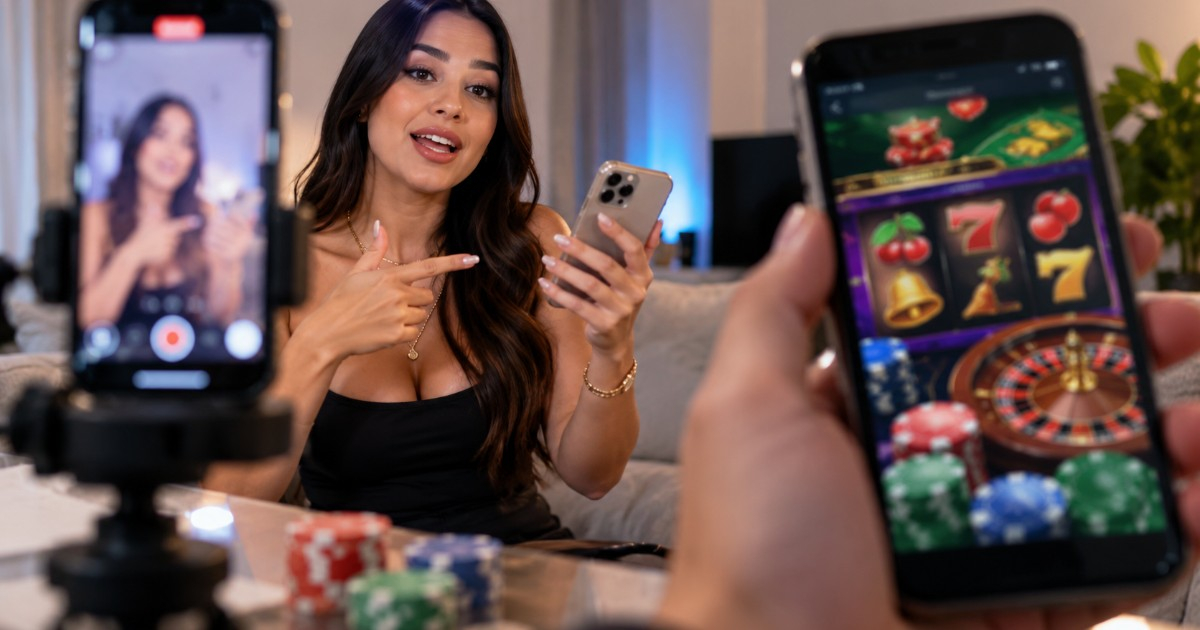
More and more Cuban influencers, many of whom reside in Miami and other cities in the United States, are using their social media platforms to promote online casinos, games that promise quick profits, raffles through ticket purchases, and other platforms related to gambling.
The trend has become especially visible in recent months. Some of these accounts gather hundreds of thousands of followers, while others exceed a million across Instagram, TikTok, and other platforms, significantly amplifying the reach of these promotions within the Cuban community, both on the island and in exile.
The problem lies not only in the promotion of the game. The concern grows when the trust built with the audience is used to direct users to platforms whose licensing, business location, or consumer protection mechanisms are difficult to verify; when they are presented as straightforward opportunities to make money; when a possible business relationship is not clearly identified; or when content can reach minors without effective controls.
Not every online casino, lottery, or promotion is necessarily fraudulent. There are regulated operators and legal promotions. However, having a website, accepting deposits from the United States, or displaying a license issued in a foreign jurisdiction does not automatically mean that a platform is authorized to operate in Florida or attract players residing there.
The normalization of gaming through influencers
The phenomenon is not exclusively Cuban.
There is a growing international concern regarding the incorporation of casinos, betting, and gambling into the everyday content of influencers, streamers, and Internet celebrities.
The World Health Organization has warned that digitalization and marketing are contributing to normalizing gambling and significantly expanding its reach.
The WHO estimates that approximately 1.2% of the adult population worldwide suffers from gambling disorder and points out that the expansion of smartphones and digital platforms is facilitating the growth of these activities.
The harms associated with problematic gambling can extend far beyond losing a specific amount of money: indebtedness, family conflicts, mental health issues, and the use of resources originally intended for housing, food, or other basic needs for gambling.
The advertising done by influencers also adds a particularly sensitive component.
A recommendation made by someone that a person follows daily can be perceived very differently from a conventional advertisement.
The user knows their life, consumes their videos, listens to their opinions, and develops a sense of familiarity with that person. When that same figure claims to be making money on a particular platform or invites their followers to "try their luck," the line between entertainment, personal recommendation, and advertising can become difficult to distinguish.
Research conducted with adolescents has identified precisely this effect: the presence of celebrities and digital creators can enhance the confidence and perception of legitimacy of betting brands among young audiences.
Although these studies have been conducted outside the Cuban community and cannot be directly extrapolated to it, they highlight one of the main risks of this promotional model.
A particularly vulnerable audience
The situation deserves particular attention within the Cuban community.
An important segment of these influencers' audience is located in the United States, particularly in Florida, while another segment resides in Cuba or in various countries across Latin America and Europe.
This means that the same promotion can reach individuals who are subject to completely different legal regulations at the same time.
There is also an economic factor.
For someone facing financial difficulties, a video showcasing a casino, a raffle, or a game as an opportunity to win hundreds or thousands of dollars can be especially appealing.
That is precisely one of the reasons why promises of "easy money" should be approached with great caution.
A screenshot showing a supposed profit does not demonstrate how much money was necessary to wager beforehand.
It also does not prove that the balance can actually be withdrawn.
And much less does it demonstrate that the followers will have the same results.
The problem of offshore casinos
One of the main mistakes consumers make is assuming that a website is legitimate simply because it operates from the United States.
Not necessarily.
The regulation of gambling in the United States largely depends on each state.
The Florida Gaming Control Commission (FGCC) expressly warns that accessing an online platform from Florida does not mean that the platform is authorized to offer gambling in the state.
In the matter of online sports betting, for example, the state regulator explains that the legal offerings are subject to the regulatory framework in Florida and warns about websites that accept players from the state despite not being authorized there.
The commission also warns about the risks posed by unauthorized operators or those based outside the United States, including the lack of equivalent regulatory oversight, difficulties in withdrawing profits, and limited chances of recovering funds in the event of a dispute.
A license granted in another territory does not automatically equate to an authorization to attract players residing in Florida.
Therefore, one of the first aspects that any consumer should check before depositing money is what company is behind the site and what authority enables it to operate in the player's location.
Raffles: buying a ticket can completely change the legal situation
Raffles are another format that is gaining traction on social media.
The mechanism seems simple.
A car, cash, a watch, a trip, or another prize is announced. Afterwards, followers buy one or several tickets and wait for a winner to be selected.
However, Florida has very specific regulations in this area.
The section 849.0935 of the Florida Statutes regulates certain raffles conducted by qualified nonprofit organizations.
Among other conditions, the law states that no entry fee, donation, payment, purchase, or contribution can be required as a mandatory condition to participate or win in this type of raffle.
Commercial promotions known as game promotions or sweepstakes are also regulated.
The section 849.094 also states that no entry fee, payment, or proof of purchase can be required as a condition for participating in such a promotion.
When the total value of the prizes exceeds certain limits, there are additional obligations related to the registration of the promotion, its rules, the prizes, and the guarantees for their delivery.
Therefore, a private raffle whose mechanics essentially consist of selling numbers to subsequently randomly select a winner should not be automatically deemed legal simply because it is conducted through Instagram, TikTok, WhatsApp, or any other digital platform.
Depending on its specific structure, it could fall into the realm of an illegal lottery.
Promoting an illegal activity is not necessarily harmless either
This issue is also important for those who have large audiences.
Florida law is not limited solely to penalizing those who organize certain illegal lotteries.
The section 849.09 of the Florida Statutes also addresses behaviors related to promoting, advertising, assisting in organizing, or collaborating with certain illegal lotteries.
Some of these offenses may rise to the level of third-degree felony, depending on the specific circumstances.
This does not mean that sharing any link or posting any Story related to a giveaway automatically constitutes a crime.
To establish responsibility, it would be necessary to analyze what type of activity was being promoted, what the relationship was between the creator and the operator, whether there was any financial compensation, what knowledge the person had about the activity, and what their exact involvement was.
But it should not be assumed that a person is completely disconnected from an activity simply because their role was to promote it to hundreds of thousands of followers.
What happens when there are minors among the followers?
This is another delicate aspect.
Many Cuban influencers have teenagers and very young users among their audience.
Florida maintains specific prohibitions regarding the participation of minors in certain gambling activities.
The section 849.04 of the Florida Statutes establishes penalties in specific cases related to knowingly allowing minors to participate in gambling.
Its application to a specific case would depend on numerous factors and does not mean that the mere fact of a minor accidentally viewing a post makes the person who shared it criminally liable.
But it shows that age control should not be regarded as an irrelevant detail.
The digital platforms themselves acknowledge this risk.
Meta and TikTok have specific policies for the promotion of betting, casinos, and real money games, with restrictions related to user age, advertising approvals, and the jurisdictions in which these activities can be advertised.
When the influencer receives money for bringing in players
There is also a question that consumers should ask themselves every time one of these links appears:
Does the person recommending this platform get paid for bringing in new players?
The online casino industry extensively utilizes affiliate systems.
A creator can receive money when someone signs up using their link or code.
Depending on the commercial agreement, you can charge for each registration, for each first deposit, or through other models related to the activities of the users you have acquired.
This creates an economic interest that the public should be aware of.
The Federal Trade Commission (FTC) requires influencers to clearly disclose any economic or material relationships they have with the products and services they promote.
The dissemination should be easily perceptible.
It's not enough to hide it among numerous hashtags, place it on another page, or use ambiguous expressions that the average consumer might not understand.
In formats like Instagram Stories, the FTC recommends that the identification of the commercial relationship be clearly visible within the content itself.
"I am winning": a statement that deserves context
There is another particularly delicate practice: showcasing supposed profits as the main tool to attract new users.
"I just won."
"Look at how much I did today."
"This is paying off a lot."
"Enter now."
Messages of this kind can present a highly distorted image of how gambling works.
In casino games, there is a mathematical advantage designed to favor the operator in the long run.
A person may win in a specific session, but only showing the positive moments and concealing how much was lost beforehand can create a misleading impression.
When there is a commercial relationship between the creator and the platform, claims about results may also be subject to U.S. regulations on misleading advertising.
Warning signs before putting in a single dollar
Before signing up for a platform promoted by an influencer, it is advisable to check several aspects.
It is not clearly stated which company operates the platform.
There is no verifiable business address.
The alleged license belongs to another jurisdiction, and it is not explained whether it allows for the acquisition of users in the location where the player resides.
Profits are presented as easy, fast, or almost guaranteed.
To withdraw money, new deposits must first be made.
Additional payments are requested for supposed "taxes," "unlocking," "verification," or "processing."
The withdrawal terms are confusing or allow for funds to be blocked through unclear conditions.
There are no visible age controls.
There are no mechanisms for self-exclusion or responsible gaming.
The influencer uses a custom code or link but does not explain if they receive financial benefits.
The supposed raffle requires the mandatory purchase of tickets without explaining its legal structure.
There are no public rules on how the winner will be selected.
The organizer can cancel participants or prizes under vague conditions.
The FTC also warns about a classic sign of fraud: supposed prizes that later require payment of a certain amount of money in order to claim them.
What to do if someone believes they have been scammed
One of the first rules is simple:
Do not continue sending money in the hope of recovering what has already been lost.
Numerous scams operate precisely by exploiting that impulse.
After an initial loss, a new payment is required to "activate the withdrawal," "verify the account," "pay taxes," or "unlock" the funds.
The victim ends up sending more and more money.
It is advisable to immediately preserve all possible evidence: screenshots of Stories and posts, links, the username of the person who carried out the promotion, used codes, conversations, receipts, bank statements, terms of service, and if cryptocurrencies were used, the wallet addresses and transaction identifiers.
If a U.S. bank card or account was used, you should promptly contact the financial institution and explain exactly what happened.
That does not mean fraudulently claiming a transaction as "unauthorized" when it was consciously made; however, the bank can inform about the available mechanisms when there is fraud, an unauthorized charge, a service breach, or other circumstances.
Where to report in the United States and Florida
Individuals who suspect illegal gambling activities in Florida can report information to the Florida Gaming Control Commission.
Frauds and deceptive business practices can be reported to the Federal Trade Commission.
Internet fraud cases can also be reported to the Internet Crime Complaint Center (IC3) of the FBI.
Similarly, the Florida Attorney General's Office has mechanisms in place to receive consumer complaints.
When significant amounts are involved, it may be advisable to consult a lawyer specializing in consumer protection, fraud, or gambling legislation.
For those living in Cuba, recovering money can be even more difficult
For a consumer located within Cuba, the risk can be even greater.
Recovering money from a foreign platform can already be difficult for a U.S. resident, but doing so from Cuba can be extremely complicated due to banking limitations, jurisdictional issues, and restricted access to certain claims mechanisms.
Therefore, the best defense mechanism remains to verify the legitimacy of the platform before sending money.
The fact that a site appears every day in the Stories of a well-known figure does not guarantee anything.
That hundreds of users writing positive comments doesn't equate to an official license either.
And the promoter claiming to have made thousands of dollars does not prove that the other players will achieve the same outcome.
Having a million followers also implies a tremendous capacity for influence
Digital influence has immense commercial value precisely because it can modify behaviors.
When a person with hundreds of thousands or more than a million followers recommends a restaurant, a car, or a clothing brand, it can lead to thousands of purchases.
When the recommended product is a platform where followers deposit money and subject it to chance, the potential consequences are different.
This makes the increasing presence of casinos, raffles, and "easy money" platforms within the content produced by Cuban influencers in the United States concerning.
Responsibility starts with clearly distinguishing between advertising and personal content, verifying what is being promoted, avoiding misleading claims, preventing minors from being deliberately targeted towards these activities, and ensuring that platforms comply with applicable laws in the territories where their users are located.
For the audience, the fundamental recommendation is even simpler:
The fame of an influencer does not make a casino safe, a raffle legal, or a promise of easy money real.
On the Internet, hundreds of thousands of followers can generate trust.
But trust does not replace a license, regulation, or the consumer's right to know who is actually receiving their money.
Related videos:
Filed under: