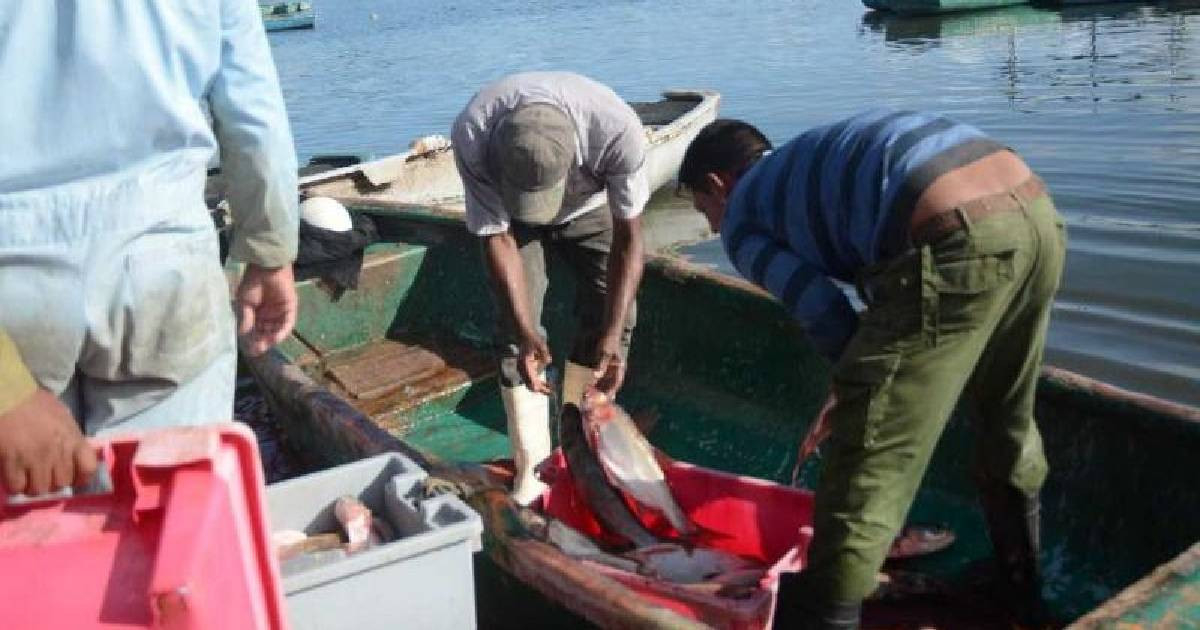
Fish, once a staple in Cuban diets, has become an increasingly scarce and expensive product for the population, as national catches plummeted by more than half between 2020 and 2024, highlighted an analysis from the Food Monitor Program published this Thursday.
The 2024 Statistical Yearbook of Cuba from the National Office of Statistics and Information recorded a total gross catch of fish and seafood of 22,330.6 tons in 2024, compared to 46,386.5 tons in 2020. Specifically, in the case of fish, production fell from 35,148.8 tons to 18,064.7 tons during the same period.
The decline affects several species that are traditionally part of the Cuban diet. In 2024, only 220.2 tons of snapper, 317.2 tons of tuna, 24 tons of bonito, 49.5 tons of mackerel, and 480.2 tons of ray were recorded.
The decline also hit high-value commercial products. The lobster dropped from 4,224.8 tons in 2022 to 2,016.3 in 2024, while the shrimp almost vanished from official statistics, plummeting from 426 tons in 2023 to just 4.6 tons a year later.
Aquaculture has not managed to offset the decline either. Tilapia production fell from 2,153.7 tons in 2020 to 790.3 in 2024, while claria production dropped from 4,428.3 to 329.1 tons.
Only the tenca maintained a high volume, with 10,442.4 tons in 2024, although this does not necessarily translate into a stable and affordable supply for consumers.
The result is evident in the markets. State fish markets rarely offer a sufficient variety and, when a product does appear, it can be unattainable for wages and pensions.
Fish such as bonito, tuna, cubera, snapper, or sierras primarily circulate through private or informal channels, with prices ranging from 650 to 900 pesos per pound, unprocessed, depending on the area, the season, and availability.
For many households, buying fresh fish has ceased to be a regular purchase and has become an exceptional acquisition. The supply that arrives through informal channels also poses issues of preservation and safety, in a context marked by blackouts, a shortage of ice, and difficulties in maintaining the cold chain.
The lack of fuel directly impacts fishing activities. According to data collected by the agency IPS, during the first half of 2024, 15,620 tons of fish and seafood were caught, which is only 53% of the planned target for marine fishing and aquaculture. Of that volume, 15% was allocated to tourism, 14% to exports, and 71% for the consumption of the population.
However, the official distribution itself raises a central question about supply. If the majority of the catches are reported as intended for domestic consumption, fish still does not appear consistently, visibly, and affordably in the popular markets.
The crisis also has a productive dimension that goes beyond the lack of fuel. The deterioration of infrastructure, technological obsolescence, lack of investment, loss of workforce, corruption, and weak production incentives have all diminished the sector's capacity.
At the same time, government controls continue to dictate who can fish, how they can market their catches, and under what authorizations.
Although Cuban legislation recognizes non-state commercial fishing methods, the activity remains subject to licenses and regulations.
In 2024, the prior requirement of having a contract with a state entity to obtain non-state commercial fishing licenses was eliminated, but marketing remained subject to local government decisions.
For the Food Monitor Program, this combination creates an obvious contradiction: the State does not guarantee supply, yet it retains a strong ability to regulate and limit private activity that could fill part of the void.
The shortage also has a nutritional cost. Fish provides high-quality proteins, omega-3 fatty acids, iodine, vitamin D, calcium, selenium, iron, zinc, vitamin A, and vitamin B12.
The Food and Agriculture Organization of the United Nations (FAO) has emphasized the importance of this food in the fight against hunger and malnutrition due to its combination of proteins, healthy fats, and micronutrients.
The disappearance of fish from the Cuban diet signifies a loss that extends beyond culinary diversity. It impacts access to proteins and micronutrients in households where other food sources have also diminished, leading to an increasing reliance on cheaper, less nutritious products.
The Food Monitor Program places this crisis within the general decline of food security in Cuba. The World Food Program noted that in 2025, food insecurity remained a significant challenge on the island, associated with economic contraction, inflation, reduced public resources, and the persistent fuel shortage.
This is complemented by an estimate from the Economic Research Service of the United States Department of Agriculture, which states that 1.4 million Cubans did not reach the daily threshold of 2,100 calories in 2023 under a baseline scenario. In an alternative GDP adjustment scenario, the number rose to 4.2 million people, equivalent to 37.8% of the population.
The fishing crisis is also disrupting the relationship of Cubans with their marine resources. The Association of Divers in Santiago de Cuba
The paradox is particularly evident due to the country's own geography. Cuba has 5,746 kilometers of coastline and an insular platform of over 50,000 square kilometers, yet a food that is closely tied to its culinary culture has become, for many of its residents, an expensive, occasional, and difficult-to-obtain product.
The question raised by the Food Monitor Program sums up that contradiction: "Where is the fish for the Cuban population?" The answer lies not in the absence of the sea, but in the collapse of production and in the economic, energy, logistical, and regulatory challenges that prevent this resource from reaching the table on a regular basis.
Related videos:
Filed under: