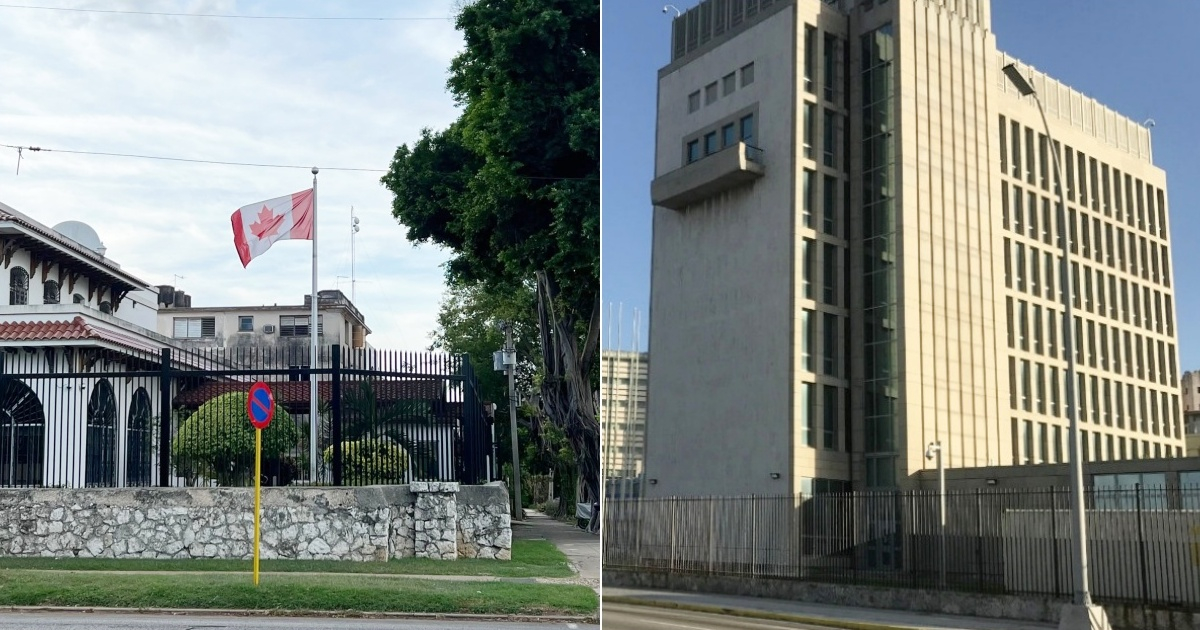
An exclusive investigation by The Globe and Mail published this Saturday reveals that Canadian diplomats gathered intelligence for U.S. agents in Cuba between 2016 and 2018, precisely when officials from both countries began to experience the mysterious symptoms known as the "Havana Syndrome."
The revelation is based on two anonymous sources who could face charges under Canada's Foreign Influence and Information Security Act, and it had never been reported before.
Covert espionage in Havana
According to the Canadian newspaper, a diplomat assigned to the Global Security Reporting Program (GSRP) at the embassy in Havana was gathering human intelligence and occasionally relayed it directly to CIA agents at the U.S. embassy.
"Sometimes they could be asked to provide the information directly" to a CIA agent, one of the sources described.
The intelligence was also sent to the Canadian Ministry of Foreign Affairs, to the Canadian Security Intelligence Service (CSIS), and to the other partners in the Five Eyes alliance: the United Kingdom, Australia, and New Zealand.
A second source revealed that the U.S. covertly introduced satellite equipment into Cuba, hiding it in diplomatic containers that the Vienna Convention prohibits from inspection.
Those devices would have been installed on the roof of the Canadian embassy and in the residences of certain diplomats.
“Satellites could be used for anything. For the internet. For whatever you wanted,” the source pointed out.
The strategic advantage of Canada in Cuba
The collaboration had a clear geopolitical logic: Ottawa never severed relations with Havana after 1959, which granted its diplomats privileged access to Cuban officials and the ability to travel outside the capital, something forbidden to Americans, who during that period only had a chargé d'affaires on the island.
This same advantage would have turned Canadians into a target.
The former national security adviser to Donald Trump, John Bolton, stated in 2023 that Canadian diplomats were attacked by sectors of "hardline" Cuba "with the cooperation" of another unidentified country, because these sectors did not "appreciate Canada's involvement in the normalization of relations between the U.S. and Cuba."
Ottawa denies it, but its own oversight body contradicts it
Global Affairs Canada rejected the revelations: its diplomats "carry out diplomatic activities openly, legally, and in compliance with the Vienna Convention," and the GSRP "is not an intelligence gathering program," the ministry asserted.
However, the Canadian national security oversight body (NSIRA) concluded in 2023 that the program operated in a "clearly gray area" between diplomacy and intelligence, with insufficient controls, and that some of its members had contacts with foreign intelligence agencies.
The legal process that Ottawa wants to silence
The revelations shake a multimillion-dollar lawsuit by Canadian diplomats against the government, filed in 2019 by ten officials and their families.
By 2021, there were 18 claimants seeking 28 million dollars, alleging that Ottawa denied them medical care, withheld information, and downplayed the severity of the brain injuries sustained.
In 2025, the government invoked Section 38 of the Canada Evidence Act— a rarely used provision typically reserved for terrorism cases— to prevent certain details of the proceedings from becoming public.
The Department of Justice confirmed this Saturday that it has resorted to that regulation.
Paul Miller, chief attorney for the diplomats, described the maneuver bluntly: "It is a major delaying tactic."
His clients watch with frustration as the U.S. made the first payments under the HAVANA Act in July 2026, disbursing nearly 3 million dollars in compensations, while Ottawa refuses to reach an agreement.
The cause of the syndrome is still unresolved
The symptoms reported by Canadian and American diplomats between 2016 and 2018 included nosebleeds, dizziness, headaches, blurred vision, and memory loss.
Canada officially concluded in 2024 that there was no evidence of malicious activity by a foreign power.
However, new intelligence reports from March 2026 once again pointed to the 29155 Unit of the Russian GRU as a possible culprit, linking the attacks to a miniaturized microwave weapon.
The question now looming over the case is whether the intelligence collaboration between Canada and the U.S. on Cuban soil was precisely what made Canadian diplomats targets, and if Ottawa has been using national security as a shield to conceal its own responsibility for years.
Related videos:
Filed under: