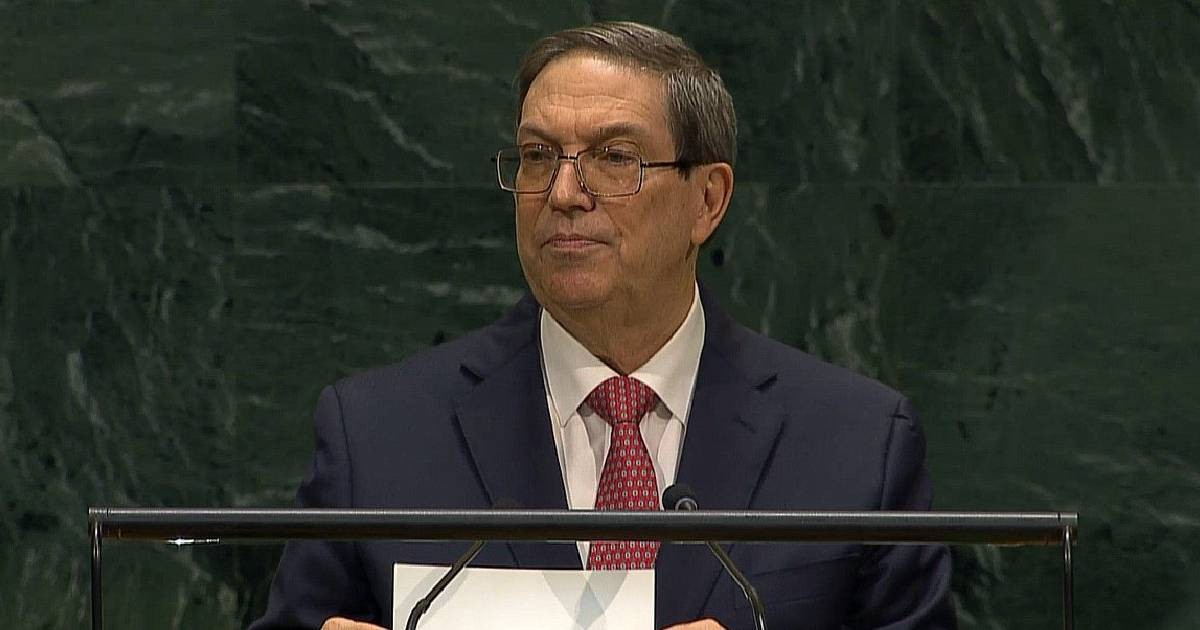
The Cuban Foreign Minister, Bruno Rodríguez Parrilla, declared this Saturday before the UN General Assembly in New York that Cuba is open to establishing trade and business relations with American companies, while denouncing Washington's maximum pressure policy against the island.
The speech, delivered during the general debate of the 81st session, came four days after President Donald Trump described Cuba as an "absolutely failed state" from the same podium and predicted that "freedom will come to Cuba," at which point the Cuban delegation left the room.
In his speech, Rodríguez responded to those remarks with a rhetorical question: "The President of the United States declared from this podium a few days ago that Cuba is a failed state. If that were the case, why then did they have to establish a fuel blockade, why did they impose secondary sanctions, why do they have to threaten, pursue, and pressure all the states on the planet?"
The chancellor described Washington's measures as a "collective punishment" and a "crime" under International Humanitarian Law, and characterized the energy restrictions imposed since January 2026 as equivalent to a "naval blockade," a term defined in international law as an act of war.
According to Rodríguez, more than 7,000 containers filled with food, medicine, and medical devices have been halted at ports in various countries due to U.S. pressures, including shipments contracted by private Cuban companies.
The minister also reported that the previous Thursday, while the General Assembly was in session, the State Department convened a meeting with countries receiving Cuban medical services to pressure them into ending that cooperation.
In his remarks, Rodríguez quoted Secretary of State Marco Rubio to illustrate the scope of Washington's strategy: "As the Secretary of State describes, the official policy of the United States is to shut off every valve, outlet, or formula for survival for Cuba."
He also recalled a previous statement from President Trump in which he allegedly said that "all that's left is to go in and smash the place," and warned that any use of military force against Cuba would constitute "a major crime."
The commercial opening declared by the regime contrasts with Rubio's position, who stated at the UN that no one should invest in Cuba under the current model and that the embargo is not the main cause of the island's energy crisis.
That crisis has worsened throughout 2026: the regime attributes the reduction of between 80% and 90% in its fuel imports to U.S. sanctions, which has resulted in electrical generation deficits exceeding 2,000 MW and multiple total disconnections of the national electrical system.
Rodríguez's speech comes at a time of contradictory signals from Washington. This same Saturday, Trump told the press that "Cuba and we will make a deal," dismissing the need for military action, as reported by Al Jazeera.
Since March 2026, the regime has sought to attract investment from American companies in sectors such as tourism, mining, energy, and oil exploration, amidst a backdrop where European hotel chains have begun to withdraw from the island due to the pressure of sanctions.
The opening signal launched this Saturday from the UN is the most public expression of that strategy, although any actual trade agreement would still be conditioned, according to Rodríguez himself, on Washington agreeing to negotiate "on equal sovereign terms and without preconditions."
Related videos:
Filed under: