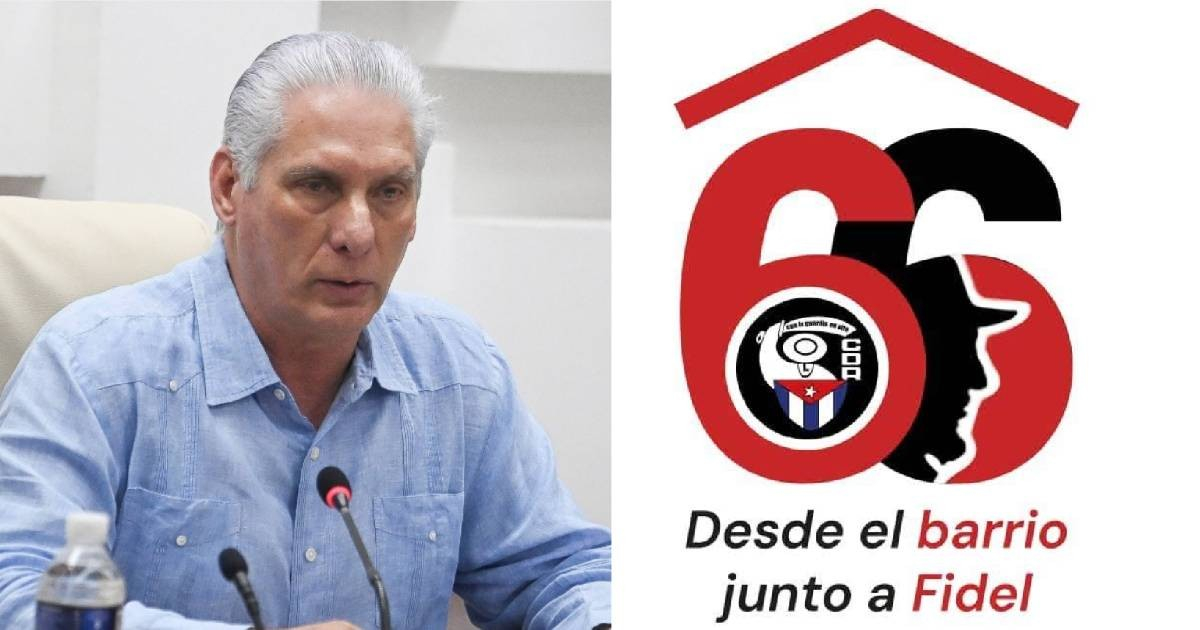
On the 66th anniversary of the Committees for the Defense of the Revolution, Miguel Díaz-Canel published a series of five messages on his account on the social network X this Monday, in which he called to expand the surveillance function of the organization founded by Fidel Castro on September 28, 1960.
"Surveillance is not abandoned, it is expanded to save energy, protect the vulnerable, and prevent crime, drugs, and corruption," wrote the leader, in what constitutes an explicit call to reinforce the social control role that the CDR has exercised since its creation six decades ago.
Díaz-Canel described the CDR as "the link that connects national politics with daily life" and dismissed the idea of creating new structures: "It's not about inventing structures, but about articulating and making use of what already exists."
At the same time, the leader acknowledged one of the most evident problems within the organization: the aging of its members and the lack of succession. "Without the involvement of young people in its activities, the CDR is experiencing a generational decline," he warned, and urged that the anniversary be celebrated "with specific, measurable tasks and follow-up."
The contrast between the official narrative and reality is stark. Days before the anniversary, Díaz-Canel himself had acknowledged in a meeting with cederistas that "many people think this is already an outdated organization", one that makes no sense under current conditions and offers nothing of value.
The intellectual and activist Alina Bárbara López was more direct this Monday, describing the CDR as a “gigantic and ineffective bureaucratic structure without a social base”. She pointed out that in Matanzas —the province designated as the National Vanguard of the organization for 2026 and the venue for the central anniversary event— many citizens no longer pay the monthly dues, do not attend meetings, and do not participate in CDR shifts.
Founded during a massive event in front of the then Presidential Palace in Havana, the CDR emerged as a neighborhood watch and informant network aimed at identifying and reporting activities deemed counter-revolutionary. Over time, they took on community tasks, but their role in social control never disappeared.
To offset the decline, the regime launched the program "My Neighborhood for the Homeland" — coordinated with the CDR along three axes: Safe Neighborhood, Productive Neighborhood, and Participatory Neighborhood — and the Community Youth Network, led by the Union of Young Communists. It also decorated 134 cederistas through Presidential Decree 1284.
The commemoration is also framed within the centenary of Fidel Castro's birth, and the official anniversary logo features the caption "From the neighborhood alongside Fidel," along with the distinctive silhouette of the dictator in a military beret.
All of this is happening while Cuba endures power outages of 18 to over 20 hours daily, an electricity generation deficit exceeding 2,000 MW, shortages of food and medicine, and a historic record of 1,339 political prisoners as of the end of August 2026, according to Prisoners Defenders.
The public reaction on social media to Díaz-Canel's call was one of irony and outright rejection: "That's been dead for a while, don't count on me," and "Only the pricing works," were some comments from Cuban internet users.
Related videos:
Filed under: